Bitcoin Basics38 min read
Bitcoin Statistics 2026: Verified Data on Adoption, Security, Mining and Regulation
115 Bitcoin statistics from primary sources on adoption, fraud, mining energy, ETFs, tax and regulation, each linked to its source and checked in October 2026.
By Christopher CannucciariPublished
On this page

Key takeaways
- Crypto was involved in $11.366 billion of the $20.877 billion in internet-crime losses reported to the FBI’s IC3 in 2025, across 181,565 crypto-related complaints.
- US ownership figures depend on the question asked: 19% of adults have ever invested in, traded or used crypto (Pew, January 2026), 10% used or held it in the prior year (Federal Reserve, October 2025) and 9% say they own it (Gallup, June 2026).
- Bitcoin’s rules are written in its software: a 21 million cap, a halving every 210,000 blocks, a 10-minute block target, a difficulty reset every 2,016 blocks and a block reward of 3.125 BTC since April 2024.
- In Cambridge’s survey of 49 mining firms, 52.4% of 2024 mining electricity came from sustainable sources, and the researchers put mining at about 138 TWh a year, roughly 0.54% of global electricity use.
- The FTX case has run its course in the lower courts: a 25-year sentence was affirmed on 12 June 2026 and a Supreme Court petition followed on 10 September 2026, while the FTX Recovery Trust reported cumulative recoveries of 96% to 100% for the main creditor classes.
- US policy changed quickly in 2024 and 2025: the SEC approved spot bitcoin ETP listings in January 2024, a March 2025 executive order created a Strategic Bitcoin Reserve that “shall not be sold”, and the GENIUS Act became law in July 2025.
- Rules abroad and for taxes are now dated: the EU’s MiCA transitional period ended on 1 July 2026, 83% of jurisdictions surveyed by the FATF have Travel Rule laws, and US brokers report gross proceeds on Form 1099-DA for transactions from 1 January 2025.
What this page covers
This page collects 115 statistics about Bitcoin from primary sources: regulators, central banks, courts, government agencies, the Bitcoin Core code and named research teams. Every figure links to the page it comes from, and each one was checked against that source on 10 October 2026. It reports what the sources say and leaves out prices, market caps and forecasts.
It is built for people who need a sourced number: journalists, students, writers and anyone checking a claim. For explanations rather than figures, start with the Start Here learning path.
Protocol rules and supply
Bitcoin’s supply and timing rules are fixed constants in its software: a 21 million BTC cap, a block reward that halves every 210,000 blocks (3.125 BTC since April 2024), and a difficulty reset every 2,016 blocks.
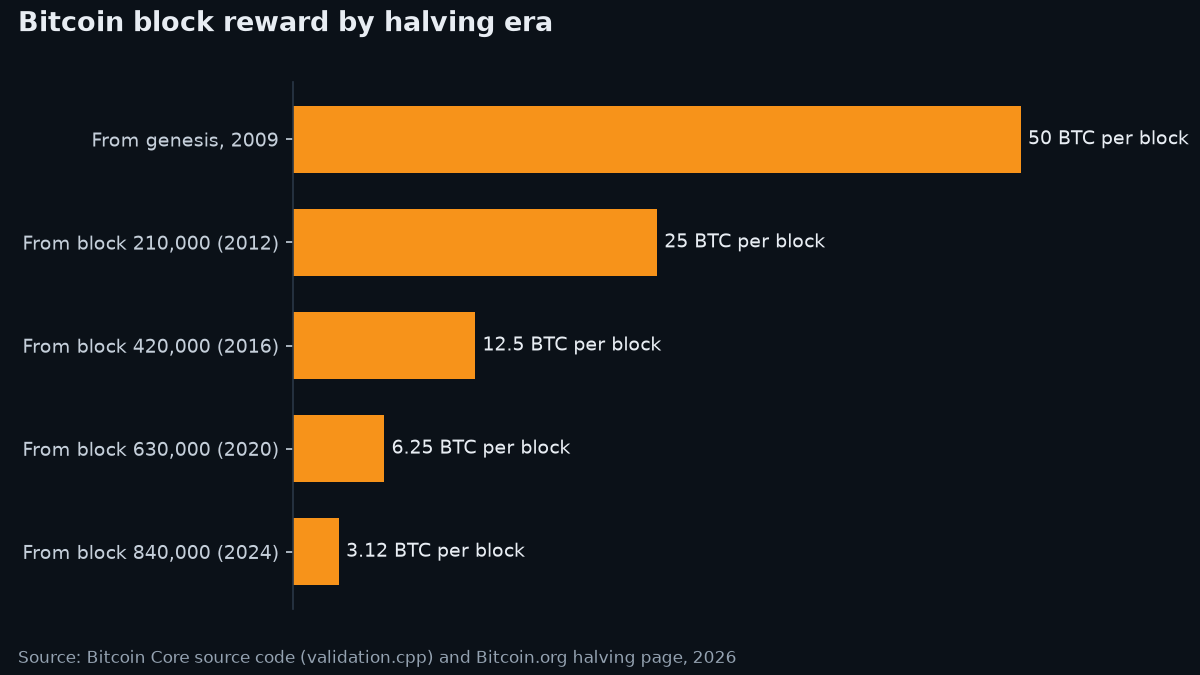
- In 2026 the Bitcoin Core source code (src/consensus/amount.h) defines MAX_MONEY as 21,000,000 times COIN, which makes 21 million bitcoin the largest amount valid under the consensus rules; this is the rule in the code, and the file’s own comment calls it a sanity-check limit rather than the actual total supply. (Source: Bitcoin Core source code, src/consensus/amount.h (GitHub, commit 228877d), 2026)
- In 2026 the Bitcoin Core source code (consensus/amount.h) defines COIN, the number of satoshis in one bitcoin, as 100,000,000; this is the rule in the code. (Source: Bitcoin Core documentation (Doxygen), consensus/amount.h, 2026)
- Bitcoin.org’s halving page lists the block reward after the first four halvings as 25 BTC (2012), 12.5 BTC (2016), 6.25 BTC (2020) and 3.125 BTC (2024), so the block reward in 2026 is 3.125 BTC until the fifth halving at block 1,050,000, which matches what the Bitcoin Core subsidy code produces from 50 BTC after four halvings. (Source: Bitcoin.org, Bitcoin Halving page (Halving history table), 2026)
- The Bitcoin Core code sets the main-network block-subsidy halving interval (nSubsidyHalvingInterval) at 210,000 blocks; this is the rule in the code in 2026. (Source: Bitcoin Core source code, src/kernel/chainparams.cpp (GitHub, commit 228877d), 2026)
- In 2026 the GetBlockSubsidy function in Bitcoin Core’s validation.cpp starts the block subsidy at 50 BTC (50 * COIN) and shifts it right by one bit, halving it, for every 210,000 blocks, returning zero after 64 halvings; this is the rule in the code. (Source: Bitcoin Core source code, src/validation.cpp, GetBlockSubsidy (GitHub, commit 228877d), 2026)
- The Bitcoin Core main-network parameters set the target block spacing at 10 minutes (nPowTargetSpacing = 10 * 60 seconds) and the difficulty-retarget timespan at two weeks (nPowTargetTimespan = 14 * 24 * 60 * 60 seconds); this is the rule in the code in 2026. (Source: Bitcoin Core source code, src/kernel/chainparams.cpp (GitHub, commit 228877d), 2026)
- Bitcoin.org’s Developer Guide states that every 2,016 blocks the network compares block-header timestamps to measure how long the last 2,016 blocks took, resetting difficulty toward an ideal of 1,209,600 seconds (two weeks). (Source: Bitcoin.org Developer Guide, Block Chain, Proof Of Work, 2026)
- The Bitcoin Core code caps the weight of a block at 4,000,000 weight units (MAX_BLOCK_WEIGHT, a network rule defined by BIP 141); this is the rule in the code in 2026. (Source: Bitcoin Core source code, src/consensus/consensus.h (GitHub, commit 228877d), 2026)
- Bitcoin’s fourth halving block, block 840,000 (4 x 210,000), carries the miner-set timestamp 2024-04-20 00:09:27 UTC on its mempool.space block page. (Source: mempool.space, Bitcoin block 840000, 2024)
- Bitcoin’s third halving block, block 630,000 (3 x 210,000), carries the miner-set timestamp 2020-05-11 19:23:43 UTC on its mempool.space block page. (Source: mempool.space, Bitcoin block 630000, 2020)
- Bitcoin’s second halving block, block 420,000 (2 x 210,000), carries the miner-set timestamp 2016-07-09 16:46:13 UTC on its mempool.space block page. (Source: mempool.space, Bitcoin block 420000, 2016)
- Bitcoin’s first halving block, block 210,000, is timestamped 28 November 2012 at 15:24:38 UTC on Blockchain.com’s block explorer page, where the block’s mining reward is shown as 25.00 BTC. (Source: Blockchain.com Explorer, Bitcoin block 210,000, 2012)
- The genesis block in Bitcoin Core’s chain parameters has nTime 1231006505, which converts to 3 January 2009 at 18:15:05 UTC, and its coinbase embeds the message “The Times 03/Jan/2009 Chancellor on brink of second bailout for banks”. (Source: Bitcoin Core documentation (Doxygen), kernel/chainparams.cpp source listing, 2009)
- Satoshi Nakamoto announced the Bitcoin paper on the Cryptography mailing list in a post titled “Bitcoin P2P e-cash paper”, which the list archive timestamps Fri Oct 31 14:10:00 EDT 2008 (31 October 2008). (Source: Cryptography mailing list archive (metzdowd.com), Bitcoin P2P e-cash paper, 2008)
Background on this topic: how the halving works, how many bitcoin are left to mine, how Bitcoin works.
Lightning and protocol upgrades
Bitcoin’s big upgrades were switched on at fixed block heights (SegWit at block 481824 in 2017, Taproot at block 709,632 in 2021), while Lightning went from a January 2016 draft paper to a March 2018 mainnet beta and now leans on 2024 to 2026 Bitcoin Core mempool changes to make fee-bumping reliable.
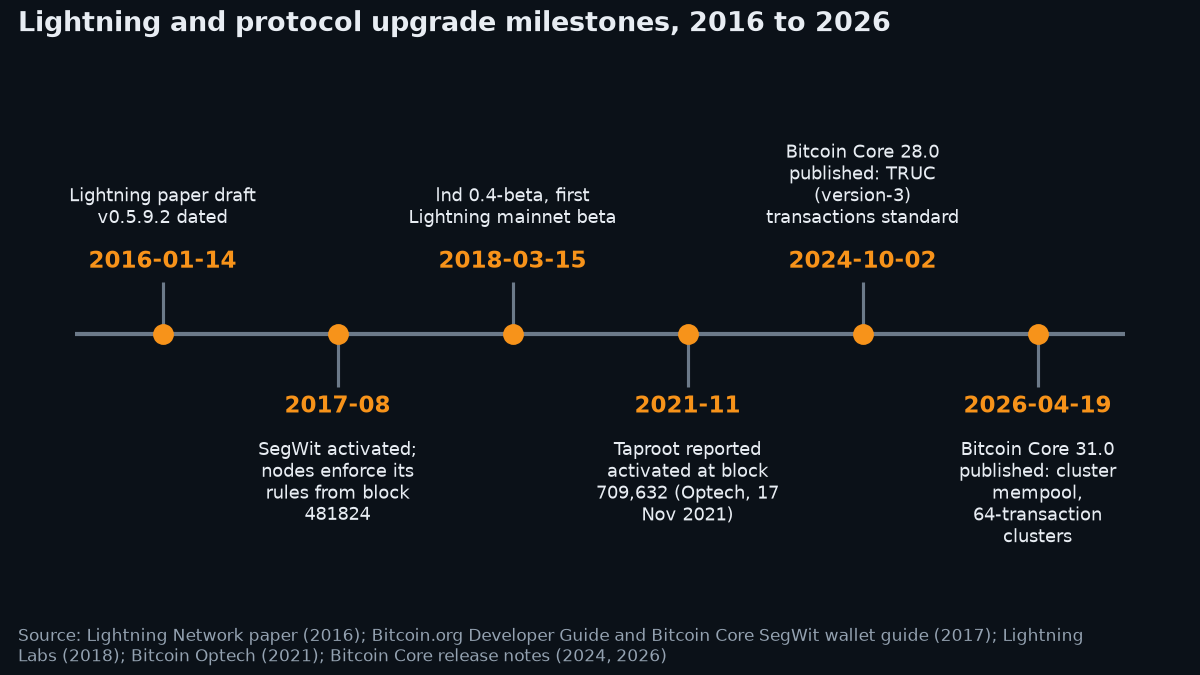
- Bitcoin Core’s SegWit wallet developer guide states that, as of block height 481824, all SegWit-ready nodes started enforcing the new SegWit consensus rules. (Source: Bitcoin Core project, Segregated Witness Wallet Development Guide, 2017)
- Bitcoin.org’s Developer Guide states that BIP 141 (Segregated Witness) was activated in August 2017. (Source: Bitcoin.org Developer Guide, Transactions (transaction malleability section), 2017)
- Bitcoin Optech’s Newsletter #175, dated 17 November 2021, reported that the Taproot soft fork had activated at block height 709,632. (Source: Bitcoin Optech, Newsletter #175 (17 November 2021))
- The Lightning Network paper by Joseph Poon and Thaddeus Dryja, a draft marked version 0.5.9.2 and dated January 14, 2016, states that Bitcoin supports less than 7 transactions per second with a 1 megabyte block limit. (Source: Poon and Dryja, The Bitcoin Lightning Network: Scalable Off-Chain Instant Payments (DRAFT Version 0.5.9.2), lightning.network, 2016)
- Lightning Labs announced lnd 0.4-beta on March 15, 2018, describing it as the 4th major lnd release and the first Lightning mainnet beta. (Source: Lightning Labs, Announcing our first Lightning mainnet release, lnd 0.4-beta!, 2018)
- Bitcoin Optech says early Lightning developers temporarily capped channel size below 2^24 base units (0.16777216 BTC), that a 2018 Lightning specification meeting let implementations opt in to larger ‘wumbo’ channels, and that the feature saw widespread implementation in 2020. (Source: Bitcoin Optech, Topics: Large channels, 2018)
- The BOLT 11 specification for Lightning invoices sets the default invoice expiry at 3600 seconds (1 hour) when an invoice carries no expiry field (specification text as of October 2026). (Source: Lightning Network specifications (BOLTs), BOLT #11: Invoice Protocol for Lightning Payments, 2026)
- Bitcoin Core 28.0, published October 2, 2024, made version-3 transactions standard on all networks under the opt-in TRUC policy of BIP 431, which limits a TRUC transaction to a maximum size of 10,000vB. (Source: Bitcoin Core project, Bitcoin Core 28.0 release notes, 2024)
- Bitcoin Core 31.0, published April 19, 2026, replaced the mempool’s ancestor and descendant limits with a cluster mempool whose default limits are 64 transactions and 101 kB in virtual size per cluster, and removed the CPFP carve-out. (Source: Bitcoin Core project, Bitcoin Core 31.0 release notes, 2026)
- Bitcoin Optech’s 2025 year-in-review newsletter (#385, December 19, 2025) reports that Lightning implementers raised the delay before marking a channel as closed, to give splice transactions time to propagate, from 12 to 72 blocks (BOLTs #1270). (Source: Bitcoin Optech, Newsletter #385: 2025 Year-in-Review Special)
Background on this topic: the Lightning Network, Taproot.
Ownership and attitudes in the United States
Roughly one in ten US adults currently holds or uses crypto and about one in five has ever tried it, but most Americans still call it risky and few use it for payments.
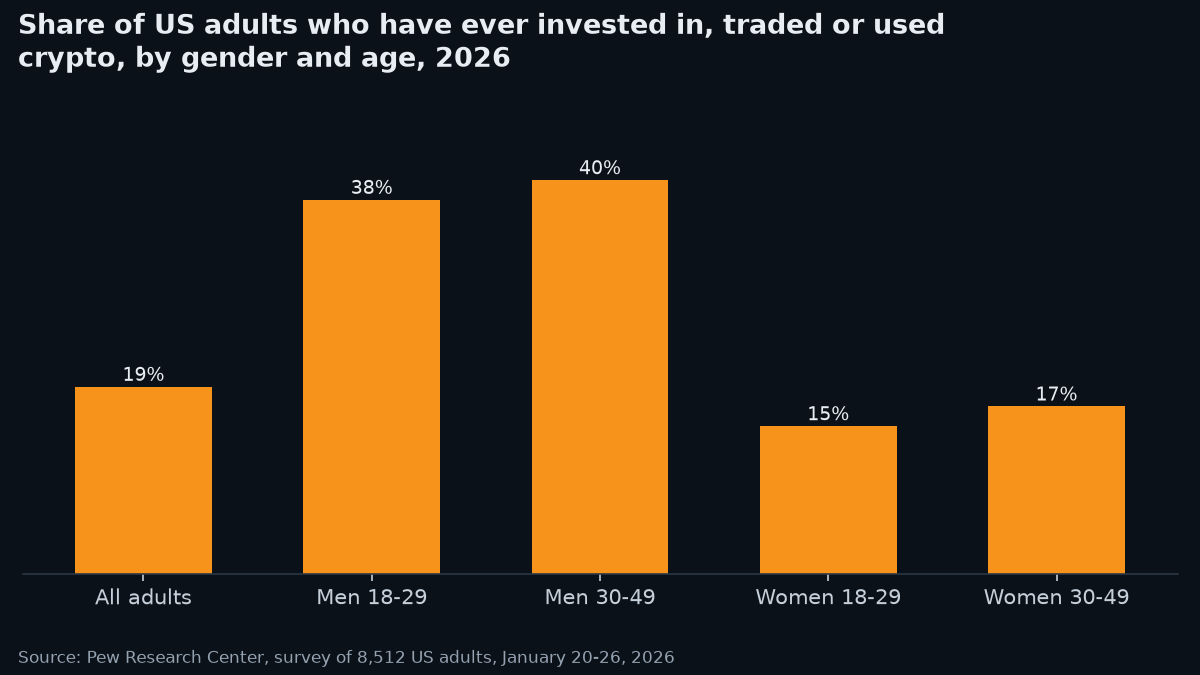
- A Pew Research Center survey of 8,512 US adults conducted January 20-26, 2026 found that 19% have ever invested in, traded or used a cryptocurrency such as bitcoin or ether, about the same as the 16% who said so in 2021. (Source: Pew Research Center, “About 1 in 5 Americans have used crypto; Republicans’ use has ticked up” (8 June 2026))
- The Federal Reserve Board’s Survey of Household Economics and Decisionmaking, fielded in October 2025 with 12,934 respondents in the final sample, found that 10% of US adults bought or held crypto as an investment, or used it to make a payment or send money, in the prior year, up from 8% in 2024 and 7% in 2023 and still below the 12% of 2021. (Source: Federal Reserve Board, Economic Well-Being of U.S. Households in 2025, Banking chapter (May 2026))
- A Gallup survey of 2,043 US adults conducted June 1-15, 2026 found that 9% report owning cryptocurrency, down from 14% in Gallup’s first reading of adults in 2025, and that ownership among investors with $10,000 or more in investable assets fell from 17% to 11%. (Source: Gallup, “U.S. Crypto Ownership Falls From 2025 High” (21 September 2026))
- In the Federal Reserve Bank of Philadelphia’s quarterly LIFE Survey (an online YouGov panel of at least 5,000 US adults per wave), 12% of respondents owned crypto in April 2026, down from 16% in both April 2025 and April 2024. (Source: Federal Reserve Bank of Philadelphia, Consumer Finance Institute, “Cryptocurrency Ownership in 2026: Fewer New Owners Among LIFE Survey Respondents” (October 2026))
- The Federal Reserve Bank of Atlanta’s 2025 Survey and Diary of Consumer Payment Choice, with 6,079 respondents, found that 9% of consumers owned crypto in 2025, up from 8% in 2024 and the same level as in 2021 and 2022. (Source: Federal Reserve Bank of Atlanta, 2025 Survey and Diary of Consumer Payment Choice: Summary Results (2026 No. 26-1))
- A Pew Research Center survey of 10,133 US adults conducted February 7-11, 2024 found that 63% had little to no confidence that current ways to invest in, trade or use cryptocurrencies are reliable and safe, while 5% were extremely or very confident. (Source: Pew Research Center, “Majority of Americans aren’t confident in the safety and reliability of cryptocurrency” (24 October 2024))
- In a Gallup survey of 2,017 US adults conducted June 2-15, 2025, 55% called cryptocurrency a very risky investment and 60% said they have no interest in ever buying it. (Source: Gallup, “Cryptocurrency Still Has Limited Main Street Appeal” (22 July 2025))
- In the same January 2026 Pew survey, 38% of men ages 18 to 29 and 40% of men ages 30 to 49 said they have ever invested in, traded or used crypto, compared with 15% of women ages 18 to 29 and 17% of women ages 30 to 49. (Source: Pew Research Center, “About 1 in 5 Americans have used crypto; Republicans’ use has ticked up” (8 June 2026))
- The January 2026 Pew survey found that 22% of Republicans and Republican-leaning independents have ever invested in, traded or used crypto versus 17% of Democrats and Democratic leaners, which Pew describes as the first time there is a partisan gap in use; Republican use was 16% in 2021. (Source: Pew Research Center, “About 1 in 5 Americans have used crypto; Republicans’ use has ticked up” (8 June 2026))
- In the Federal Reserve Board’s October 2025 survey, 2% of US adults said they used cryptocurrency to make a financial transaction (to buy something, make a payment or send money to friends or family), against nearly 1 in 10 (9%) who bought or held it as an investment. (Source: Federal Reserve Board, Economic Well-Being of U.S. Households in 2025, Banking chapter (May 2026))
- The FINRA Investor Education Foundation’s 2024 Investor Survey, covering 2,861 US respondents who hold investments outside retirement accounts, found that 27% of investors invest in cryptocurrency, unchanged from 2021, and that 66% of investors aware of crypto call it an extremely or very risky investment, up from 58% in 2021. (Source: FINRA Investor Education Foundation, Investors in the United States: A Report of the National Financial Capability Study (4th edition, December 2025), 2024)
- The FDIC’s 2023 National Survey of Unbanked and Underbanked Households, a Census Bureau supplement fielded in June 2023 to almost 30,000 households, found that 4.8% of US households had owned or used crypto such as Bitcoin or Ether in the past 12 months, and 92.6% of those households held it as an investment. (Source: FDIC, 2023 FDIC National Survey of Unbanked and Underbanked Households, Key Findings (page updated November 2024))
Background on this topic: what Bitcoin is, whether Bitcoin is a good investment.
Adoption outside the United States
Official surveys outside the US put self-reported crypto ownership at roughly 5% to 10% of adults in the large European and Hong Kong samples, with Canada’s 25% the outlier, and every survey defines ownership differently.
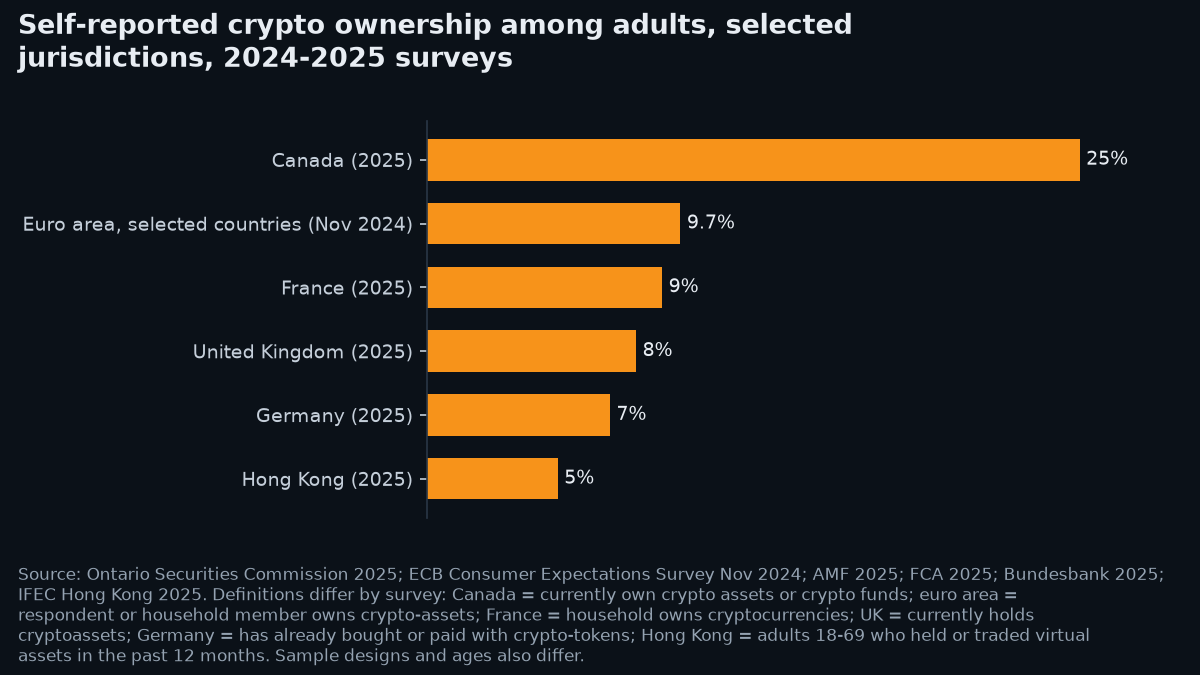
- In the Financial Conduct Authority’s 2025 consumer research, a YouGov online survey of 2,353 UK adults fielded from 5 August to 2 September 2025, 8% said they currently hold cryptoassets, down from 12% in 2024. (Source: Financial Conduct Authority, Cryptoassets consumer research 2025 (Wave 6), research note)
- The European Central Bank’s November 2024 Consumer Expectations Survey, covering selected euro area countries, found that on average 9.7% of respondents, or someone in their household, owned crypto-assets, slightly down from November 2022. (Source: European Central Bank, Financial Stability Review May 2025, special feature ‘Just another crypto boom? Mind the blind spots’, 2024)
- An Ipsos online survey of 2,360 Canadian adults for the Ontario Securities Commission, fielded from 18 December 2025 to 22 January 2026, found that 25% currently own crypto assets or crypto investment funds, up from 10% in 2023. (Source: Ontario Securities Commission, Crypto Assets 2025 survey report (Ipsos))
- In the Bundesbank’s 2025 payment behaviour study (forsa interviews with German-speaking adults, 8 September to 2 December 2025; 2,004 respondents answered the crypto question), 7% said they had already bought or paid with crypto-tokens such as Bitcoin, up from 6% in 2023, and a further 4% planned to. (Source: Deutsche Bundesbank, Payment behaviour in Germany in 2025 (English edition, July 2026))
- In the French financial regulator AMF’s 2025 savings and investment barometer, an online survey of 2,120 people representative of France’s population aged 18 and over (19 September to 3 October 2025), 9% said their household owned cryptocurrencies such as Bitcoin, Ether or stablecoins. (Source: Autorite des marches financiers (AMF) with Audirep, Barometre de l’epargne et de l’investissement 2025 (in French))
- A street survey of 1,000 adults aged 18 to 69 by Hong Kong’s Investor and Financial Education Council in April 2025 found that 5% had held or traded virtual assets or related products, such as cryptocurrencies, NFTs, stablecoins and virtual-asset ETFs, in the past 12 months, compared with 6% in 2023. (Source: Investor and Financial Education Council (Hong Kong), Retail Investor Study 2025 (February 2026))
- At the end of 2025, South Korea’s 27 registered virtual asset service providers reported 11.13 million user accounts eligible to trade (printed as 1,113만, that is 1,113 x 10,000), up 3% from the end of June 2025, in a joint survey by the Korea Financial Intelligence Unit and the Financial Supervisory Service; the figure counts accounts, not unique people. (Source: Financial Services Commission (Korea), 2025 H2 Virtual Asset Service Provider Survey Results, press release of 25 March 2026 (in Korean))
- Chainalysis, a blockchain-analytics vendor, ranked India first and the United States second among 151 countries in its own 2025 Global Crypto Adoption Index, followed by Pakistan, Vietnam and Brazil; the index scores estimated on-chain transaction volumes derived from web traffic to crypto services, not survey answers about ownership. (Source: Chainalysis, 2025 Global Crypto Adoption Index (excerpt of the 2025 Geography of Cryptocurrency Report), 2 September 2025)
- An IMF working paper by a staff economist (views not official IMF positions) estimated that stablecoin flows in 2024 equalled 7.7% of GDP in Latin America and the Caribbean and 6.7% of GDP in Africa and the Middle East, from an analysis of $2 trillion of stablecoin transactions. (Source: International Monetary Fund, Working Paper WP/25/141, ‘Decrypting Crypto: How to Estimate International Stablecoin Flows’ (M. Reuter, July 2025), 2024)
- In the Bank for International Settlements’ 2024 survey of 93 central banks (fielded October to December 2024), 21% of the central banks answering said stablecoins are used mainly by niche groups for remittances in their jurisdiction, and 4% reported wider or significant use for remittances, all of them emerging market or developing economies. (Source: Bank for International Settlements, BIS Papers No 159, ‘Advancing in tandem: results of the 2024 BIS survey on central bank digital currencies and crypto’)
Background on this topic: what cryptocurrency is, stablecoins.
Mining and energy use
Cambridge’s survey of miners puts Bitcoin mining at about 138 TWh of electricity a year, roughly 0.5% of global use, with just over half of that power reported as sustainable but natural gas still the largest single source.
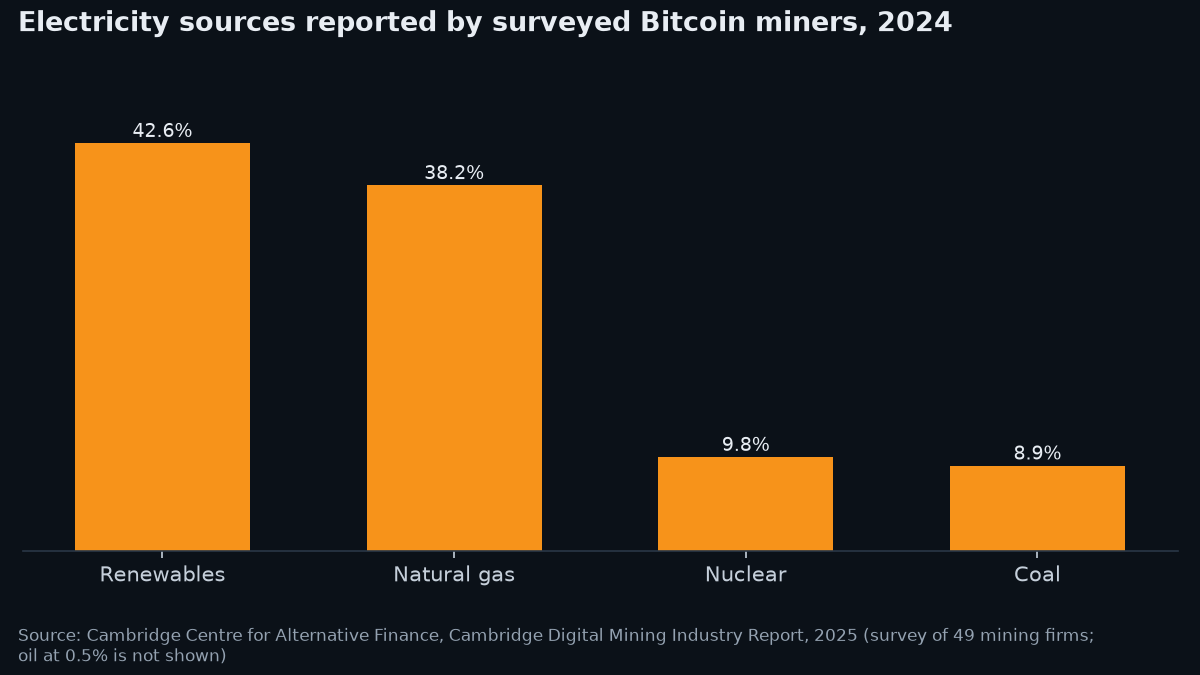
- Cambridge’s April 2025 survey of 49 mining firms in 23 countries, covering about 48% of the Bitcoin network’s hashrate at the time, found that miners reported sourcing 52.4% of their 2024 electricity from sustainable sources (42.6% renewables and 9.8% nuclear), up from an estimated 37.6% in 2022. (Source: Cambridge Centre for Alternative Finance (CCAF), Cambridge Digital Mining Industry Report, publication page, Cambridge Judge Business School, 2024)
- In the same Cambridge survey, miners reported that natural gas supplied 38.2% of their 2024 electricity (up from 25.0% in 2022), making it the largest single source, while coal fell to 8.9% from 36.6% in 2022. (Source: Cambridge Centre for Alternative Finance (CCAF), Cambridge Digital Mining Industry Report, publication page, Cambridge Judge Business School, 2024)
- Cambridge researchers estimated that Bitcoin mining used about 138 TWh of electricity per year as of mid-2024, up 17% year on year and approximately 0.54% of global electricity use. (Source: Cambridge Centre for Alternative Finance (CCAF), Cambridge Digital Mining Industry Report, publication page, Cambridge Judge Business School, 2024)
- Cambridge estimated that Bitcoin mining’s annual greenhouse gas emissions were 39.8 MtCO₂e, about 0.08% of the global total, using the electricity mix miners reported, while an IP-based location model gave 69.6 MtCO₂e instead. (Source: Cambridge Centre for Alternative Finance (CCAF), Cambridge Digital Mining Industry Report, publication page, Cambridge Judge Business School, 2024)
- Mining firms in the Cambridge survey reported that electricity accounted for over 80% of their cash-based operating expenses in 2024, with median electricity-only costs of $45/MWh and median all-in costs of $55.5/MWh. (Source: Cambridge Centre for Alternative Finance (CCAF), Cambridge Digital Mining Industry Report, publication page, Cambridge Judge Business School, 2024)
- A peer-reviewed study in Nature Communications (March 2025) found that the 34 largest US bitcoin mines consumed 32.3 terawatt-hours of electricity between mid-2022 and mid-2023, with 85% of it coming from fossil fuels. (Source: Nature Communications, ‘The environmental burden of the United States’ bitcoin mining boom’ (Guidi et al., published 26 March 2025), 2023)
- In a February 2024 analysis, the US Energy Information Administration preliminarily estimated that cryptocurrency mining accounted for 0.6% to 2.3% of US electricity consumption in 2023, a range it built from Cambridge’s Bitcoin electricity estimates. (Source: U.S. Energy Information Administration, Today in Energy: Tracking electricity consumption from U.S. cryptocurrency mining operations (1 February 2024), 2023)
- The International Energy Agency estimated that cryptocurrencies worldwide used about 110 TWh of electricity in 2022, equal to 0.4% of global annual electricity demand. (Source: International Energy Agency, Electricity 2024: Analysis and forecast to 2026 (January 2024), 2022)
- In an April 2025 filing to the Federal Energy Regulatory Commission, the North American Electric Reliability Corporation listed 25 load-loss events at crypto-mining facilities in Texas’s ERCOT grid between November 2023 and January 2025, of 100 MW to 400 MW. (Source: North American Electric Reliability Corporation (NERC), Comments in FERC Docket EL25-49-000 (signed 23 April 2025), 2024)
- NERC’s July 2025 large-loads white paper describes a cryptocurrency mining facility in North America whose load ramped down by 298 MW within 25 seconds after a load-control problem caused by an offsite telecommunications failure. (Source: North American Electric Reliability Corporation (NERC), Characteristics and Risks of Emerging Large Loads, Large Loads Task Force white paper (July 2025))
Background on this topic: Bitcoin energy use, what a mining operation looks like, mining profitability.
Fraud, scams and crime
Cryptocurrency was involved in more than half of the dollars lost to internet crime reported to the FBI in 2025, with investment scams the largest piece, while blockchain-analytics firms put illicit on-chain volume at a record but small share of all activity.
- In 2025, the FBI’s Internet Crime Complaint Center (IC3) recorded 181,565 complaints with a cryptocurrency nexus, 21% more than in 2024. (Source: FBI Internet Crime Complaint Center, 2025 Internet Crime Report)
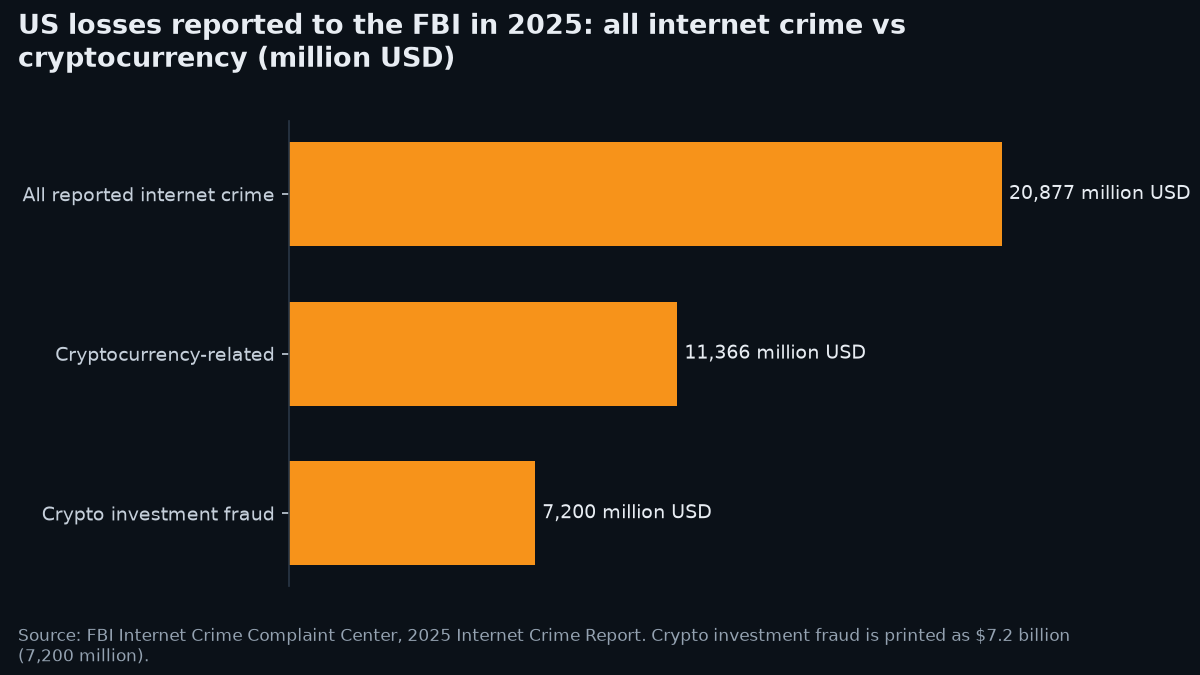
- Complaints to the FBI’s IC3 that involved cryptocurrency reported $11.366 billion in losses in 2025, 22% more than in 2024, an average loss of $62,604 per complaint. (Source: FBI Internet Crime Complaint Center, 2025 Internet Crime Report)
- All internet-crime complaints to the FBI’s IC3 in 2025 totaled 1,008,597 and reported $20.877 billion in losses, a 26% increase in losses from 2024. (Source: FBI Internet Crime Complaint Center, 2025 Internet Crime Report)
- The FBI’s IC3 reported that cryptocurrency investment fraud was the largest source of financial losses to Americans in 2025, at $7.2 billion. (Source: FBI Internet Crime Complaint Center, 2025 Internet Crime Report)
- In 2025, the FBI’s IC3 received 13,460 complaints involving cryptocurrency ATMs or kiosks with reported losses of $389 million, up 23% in complaints and 58% in losses from 2024. (Source: FBI Internet Crime Complaint Center, 2025 Internet Crime Report)
- People aged 60 and over reported $4,432,224,488 in cryptocurrency-related losses to the FBI’s IC3 in 2025, the largest of any age group and well ahead of the $2,139,033,232 reported by people aged 50 to 59. (Source: FBI Internet Crime Complaint Center, 2025 Internet Crime Report)
- The FTC’s Consumer Sentinel Network Data Book 2024 shows people reported losing $1.42 billion to fraud paid with cryptocurrency in 2024, second only to bank transfers and payments at $2.09 billion. (Source: Federal Trade Commission, Consumer Sentinel Network Data Book 2024)
- In the Federal Reserve’s October 2025 survey of nearly 13,000 US adults, 65 percent of adults who experienced fraud involving cryptocurrency lost money that was not recovered, the highest share of any payment method and roughly double the 31 percent for debit cards. (Source: Federal Reserve Board, Report on the Economic Well-Being of U.S. Households in 2025 (banking section, Financial Fraud and Scams))
- In the Federal Reserve’s October 2025 survey of nearly 13,000 US adults, 9% of adults who had experienced fraud not involving a credit card said cryptocurrency was a payment method involved, versus 41% for debit cards (respondents could name more than one method). (Source: Federal Reserve Board, Report on the Economic Well-Being of U.S. Households in 2025 (Table 37))
- FinCEN analyzed 33,904 Bank Secrecy Act reports filed between 8 September 2023 and 31 December 2025 on suspected digital asset investment scams, which described approximately $12.7 billion in suspected scam-related financial activity. (Source: FinCEN, Financial Trend Analysis: Digital Asset Investment Scams, 2023-2025 Threat Pattern & Trend Information)
- Chainalysis estimated that illicit cryptocurrency addresses received at least $154 billion in 2025, a 162% increase on 2024 driven mainly by a 694% rise in value received by sanctioned entities, and calls the figure a lower bound. (Source: Chainalysis, 2026 Crypto Crime Report: Introduction, 2025)
- TRM Labs estimated that illicit crypto volume reached a record USD 158 billion in 2025, up nearly 145% from 2024, using its own attribution methodology. (Source: TRM Labs, 2026 Crypto Crime Report, 2025)
- Chainalysis estimated that stablecoins accounted for 84% of all illicit cryptocurrency transaction volume in 2025. (Source: Chainalysis, 2026 Crypto Crime Report: Introduction, 2025)
- TRM Labs estimated that illicit activity made up 1.2% of total attributed on-chain volume in 2025, down slightly from 1.3% in 2024. (Source: TRM Labs, 2026 Crypto Crime Report, 2025)
- As of April 23, 2026, the Justice Department said the Scam Center Strike Force and its partners had restrained more than $700 million in cryptocurrency alleged to be tied to laundering the proceeds of cryptocurrency scams. (Source: U.S. Department of Justice, Office of Public Affairs press release, April 23, 2026)
- In 2025, the FBI’s Operation Level Up notified 3,780 victims of cryptocurrency investment fraud, and 78% of them did not know they were being scammed. (Source: FBI Internet Crime Complaint Center, 2025 Internet Crime Report)
Background on this topic: common Bitcoin scams, whether Bitcoin is safe, Bitcoin ATMs.
Exchange failures and retail losses
The FTX collapse produced a criminal conviction upheld on appeal, and customers are being repaid through bankruptcy in dollars, while the case now sits with the US Supreme Court.
- On 12 June 2026 the US Court of Appeals for the Second Circuit affirmed the conviction of Sam Bankman-Fried, whom a jury had found guilty of seven counts of fraud and conspiracy tied to the FTX exchange and the Alameda Research trading firm he operated and controlled. (Source: US Court of Appeals for the Second Circuit, United States v. Bankman-Fried, No. 24-961-cr (opinion), 2026)
- The Second Circuit’s opinion records that, after a four-week trial, the district court sentenced Bankman-Fried to 25 years in prison followed by three years of supervised release. (Source: US Court of Appeals for the Second Circuit, United States v. Bankman-Fried, No. 24-961-cr (opinion), 2024)
- The same opinion states that the district court also ordered a forfeiture of approximately $11 billion, which the appeals court left in place. (Source: US Court of Appeals for the Second Circuit, United States v. Bankman-Fried, No. 24-961-cr (opinion), 2024)
- According to the Second Circuit’s account of the trial evidence, the net asset value of Alameda Research fell from more than $40 billion in late 2021 to around $10 billion in June 2022, because its assets were mostly in cryptocurrency. (Source: US Court of Appeals for the Second Circuit, United States v. Bankman-Fried, No. 24-961-cr (opinion), 2022)
- Bankman-Fried filed a petition for a writ of certiorari asking the US Supreme Court to review the Second Circuit ruling on 10 September 2026 (No. 26-349); the docket showed the government’s response due 15 October 2026 and a government motion for more time filed on 9 October 2026. (Source: Supreme Court of the United States, docket for No. 26-349, Bankman-Fried v. United States, 2026)
- A Bank for International Settlements bulletin from February 2023 reported that over $450 billion of crypto market value vanished in the Terra/Luna collapse of May 2022 alone, and that another $200 billion was lost in the wake of the FTX bankruptcy in November 2022. (Source: Bank for International Settlements, BIS Bulletin No 69, Crypto shocks and retail losses (20 February 2023), 2022)
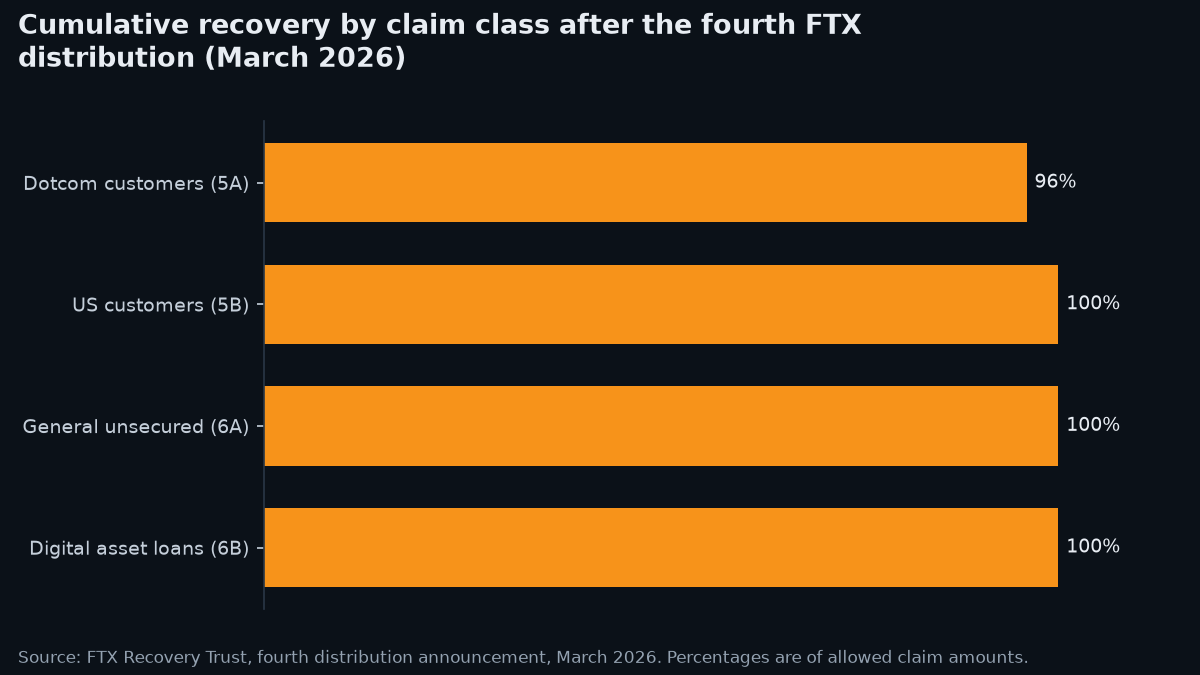
- On 31 March 2026 the FTX Recovery Trust made its fourth distribution to creditors of approximately $2.2 billion, which its announcement put at an incremental 18% for Dotcom customer claims (Class 5A), taking their cumulative recovery to 96%. (Source: FTX Recovery Trust, announcement of the fourth distribution (PR Newswire, March 2026))
- In the same March 2026 distribution notice, the FTX Recovery Trust reported cumulative recovery of 100% for US customer claims (Class 5B, after an incremental 5%) and for general unsecured and digital asset loan claims (Classes 6A and 6B, each after an incremental 15%). (Source: FTX Recovery Trust, announcement of the fourth distribution (PR Newswire, March 2026))
Background on this topic: the FTX story and the Netflix series about it, how to choose an exchange, self-custody.
ETFs, institutions and governments
Between January 2024 and September 2025 US agencies approved spot bitcoin ETPs and eased bank crypto rules, and by 31 December 2025 one ETF trust and one listed company each reported holding more than 670,000 bitcoin in SEC filings.
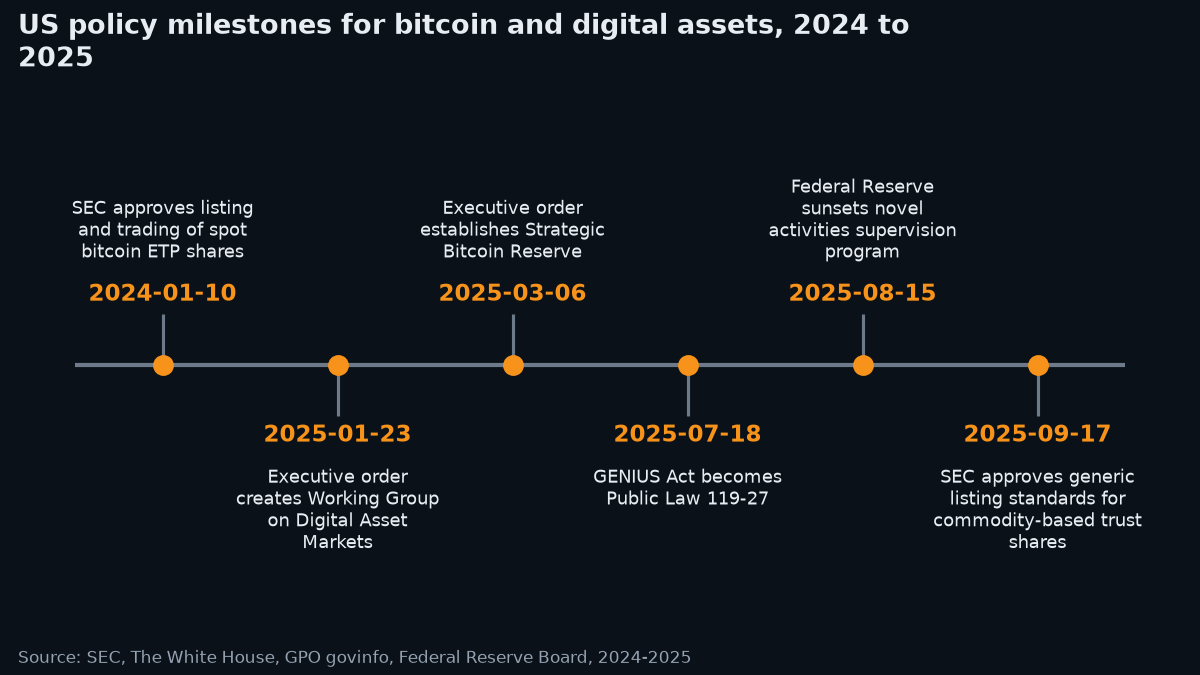
- On January 10, 2024, SEC Chair Gary Gensler stated that the Commission had approved the listing and trading of a number of spot bitcoin exchange-traded product shares, and that SEC staff was completing review of registration statements for 10 spot bitcoin ETPs at the same time. (Source: U.S. Securities and Exchange Commission, Statement on the Approval of Spot Bitcoin Exchange-Traded Products (Gary Gensler, 10 Jan 2024))
- A presidential executive order dated March 6, 2025 established a Strategic Bitcoin Reserve capitalized with forfeited bitcoin held by the Treasury Department, states that bitcoin deposited in it shall not be sold, and limits any further acquisition of bitcoin to strategies that are budget neutral. (Source: The White House, Establishment of the Strategic Bitcoin Reserve and United States Digital Asset Stockpile (executive order), 2025)
- The iShares Bitcoin Trust ETF’s annual report on Form 10-K for 2025, signed February 27, 2026, lists 770,792 bitcoin held by the trust at December 31, 2025, up from 551,918 bitcoin at December 31, 2024. (Source: iShares Bitcoin Trust ETF, Form 10-K for the year ended December 31, 2025 (SEC EDGAR), Schedules of Investments)
- Strategy Inc. (formerly MicroStrategy) stated in its annual report on Form 10-K for fiscal 2025, signed February 19, 2026, that it held approximately 672,500 bitcoin as of December 31, 2025, compared with 447,470 a year earlier. (Source: Strategy Inc, Form 10-K for the fiscal year ended December 31, 2025 (SEC EDGAR))
- On October 14, 2025, the US Department of Justice announced a civil forfeiture complaint against approximately 127,271 bitcoin that it alleges are proceeds and instrumentalities of fraud and money laundering by Prince Group chairman Chen Zhi, and called it the largest forfeiture action in the Department’s history. (Source: U.S. Department of Justice, Office of Public Affairs, press release ‘Chairman of Prince Group Indicted…’ (14 Oct 2025))
- On September 17, 2025, the SEC voted to approve rule changes by three national securities exchanges adopting generic listing standards, so exchanges can list commodity-based trust shares, including products holding digital assets, without filing a separate proposed rule change for each product. (Source: U.S. Securities and Exchange Commission, press release 2025-121, SEC Approves Generic Listing Standards for Commodity-Based Trust Shares)
- The GENIUS Act, which creates a federal framework for payment stablecoins, was approved on July 18, 2025 and became Public Law 119-27. (Source: U.S. Government Publishing Office (govinfo), Public Law 119-27 (S. 1582), GENIUS Act, 2025)
- On August 15, 2025, the Federal Reserve Board announced it would sunset its novel activities supervision program, which had supervised certain crypto and fintech activities at banks, and rescind the 2023 supervisory letter (SR 23-7) that created it. (Source: Board of Governors of the Federal Reserve System, press release of August 15, 2025 (novel activities supervision program))
- An executive order dated January 23, 2025, ‘Strengthening American Leadership in Digital Financial Technology’, created the President’s Working Group on Digital Asset Markets and gave it 180 days to submit a report recommending regulatory and legislative proposals, including whether to create a national digital asset stockpile. (Source: The White House, Strengthening American Leadership in Digital Financial Technology (executive order, 23 Jan 2025))
- On March 7, 2025, the Office of the Comptroller of the Currency published Interpretive Letter 1183, confirming that crypto-asset custody, certain stablecoin activities and participation in independent node verification networks are permissible for national banks and federal savings associations, and rescinding a 2021 letter (IL 1179) that had set a supervisory non-objection process. (Source: Office of the Comptroller of the Currency, News Release 2025-16 and Interpretive Letter 1183)
- On June 28, 2024, Treasury and the IRS released final regulations requiring brokers to report gross proceeds from digital-asset sales beginning in 2026 for 2025 sales, saying they had reviewed more than 44,000 public comments on the proposal. (Source: U.S. Department of the Treasury, press release ‘U.S. Department of the Treasury, IRS Release Final Regulations Implementing Bipartisan Tax Reporting Requirements for Sales and Exchanges of Digital Assets’ (28 Jun 2024))
- A US Deputy Attorney General memorandum dated April 7, 2025, titled ‘Ending Regulation By Prosecution’, ordered the Justice Department’s National Cryptocurrency Enforcement Team (NCET) disbanded effective immediately. (Source: U.S. Department of Justice, Office of the Deputy Attorney General, memorandum ‘Ending Regulation By Prosecution’ (7 Apr 2025))
Background on this topic: Bitcoin ETFs, how Bitcoin is regulated in the US.
US tax treatment and broker reporting
US brokers must report digital asset sales to the IRS on Form 1099-DA for transactions from January 1, 2025, with basis reporting added from January 1, 2026, under a rule built on the IRS’s 2014 treatment of virtual currency as property and a 2021 law that widened the broker definition.
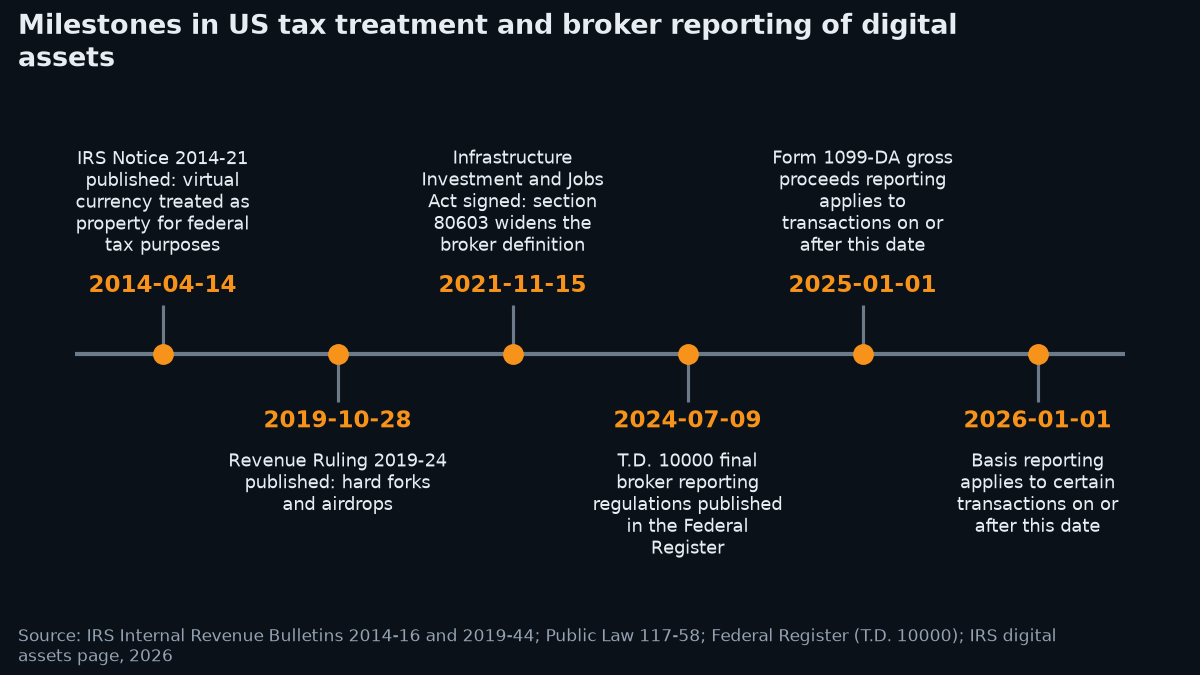
- The IRS states that brokers must report gross proceeds on Form 1099-DA for digital asset transactions effected on or after January 1, 2025, and must report basis on certain transactions effected on or after January 1, 2026. (Source: IRS, Digital assets (Broker compliance section; page last reviewed September 2, 2026), 2025)
- In the final broker reporting regulations published in the Federal Register on July 9, 2024 (T.D. 10000, effective September 9, 2024), Treasury and the IRS estimated that 13 to 16 million customers (midpoint 14.5 million) and approximately 900 to 9,700 brokers (midpoint 5,300) would be affected, with the customer figure based on tax year 2021 Forms 1099 reporting digital asset activity plus Form 1040 ‘yes’ answers to the digital asset question. (Source: Federal Register, Gross Proceeds and Basis Reporting by Brokers and Determination of Amount Realized and Basis for Digital Asset Transactions (T.D. 10000, 89 FR 56480), 2024)
- Public Law 119-5, approved April 10, 2025 after passing the House on March 11 and the Senate on March 26, provides that Congress disapproves the IRS rule titled “Gross Proceeds Reporting by Brokers That Regularly Provide Services Effectuating Digital Asset Sales” (89 Fed. Reg. 106928, December 30, 2024) and that the rule “shall have no force or effect.” (Source: U.S. Government Publishing Office, Public Law 119-5 (H.J. Res. 25), 139 Stat. 48, 2025)
- Treasury Decision 10021, published in the Federal Register on December 30, 2024 (89 FR 106928, effective February 28, 2025), treated only providers of trading front-end services as the new category of DeFi brokers and set its reporting rule to apply to sales of digital assets occurring on or after January 1, 2027. (Source: Federal Register, Gross Proceeds Reporting by Brokers That Regularly Provide Services Effectuating Digital Asset Sales (T.D. 10021, 89 FR 106928), 2024)
- In its June 28, 2024 announcement of the final broker regulations, the US Treasury said brokers will be required to report gross proceeds on digital asset sales “beginning in 2026 for all sales in 2025” and tax basis for certain digital assets beginning in 2027 for sales in 2026. (Source: U.S. Department of the Treasury press release, Final Regulations Implementing Bipartisan Tax Reporting Requirements for Sales and Exchanges of Digital Assets (June 28, 2024))
- The IRS states that a gain on a digital asset held as a capital asset is short-term if the asset was held for one year or less before it was sold, exchanged or otherwise disposed of, and long-term if it was held for more than one year. (Source: IRS, Digital assets (How to report digital asset transactions; page last reviewed September 2, 2026))
- For digital asset transactions in calendar year 2025 (reported in 2026), the IRS says it will not impose penalties on brokers for failing to file and furnish Forms 1099-DA if they make a good faith effort to file and furnish them correctly and on time, under transition relief in Notices 2024-56 and 2025-33. (Source: IRS, Digital assets (Broker compliance: Notice for Penalty Relief; page last reviewed September 2, 2026), 2025)
- Section 80603 of the Infrastructure Investment and Jobs Act (Public Law 117-58, approved November 15, 2021) added to the tax code’s definition of a broker any person who, for consideration, is responsible for regularly providing any service effectuating transfers of digital assets on behalf of another person, effective for returns required to be filed and statements required to be furnished after December 31, 2023. (Source: U.S. Government Publishing Office, Public Law 117-58 (Infrastructure Investment and Jobs Act), section 80603, 135 Stat. 1339-1341, 2021)
- In IRS Notice 2014-21, published in Internal Revenue Bulletin 2014-16 dated April 14, 2014, the IRS stated that for federal tax purposes virtual currency is treated as property, and that it is not treated as currency that could generate foreign currency gain or loss. (Source: IRS, Internal Revenue Bulletin 2014-16 (Notice 2014-21, Q&A-1 and A-2))
- IRS Revenue Ruling 2019-24, published in the Internal Revenue Bulletin of October 28, 2019, holds that a taxpayer has no gross income from a hard fork of a cryptocurrency if no units of a new cryptocurrency are received, but has ordinary gross income from an airdrop of new cryptocurrency units received following a hard fork. (Source: IRS, Internal Revenue Bulletin 2019-44 (Rev. Rul. 2019-24))
Background on this topic: how Bitcoin is taxed in the US, how to sell bitcoin.
Regulation outside the United States
Outside the US, crypto rules now run on fixed legal dates: MiCA has applied across the EU since 30 December 2024 with grandfathering ending by 1 July 2026, and 83% of jurisdictions surveyed by the FATF report Travel Rule laws.
- The Financial Action Task Force’s seventh targeted update on virtual assets, published on 16 July 2026, reported that 83% of surveyed jurisdictions have passed legislation implementing the Travel Rule, up from 73% in 2025, while a further 11 jurisdictions said implementation is under way. (Source: FATF, news release on the 7th Targeted Update on Implementation of the FATF Standards on Virtual Assets and VASPs (16 July 2026))
- A Financial Stability Board peer review using information as of August 2025 found that 11 jurisdictions (39%) of those reviewed had finalised a regulatory framework for crypto-assets that addresses financial stability, and that five jurisdictions had finalised a framework for stablecoins. (Source: Financial Stability Board, Thematic Review on FSB Global Regulatory Framework for Crypto-asset Activities: Peer review report (16 October 2025))
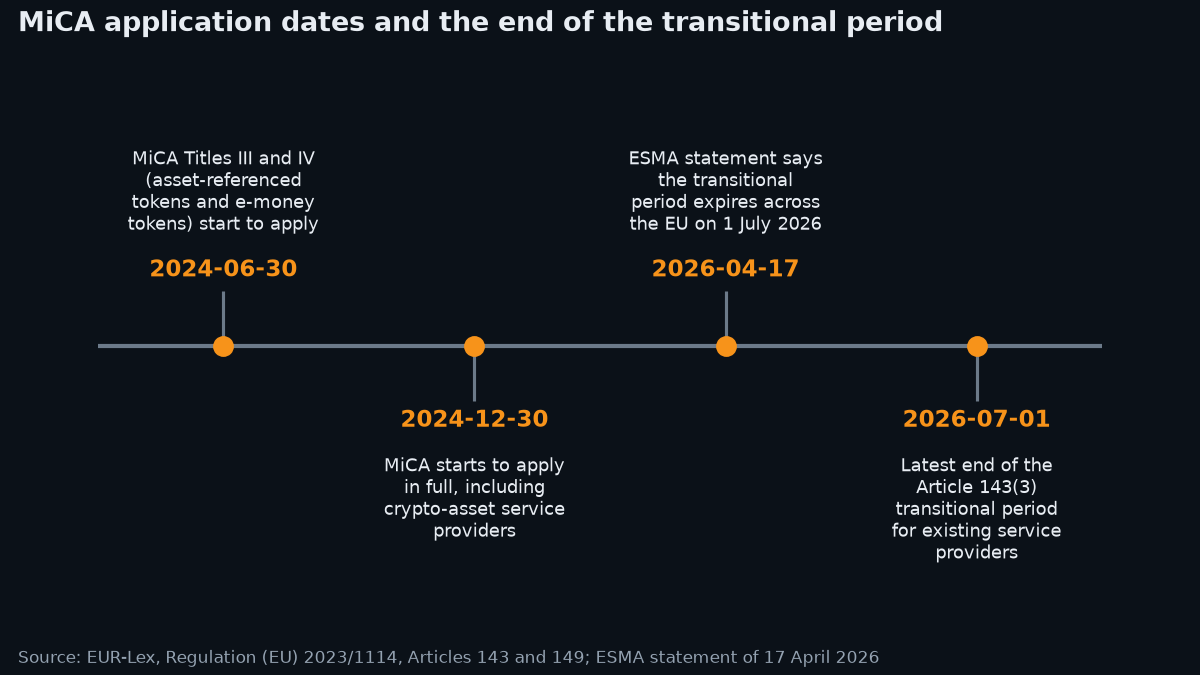
- Article 149 of the EU’s Markets in Crypto-assets Regulation (Regulation (EU) 2023/1114, signed on 31 May 2023) says the Regulation applies from 30 December 2024, while its Titles III and IV, covering asset-referenced tokens and e-money tokens, apply from 30 June 2024. (Source: EUR-Lex, Regulation (EU) 2023/1114 (MiCA), Article 149, 2024)
- MiCA Article 143(3) lets crypto-asset service providers that operated lawfully before 30 December 2024 keep going until 1 July 2026, or until their authorisation is granted or refused if that comes sooner, and lets Member States shorten or switch off that transitional period. (Source: EUR-Lex, Regulation (EU) 2023/1114 (MiCA), Article 143(3), 2026)
- In a statement dated 17 April 2026, the European Securities and Markets Authority said the MiCA transitional period expires across the EU on 1 July 2026 and that after that date any entity providing crypto-asset services to EU clients without a MiCA licence is in breach of EU law. (Source: ESMA, Statement on the End of Transitional Periods under MiCA (ESMA75-113276571-1679, 17 April 2026))
- On 26 February 2025 the IMF Executive Board approved a 40-month Extended Fund Facility arrangement for El Salvador with access of SDR 1033.92 million (around US$1.4 billion), and the programme addresses Bitcoin risks by making acceptance of Bitcoin voluntary and confining public-sector engagement in Bitcoin-related activity. (Source: IMF Press Release No. 25/043, IMF Executive Board Approves New 40-month US$1.4 billion Extended Fund Facility Arrangement for El Salvador, 2025)
- The UK’s Financial Services and Markets Act 2000 (Cryptoassets) Regulations 2026 (SI 2026/102), made by HM Treasury on 4 February 2026, come into force in full on 25 October 2027, while the parts that let the FCA make rules and receive applications for permission started 21 days after the day following the day they were made. (Source: legislation.gov.uk, The Financial Services and Markets Act 2000 (Cryptoassets) Regulations 2026, SI 2026/102 (as made), regulation 1)
- On 1 October 2026 the IMF Executive Board completed the second and third reviews of El Salvador’s 40-month arrangement, allowing an immediate disbursement of SDR 101.96 million (about US$138 million), and granted waivers for performance criteria that were not met, including on Bitcoin accumulation. (Source: IMF Press Release No. 26/316, IMF Executive Board Concludes the Second and Third Reviews Under the Extended Fund Facility for El Salvador, 2026)
- On 10 April 2026 the Hong Kong Monetary Authority granted stablecoin issuer licences under the Stablecoins Ordinance to two companies, Anchorpoint Financial Limited and The Hongkong and Shanghai Banking Corporation Limited, with the licences taking effect the same day. (Source: Hong Kong Monetary Authority, press release ‘Granting of stablecoin issuer licences’ (10 April 2026))
- From 30 June 2025, Singapore requires digital token service providers that serve only customers outside Singapore to be licensed, and the Monetary Authority of Singapore said it will generally not issue a licence to them. (Source: Monetary Authority of Singapore, media release ‘MAS Clarifies Regulatory Regime for Digital Token Service Providers’ (6 June 2025))
- As of 1 September 2026, Japan’s Financial Services Agency listed 27 registered crypto-asset exchange service providers, 25 of them under the Kanto Finance Bureau and 2 under the Kinki Finance Bureau. (Source: Japan Financial Services Agency, List of Registered Crypto-asset Exchange Service Providers in Japan (as of 1 September 2026))
- ESMA’s published list of national grandfathering periods under MiCA Article 143(3) shows 15 of the 27 EU Member States at 18 months, 5 at 12 months, 1 at 9 months and 6 at 6 months (counted by us from the table: 15 + 5 + 1 + 6 = 27), as communicated to ESMA by national authorities. (Source: ESMA, List of grandfathering periods decided by Member States under Article 143 of Regulation (EU) 2023/1114 (MiCA), 2025)
- The UK Financial Conduct Authority said it issued 146 alerts about cryptoasset promotions on the first day of its new financial promotions regime, which took effect on 8 October 2023. (Source: FCA, statement ‘FCA issues 146 alerts in first 24 hours of new crypto marketing regime’ (published 9 October 2023))
Background on this topic: how to choose an exchange, monetary freedom.
Methodology
What counts as a source. Only the organisation that collected the data: regulators, central banks, courts and government agencies, academic centres, survey publishers and the Bitcoin Core source code. Two crypto-analytics firms, Chainalysis and TRM Labs, are cited for their own estimates of illicit activity; each is labelled as that firm’s estimate and the two are never averaged. No roundups, price trackers or encyclopedias are used. The page excludes prices, market caps, live counters and forecasts.
How each figure was checked. Every statistic was taken from the page or document it links to, and the number as printed on that page was searched for by an automated check. Where the source is a PDF, a page that blocks automated readers or a script-driven page, the figure was instead read in the document itself, in a browser or through the publisher’s data feed, and the sentence around it was compared with the claim here for population, unit, place and year. Statistics that could not be confirmed this way were dropped.
Conflicts and limits. Surveys measure different things (ever used, own now, household holdings), so the figures in the ownership and adoption sections are not directly comparable; each statement names its definition. Where sources disagree, both are shown and attributed. A few figures are historical (the genesis block, early halvings, the 2022 collapses) and say so. Statements about law describe what the cited official source says for that jurisdiction; this is not legal, tax or financial advice. Dockets, registers and reports change, so each such figure carries its date.
Refresh. Reviewed every quarter and whenever a major source updates (FBI annual report each spring, Federal Reserve household survey each May, Cambridge mining report, court dockets). Next review: 15 January 2027.
Sources by publisher
Each statistic above links to its exact page. These are the publishers behind them.
- amf-france.org
- atlantafed.org
- bis.org
- bitcoin.org
- bitcoincore.org
- bitcoinops.org
- blockchain.com
- bundesbank.de
- chainalysis.com
- developer.bitcoin.org
- doxygen.bitcoincore.org
- ecb.europa.eu
- eia.gov
- esma.europa.eu
- eur-lex.europa.eu
- fatf-gafi.org
- fca.org.uk
- fdic.gov
- federalregister.gov
- federalreserve.gov
- fincen.gov
- finrafoundation.org
- fsa.go.jp
- fsb.org
- fsc.go.kr
- ftc.gov
- github.com
- govinfo.gov
- hkma.gov.hk
- home.treasury.gov
- ic3.gov
- iea.blob.core.windows.net
- ifec.org.hk
- imf.org
- irs.gov
- jbs.cam.ac.uk
- justice.gov
- legislation.gov.uk
- lightning.engineering
- lightning.network
- mas.gov.sg
- mempool.space
- metzdowd.com
- nature.com
- nerc.com
- news.gallup.com
- occ.gov
- osc.ca
- pewresearch.org
- philadelphiafed.org
- prnewswire.com
- sec.gov
- supremecourt.gov
- trmlabs.com
- whitehouse.gov
- ww3.ca2.uscourts.gov
Where to go next
- Is Bitcoin Safe? The Real Risks and Common Scams: the risks behind the fraud figures.
- The History of Bitcoin: From a Whitepaper to a Global Network: the story behind the dates.
- Bitcoin Glossary: Key Terms Explained in Plain English: the terms used in the sources.
- Free Bitcoin tools: explore the halving schedule and unit conversions yourself.
Frequently asked questions
How many people own bitcoin?
No source on this page counts unique bitcoin owners worldwide, and the surveys measure different things. In the US, Pew found in January 2026 that 19% of adults have ever invested in, traded or used crypto, the Federal Reserve found in October 2025 that 10% used or held it in the prior year, and Gallup found in June 2026 that 9% say they own it. Outside the US, surveys put ownership at 8% in the UK (2025) and 25% in Canada (2025), with different definitions.
How much did crypto scams cost Americans in 2025?
The FBI's Internet Crime Complaint Center recorded $11.366 billion in losses across 181,565 crypto-related complaints in 2025, of which crypto investment fraud was $7.2 billion. The FTC's 2024 Data Book, a different dataset, listed $1.42 billion in reported losses paid in cryptocurrency. The two are not directly comparable.
How much electricity does Bitcoin mining use?
Cambridge researchers estimated about 138 TWh a year as of mid-2024, roughly 0.54% of global electricity use, and found that 52.4% of the electricity miners reported for 2024 came from sustainable sources. The IEA's older estimate for all cryptocurrencies was about 110 TWh in 2022.
How many bitcoin will ever exist?
The Bitcoin Core code sets MAX_MONEY at 21,000,000 BTC, halves the block reward every 210,000 blocks and starts it at 50 BTC. The source file's own comment says this constant is a sanity-check limit rather than the actual total supply, which is slightly lower.