Technology5 min read
What Is the Lightning Network?
The Lightning Network is a second layer on top of Bitcoin built for fast, small payments. Here is how payment channels work and where the trade-offs are.
By Christopher CannucciariPublished
On this page

Key takeaways
- The Lightning Network is a payment layer built on top of Bitcoin. It is designed for quick, low-value payments that would be awkward to settle on the main blockchain.
- Two people lock bitcoin into a shared “channel,” then update who owns what off-chain. Only the opening and closing of the channel are recorded on the blockchain.
- Payments can hop across a network of channels, so you do not need a direct channel with everyone you pay.
- Lightning brings real trade-offs: liquidity limits, the need to stay online or use a service that does it for you, and a more complicated security model than on-chain bitcoin.
Why a second layer exists
Bitcoin’s base layer adds a block roughly every ten minutes, and each block has limited space. That design keeps the network simple to verify and hard to attack, but it also means every on-chain transaction competes for room and takes a while to be considered settled. Paying for a coffee that way is possible, but it is not a natural fit.
Rather than change the base rules, developers built another system on top. If you have read How Does Bitcoin Work?, think of the blockchain as the final court record. Lightning is the running tab you keep with a friend during the evening, settled up with the record only when needed.
The Lightning whitepaper was published in 2015, and the network began seeing real use in the years after. It is not a separate coin. It moves bitcoin.
How payment channels work
The core idea is the payment channel. Suppose Alice and Bob expect to pay each other repeatedly.
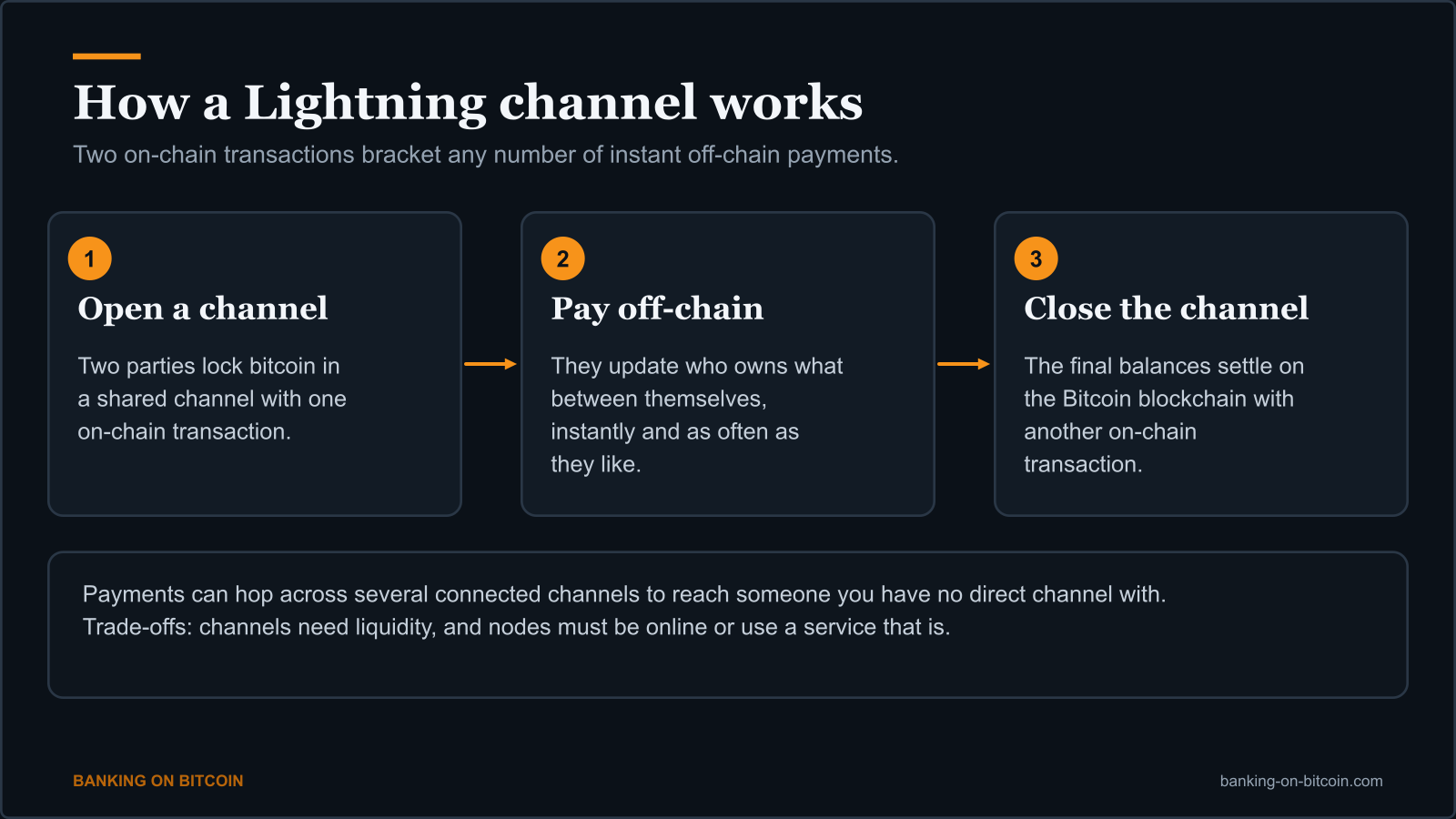
- They create a special shared wallet that needs both of their signatures to spend from. Each deposits some bitcoin into it. This “opening” is an ordinary on-chain transaction.
- From then on, they update the split between them by signing new versions of a balance sheet. If Alice pays Bob a small amount, they both sign a new sheet showing the new split. Nothing goes on the blockchain.
- When they are finished, they close the channel. The final balance sheet is broadcast, and each gets their share.
Because updates are just signed messages exchanged between two computers, they are fast and cost very little. The blockchain only sees the start and the end.
The obvious worry is cheating: what stops Alice from broadcasting an older balance sheet that favored her? The protocol includes penalty mechanisms. If one side publishes an outdated state and the other party is watching, the honest party can claim the cheater’s funds. That is the reason channel participants, or a service acting for them, need to be able to check the chain periodically.
Payments across the network
Most people will not open a channel with every merchant or friend. Lightning instead links channels together into a network. If Alice has a channel with Carol, and Carol has one with Bob, Alice can pay Bob by routing through Carol.
The routing uses a technique in which the payment is conditional: each hop only receives its funds if the next hop is paid, so an intermediary cannot simply take the money and stop. Intermediate nodes can charge a small routing fee for their service. Payments are sent in an onion-style format, so a routing node generally knows only the neighbor before it and the neighbor after it, not the full path. That gives Lightning some privacy advantages, though not a guarantee. For a wider look at what Bitcoin does and does not reveal, see Is Bitcoin Private?.
What Lightning is good for
Lightning suits payments where speed and small size matter:
- Everyday purchases and tips of small amounts.
- Sending value across borders without waiting for on-chain confirmation.
- Streaming or pay-per-use services where tiny payments happen often.
It is used less for holding a large long-term savings balance. Most people who care about long-term holdings keep those on-chain in their own wallet, a subject covered in The Power of Self-Custody.
The trade-offs
Lightning is useful, but it is not free of costs, and it is worth being honest about them.
Liquidity. A channel has a fixed capacity. You can only send as much as your side of the channel holds, and you can only receive as much as the other side holds. Large payments may fail to find a route.
Being online. To be safe against outdated-state cheating, your node or a service on your behalf needs to keep an eye on the chain. Closing a channel or handling a dispute also requires on-chain transactions, which cost fees.
Custody choices. Running your own Lightning node gives you control, but it takes technical work. Many people instead use a custodial Lightning wallet, where a company holds the funds. That is convenient and also reintroduces counterparty risk: you are trusting the provider, the same way you trust an exchange. Non-custodial mobile wallets exist that try to reduce the setup burden, though they involve their own trade-offs.
Hot wallet risk. Channel funds live in software that is connected to the internet, so the sensible approach is to keep only spending-sized amounts there, as you would carry cash in a wallet rather than your whole savings.
Complexity and evolution. The technology is younger than the base layer and still changing. Features, wallets and best practices shift, so anything you read about specific apps or fees can go out of date quickly.
None of these problems make Lightning pointless. They mean it is a specialized tool, and it is better to understand it before relying on it.
Where Lightning fits in the bigger picture
Bitcoin’s base layer prioritizes security and decentralization over throughput. Lightning is one attempt to add speed on top without altering that base. Whether it becomes a widely used payment method is an open question, and reasonable people disagree. What you can say with confidence is how it works and what it costs you in complexity and trust.
If you are just getting oriented, the Start Here learning path is a good route through the basics before you explore layers like this one.
Where to go next
- How Does Bitcoin Work? Blocks, Miners and Keys Explained for the base layer Lightning builds on.
- The Power of Self-Custody for the difference between holding your own keys and trusting a provider.
- Is Bitcoin Private? for what on-chain and Lightning payments reveal.
- Inside a Bitcoin Mining Operation for how the base layer gets secured.
- Bitcoin unit converter: convert between BTC and satoshis, the unit most Lightning wallets use.
- Bitcoin Fees Explained: where Lightning fits in the fee picture.
- How to Spend Bitcoin: Paying With It, Cards and Taxes: where Lightning fits in everyday payments.
- What Is a Bitcoin Node? What Running One Means: who checks the rules.