Investing8 min read
Bitcoin ETFs: What They Are and What They Mean for Investors
What a spot Bitcoin ETF is, how it differs from owning Bitcoin, and how to compare funds by fees, custody and structure without ranking any.
By Christopher CannucciariPublished
On this page
Key takeaways
- A spot Bitcoin ETF is a fund whose shares trade on a stock exchange and whose value is tied to the price of Bitcoin the fund holds. Buying a share is not the same as owning Bitcoin directly.
- US spot Bitcoin ETFs began trading in January 2024, after years of regulatory refusals. Earlier products tracked futures contracts instead.
- The convenience is real: you can hold exposure in an ordinary brokerage account, including retirement accounts where your provider allows it.
- The trade-offs are also real: ongoing fees, no ability to withdraw coins or use them as money, trading mainly during regular market hours, and reliance on the fund’s custodian.
- When comparing funds, look at the expense ratio, how the bitcoin is held, how tightly the fund tracks the price, and its structure. This article does not rank or recommend any product.
What an ETF is
An exchange-traded fund, or ETF, is a pooled investment that trades on a stock exchange throughout the day, just like a share of a company. The fund holds some underlying assets, and each share represents a slice of them. Index funds that track the stock market are the most familiar example.
A spot Bitcoin ETF holds actual bitcoin. Its shares are designed to track the price of that bitcoin, less the fund’s fees. You buy and sell shares through a normal brokerage account, using the same interface you would use to buy any other stock or fund. You never see a wallet, a private key or a blockchain address.
For someone who wants to have Bitcoin in their portfolio but does not want to open an exchange account, manage keys or worry about security, that is a genuine simplification. It is also why the products attracted substantial attention when they launched.
A short history
Applications for a US Bitcoin ETF were filed and refused for years. The SEC, the main securities regulator, repeatedly declined to approve spot products, citing concerns about market manipulation and surveillance of the underlying trading venues. You can read more about the agency on its home page at sec.gov, and our regulation overview explains how the SEC and other regulators divide responsibilities.
In 2021, the first US Bitcoin futures-based ETF launched. These funds do not hold bitcoin. They hold futures contracts, which are agreements tied to the future price. In January 2024, after a court decision that criticized the SEC’s earlier reasoning, the agency allowed a group of spot Bitcoin ETFs to list and trade. That is the moment most people refer to when they talk about “the Bitcoin ETFs.”
How a spot ETF works behind the scenes
The structure has a few moving parts, and understanding them helps you judge the risks.
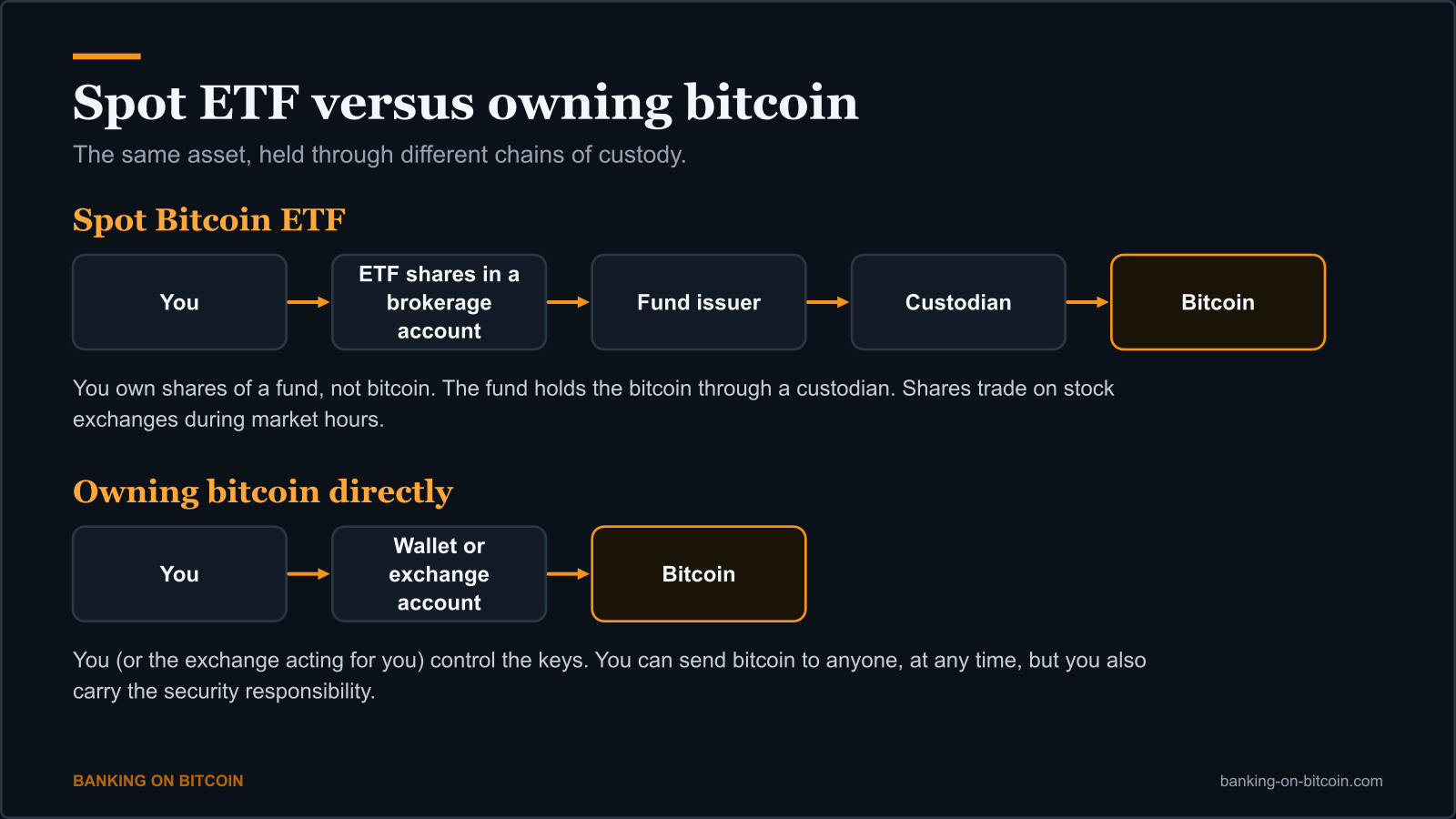
The fund holds bitcoin with a custodian, a specialized company that safeguards the keys. Investors in the fund do not hold the keys and cannot demand delivery of coins. If you care about holding your own keys, a fund is the opposite of that approach, which we discuss in The Power of Self-Custody.
Large financial firms called authorized participants create and redeem shares in big blocks. When demand for shares rises, they deliver bitcoin or cash to the fund in exchange for new shares, and they do the reverse when demand falls. This mechanism is meant to keep the share price close to the value of the bitcoin the fund holds. In practice the gap can widen briefly during stressed markets.
The fund charges an annual fee, called the expense ratio, taken out of the fund’s assets. You do not pay it as a separate bill. It shows up as a slightly lower return than the bitcoin price alone would give you, and it applies every year you own the shares.
Spot ETF versus owning Bitcoin directly
Neither is universally better. They serve different needs.
With a spot ETF you gain simplicity. Your holding appears in your regular brokerage statement, and tax reporting is handled through the forms your brokerage sends. You can hold it in accounts where direct coins may be hard to use, and some retirement account providers permit ETFs. The Bitcoin IRA guide covers how that works in general terms.
With direct ownership you gain control and flexibility. You can move coins to your own wallet, send them to anyone, use them around the clock and pay no annual fund fee. You also take on all the security responsibility, and you have to handle the record-keeping yourself.
The ETF loses several of the reasons some people are interested in Bitcoin in the first place. You cannot use shares as a payment method, you cannot self-custody them, and you can mostly trade only during regular market hours, which matters because Bitcoin itself trades continuously. Extended-hours trading exists before and after the regular session, with fewer buyers and sellers, and overnight sessions are planned, so trading hours are changing. If the exchange is closed on a weekend and the price moves sharply, your shares may not be able to react until trading resumes. And you hold a claim on the fund, so you depend on the fund’s custodian and operator behaving properly.
Spot versus futures-based funds
Futures-based ETFs work differently, and the differences matter. Because they hold futures contracts, which expire, the fund has to replace them periodically, a process called rolling. When futures prices are higher than the current price, rolling can cost the fund money, and the fund’s return can drift below the return of Bitcoin itself over time. A spot fund holds the asset and does not have this particular drag.
Futures funds can still be the right instrument for some purposes, but for someone who simply wants exposure to the price, the spot structure is the more direct one. Check the fund’s own documents to see which type you are looking at, because the names can be similar.
How to compare funds without a ranking
Lists of “the best Bitcoin ETF” appear everywhere, but the right answer depends on what you care about, and the numbers change. Here is a framework instead of a ranking.
Fees. Compare the expense ratios. Small differences compound over many years. Some funds have introduced temporary fee waivers, so read whether a low number is permanent or promotional, and what it becomes afterward. Current figures are on each provider’s website and change, so check them directly before deciding.
Custody. Find out who holds the bitcoin, whether it is held with a single custodian or several, and how the fund describes its security arrangements. Custody concentration is a real consideration: a fund is only as safe as the place its coins are stored.
Structure and tracking. Check whether the fund is a spot or futures product, whether creations and redemptions happen in cash or in bitcoin, and how closely the share price has followed the value of its holdings historically. The fund’s prospectus, the official disclosure document, spells out how it works.
Liquidity. Larger, more actively traded funds usually have narrower bid-ask spreads, meaning a smaller hidden cost when you buy and sell. Very small funds can be costlier to trade.
Fund size and issuer. An issuer’s track record with other funds and the fund’s own assets under management are worth a look, though asset totals move constantly and are not a reason to choose or avoid a product on their own.
Risks and taxes
An ETF removes the wallet risk but not the price risk. Bitcoin’s price has fallen by large percentages several times in its history, and a fund holding it will fall with it. There is no guarantee of any outcome.
Regulation could also change. The rules for these products are recent, and future decisions by regulators or lawmakers could affect how they operate.
Taxes depend on the type of account. In a taxable brokerage account, selling shares at a gain generally creates a taxable event, and the rules differ from those for holding bitcoin directly. Inside a traditional or Roth retirement account, different rules apply. The specifics, including rates, change and depend on your situation, so check the IRS home page at irs.gov or consult a tax professional. For the wider picture on classification and reporting, see our overview of US regulation.
What ETFs mean for the wider market
The arrival of these funds changed who can conveniently own Bitcoin exposure. Financial advisers, pension platforms and ordinary savers can now reach it without leaving their brokerage. Supporters see this as a maturing of the market. Critics note that it moves Bitcoin toward the traditional finance system that many early adopters hoped to avoid, concentrates coins with a few custodians, and encourages a paper-claim version of Bitcoin. The tension between convenience and the original ideals is a running debate, and readers who want the economic context can start with Bitcoin’s Role in a Changing Global Economy.
If you are new to Bitcoin and want a structured introduction before deciding anything, Start Here collects the fundamentals in order. This article is educational, not personalized advice. A licensed financial adviser or tax professional can help you decide whether any Bitcoin product fits your goals.
Where to go next
- Can You Buy Bitcoin in an IRA?: how ETFs and self-directed accounts compare inside retirement accounts.
- Is Bitcoin Regulated in the US?: the roles of the SEC, the CFTC and the IRS.
- The Power of Self-Custody: what you give up, and what you gain, when a fund holds the keys.
- Bitcoin’s Role in a Changing Global Economy: the wider economic case and its limits.
- ETF fee-cost calculator: see how a fund’s yearly fee compounds, and compare two fees.
- Bitcoin route finder: answer two questions to find the guide for ETFs, IRAs or holding your own coins.
- How Is Bitcoin Taxed in the US? A General Guide: tax concepts that apply to holding and selling.
- How to Sell Bitcoin: Your Options, the Costs and What to Watch For: the other side of buying.
- Is Bitcoin a Good Investment? How to Think About It Without Hype: questions to ask before deciding.
- Bitcoin Treasury Companies: What They Are and How They Work: the company route to exposure.
- Bitcoin Futures Explained: How They Work and What They Are Used For: contracts, margin, leverage and perpetual funding, and the risks.
- Bitcoin Stocks Explained: Miners, Treasury Companies and Exchanges: miners, treasury companies, exchanges and funds, and how their shares differ from bitcoin.