Bitcoin Basics6 min read
What Is Bitcoin? A Plain-English Introduction
Bitcoin is a digital money system that runs without a bank or company in charge. Here is what it is, who owns it and what it can and cannot do.
By Christopher CannucciariPublished
On this page
Key takeaways
- Bitcoin is both a digital currency (written “bitcoin” or BTC) and the open network and software (written “Bitcoin”) that keeps track of who owns it.
- No company, bank or government runs it. Thousands of independent computers follow the same public rules.
- Only 21 million bitcoin can ever exist. That limit is written into the software.
- You do not own a coin file. You control private keys that let you spend bitcoin recorded on a shared ledger.
- Bitcoin is volatile and unforgiving of mistakes. It is worth understanding before you consider owning any.
Bitcoin in one paragraph
Bitcoin is a way to hold and send value over the internet without asking a bank or payment company for permission. It was described in a nine-page paper published on 31 October 2008 by a person or group using the name Satoshi Nakamoto, and the network began running on 3 January 2009.
Think of it as a public notebook that thousands of people keep identical copies of. Every payment is a line in that notebook. Nobody owns the notebook, and everyone can check that the lines follow the rules.
Bitcoin the network and bitcoin the money
The same word is used for two things, which confuses beginners. “Bitcoin” with a capital B usually means the system: the software, the network and the rules. “Bitcoin” or “bitcoin” in lowercase, or “BTC”, usually means the unit of money.
A bitcoin can be divided into 100 million smaller pieces. The smallest piece is called a satoshi. So you never need to buy a whole bitcoin. Most people own a fraction.
What Bitcoin is not
Bitcoin is not a company, and there is no Bitcoin headquarters or customer service line. It is not a stock, so owning it does not give you a claim on anyone’s profits. It is also not a digital version of a dollar. Dollars are issued and managed by the Federal Reserve and the banking system, while bitcoin follows a fixed schedule set in code.
It is also not automatically anonymous. Transactions are recorded on a public ledger, which is covered in Is Bitcoin Private? What Transactions Reveal.
Who owns Bitcoin?
Nobody owns the network. Individual bitcoin is owned by whoever controls the private keys that can spend it. That includes individuals, companies, funds and exchanges holding bitcoin on behalf of their customers.
Nobody controls the rules either, in the way a company controls its product. The main software, called Bitcoin Core, is open source, meaning anyone can read and propose changes. But changes only matter if the people running the network choose to adopt them. This is why the rules have changed very rarely since the launch.
Who runs it?
Two groups keep the network working. Nodes are computers that store the full ledger and check every transaction against the rules. Miners are specialized computers that bundle new transactions into blocks and compete to add them to the ledger.
Miners are paid in newly created bitcoin and transaction fees, which gives them a reason to follow the rules. The mechanics are explained step by step in How Does Bitcoin Work? Blocks, Miners and Keys Explained, and the industry itself is covered in Inside a Bitcoin Mining Operation.
The 21 million limit
The software allows only 21 million bitcoin to ever exist. New coins are released to miners on a schedule, and the amount released is cut in half roughly every four years, an event called the halving. The last coins are expected to be created around the year 2140.
Compare that with government currencies, where the supply can be expanded by central banks. Whether a fixed supply is a strength or a weakness is one of the main debates about Bitcoin. Why people value it at all is covered in Why Does Bitcoin Have Value?.
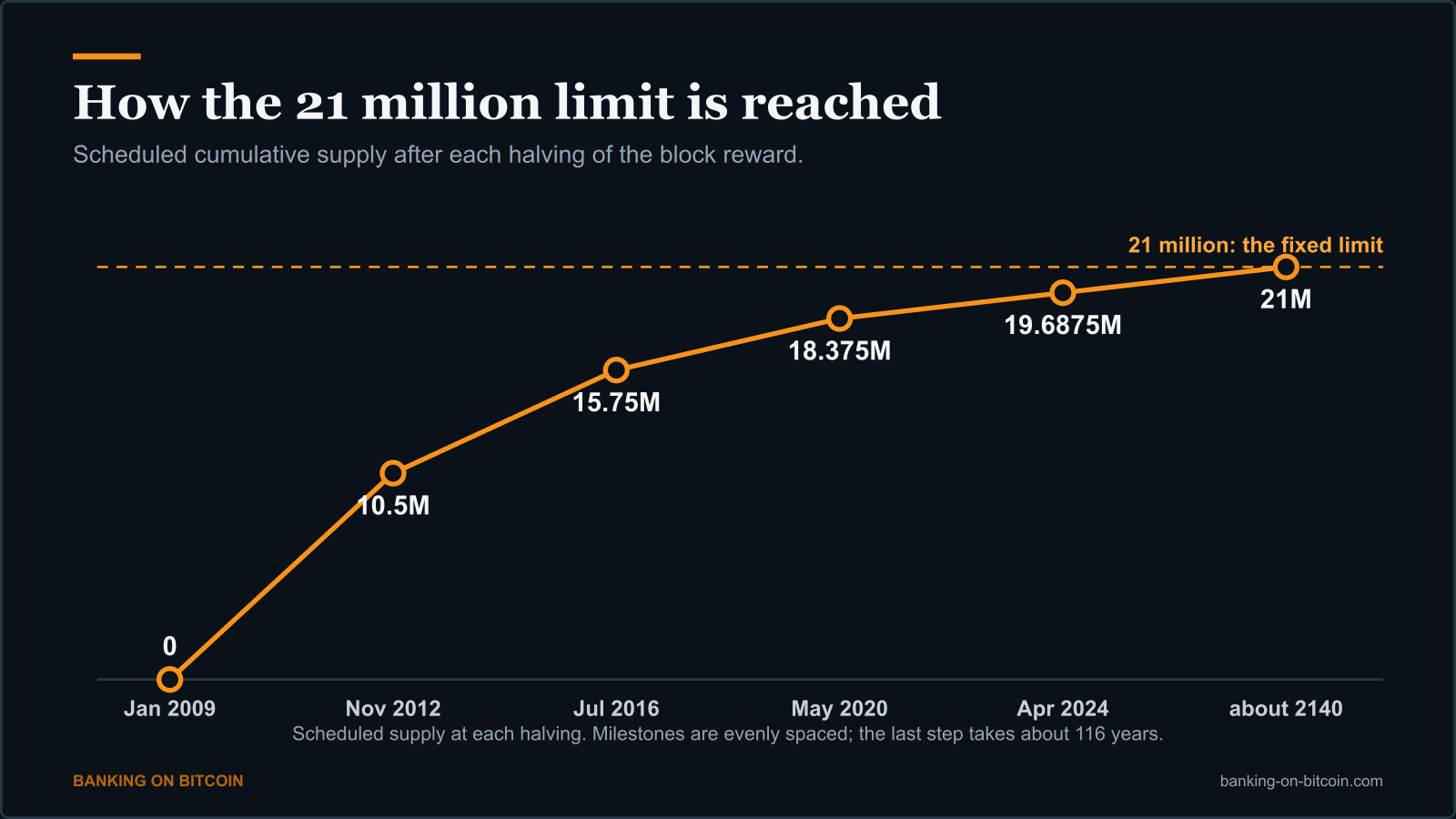
| Milestone | Scheduled cumulative supply |
|---|---|
| Jan 2009 (genesis block) | 0 |
| Nov 2012 (first halving) | 10.5 million |
| Jul 2016 (second halving) | 15.75 million |
| May 2020 (third halving) | 18.375 million |
| Apr 2024 (fourth halving) | 19.6875 million |
| About 2140 | 21 million (the fixed limit) |
What people use it for
People use Bitcoin in a few different ways, and reasonable people disagree about which matter most.
- Long-term holding. Some treat it as a store of value, similar to how others use gold, accepting large price swings in exchange for possible long-term upside.
- Sending money. Bitcoin can be sent to anyone with an internet connection, across borders, at any hour. Fees and confirmation times vary.
- Investing. Since January 2024, US-listed spot Bitcoin ETFs let people get price exposure through a regular brokerage account. See Bitcoin ETFs: What They Are and What They Mean for Investors.
Paying for everyday purchases directly with bitcoin is still uncommon in the US, and a sale of bitcoin can be a taxable event, so it is not as simple as spending dollars.
The risks, stated plainly
Bitcoin’s price can fall sharply and has done so more than once. Nobody guarantees its value, and no deposit insurance covers it.
Mistakes are usually permanent. A payment sent to the wrong address generally cannot be reversed. If you lose your private keys and have no backup, nobody can recover your bitcoin for you. Scams that target new buyers are common. And if you keep bitcoin on an exchange, you are trusting that company, which has failed in the past.
Rules and taxes also apply. In the US, bitcoin is generally treated as property for federal tax purposes, and the details depend on your situation. An overview is in Is Bitcoin Regulated in the US?.
A sensible way to learn
You do not have to decide anything about Bitcoin to learn about it. Reading, asking questions and testing your understanding costs nothing. If you later decide to buy, start small, use amounts you can afford to lose, and speak with a qualified financial or tax professional about your own situation.
New to the site? The Start Here learning path lists the four core guides in order.
Where to go next
- Why Does Bitcoin Have Value?: scarcity, trust and network effects.
- How Does Bitcoin Work? Blocks, Miners and Keys Explained: the technology in plain terms.
- How to Buy and Secure Bitcoin: A Careful Beginner’s Guide: practical steps and common scams.
- The History of Bitcoin: From a Whitepaper to a Global Network: where it came from.
- Halving and supply explorer: how the 21 million limit is reached, year by year.
- Bitcoin unit converter: convert between BTC, satoshis, millibitcoin and bits.
- Who Is Satoshi Nakamoto? What We Know and What We Don’t: the pseudonymous creator.
- Bitcoin vs Ethereum: Key Differences Explained: how Bitcoin differs from the other best-known network.
- Is Bitcoin Safe? The Real Risks and Common Scams: the risks stated plainly.
- How Many Bitcoin Are Left to Mine? The 21 Million Cap Explained: the supply schedule in detail.
- Why Is Bitcoin So Volatile? And Can Anyone Predict a Crash?: why the price swings.
- What Is a Blockchain? Bitcoin’s Ledger Explained: the data structure behind Bitcoin.
- The Bitcoin Whitepaper Explained, Section by Section: the original design.
- Bitcoin Glossary: Key Terms Explained in Plain English: the vocabulary in one place.
- The Bitcoin Genesis Block: The First Block and Its Hidden Message: where the chain began.
- What Is Cryptocurrency? How It Works and Where Bitcoin Fits: the wider field.
- Bitcoin Statistics 2026: sourced numbers on adoption, fraud, mining, ETFs, tax and regulation.
- Is Bitcoin Dead? What the Claim Means and How to Judge It: what the claim means and which network signals you can check yourself.
Related articles