Bitcoin Basics8 min read
The History of Bitcoin: From a Whitepaper to a Global Network
From the 2008 whitepaper and the genesis block to Mt. Gox, the block size debate, halvings and spot ETFs: the key milestones in Bitcoin's history.
By Christopher CannucciariPublished
On this page
Key takeaways
- Bitcoin was described in a whitepaper published on 31 October 2008 by the pseudonymous Satoshi Nakamoto, and its first block was created on 3 January 2009.
- It built on decades of earlier work in cryptography and digital cash, and its creator’s identity remains unknown.
- Its history includes failures and disputes, such as exchange collapses and the block size debate, as well as steady technical upgrades.
- Institutional acceptance grew over time, including US-listed spot Bitcoin ETFs from January 2024.
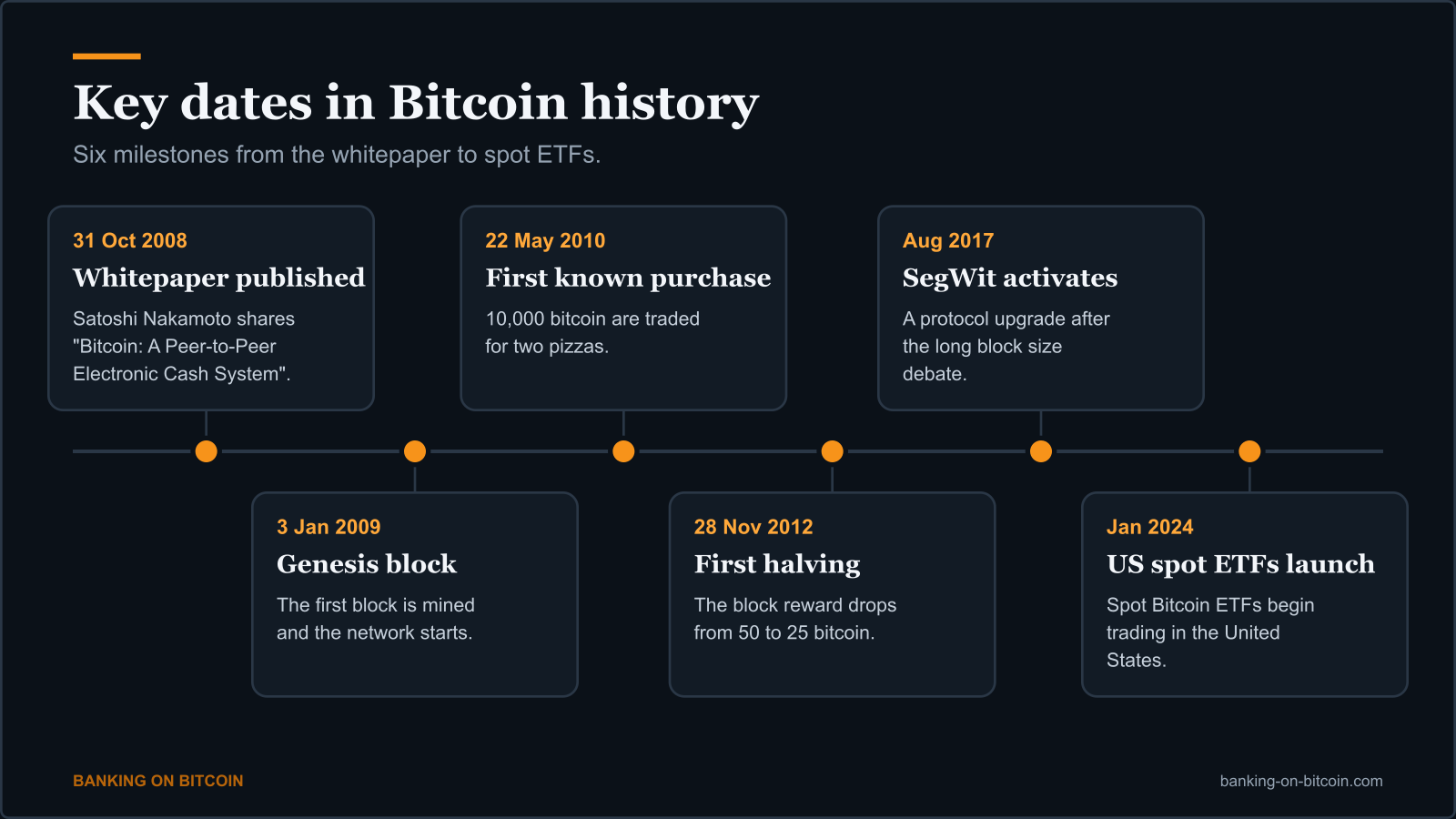
| Date | Milestone |
|---|---|
| 31 Oct 2008 | Satoshi Nakamoto publishes the Bitcoin whitepaper |
| 3 Jan 2009 | The genesis block is mined and the network starts |
| 22 May 2010 | First known purchase with bitcoin: 10,000 bitcoin for two pizzas |
| 28 Nov 2012 | First halving: the block reward drops from 50 to 25 bitcoin |
| Aug 2017 | SegWit activates |
| Jan 2024 | US spot Bitcoin ETFs begin trading |
Before Bitcoin: the search for digital cash
Bitcoin did not appear from nothing. Since the 1980s, cryptographers had been trying to build electronic money. David Chaum’s DigiCash, founded in the late 1980s, allowed private digital payments but depended on a company at the center, and it did not survive.
In the 1990s and 2000s a community known as the cypherpunks discussed privacy and cryptography on mailing lists. Several proposals came out of it. Adam Back created Hashcash, a proof-of-work system originally meant to make email spam costly. Wei Dai described b-money, and Nick Szabo described bit gold. Neither was fully built, but both explored ideas that appear in Bitcoin.
What was missing was a way to stop double spending without a central operator. That is the problem Bitcoin addressed. If you want to see the mechanism, read How Does Bitcoin Work?.
2008: the whitepaper
On 31 October 2008, someone using the name Satoshi Nakamoto sent a paper titled “Bitcoin: A Peer-to-Peer Electronic Cash System” to a cryptography mailing list. It is nine pages long and remains available at bitcoin.org/bitcoin.pdf.
The paper proposed a network of computers that would record transactions in a chain of blocks secured by proof of work, so that no trusted third party was needed. The timing coincided with the global financial crisis, which shaped how many people read the project.
2009: the genesis block
Nakamoto released the first version of the software in early January 2009. The first block, called the genesis block, was created on 3 January 2009. Embedded in it was a line of text referencing a headline from The Times of London of that date about the Chancellor considering a second bailout for banks. Many read it as both a timestamp and a comment on the banking system, though Nakamoto never spelled out the intent.
The first transaction between two different people took place on 12 January 2009, when Nakamoto sent bitcoin to Hal Finney, a well-known cryptographer and early supporter. In the earliest period, the network was tiny, and coins had no market price.
Who was Satoshi Nakamoto?
Nobody knows for certain. Nakamoto communicated by email and forum posts, never appeared publicly, and stopped participating in 2010 and 2011, handing the project to other developers. Over the years several people have been named or have claimed to be Nakamoto, and none has proven it by moving the early coins or by signing a message with the earliest keys.
The absence of a founder has consequences. There is no leader to direct Bitcoin, and no one to lean on when disagreements arise. Many supporters see that as a feature.
2010: the first real-world prices
Early on, people traded bitcoin informally on forums. On 22 May 2010, a programmer named Laszlo Hanyecz paid 10,000 bitcoin for two pizzas, one of the first widely known purchases of a physical good with bitcoin. The date is celebrated by the community each year as Bitcoin Pizza Day.
The same period saw the first online exchange markets appear. Around 2010, miners began moving from ordinary computer processors to graphics cards, the first of several hardware changes described in Inside a Bitcoin Mining Operation.
2011 to 2013: growth and growing pains
Bitcoin gained wider public attention during these years, and it attracted both enthusiasts and criminals. The Silk Road marketplace, which used bitcoin for illegal sales, operated from 2011 until US authorities shut it down in 2013. That episode fed the belief that Bitcoin is mainly a criminal tool, though its ledger’s public nature has since helped investigators trace funds. See Is Bitcoin Private? What Transactions Reveal.
The first block reward halving took place in November 2012, cutting the reward from 50 to 25 bitcoin. This was the first test of the fixed issuance schedule, and the schedule held.
2014: Mt. Gox
Mt. Gox was a Tokyo-based exchange that, at one point, handled a large share of all bitcoin trading. In early 2014 it suspended withdrawals and then filed for bankruptcy, saying a large amount of customers’ bitcoin had been lost. The failure was a lasting lesson about counterparty risk, and it is the origin of the saying “not your keys, not your coins.”
Repayment to creditors took many years. The episode is a good reason to read How to Buy and Secure Bitcoin before leaving funds on a platform.
2015 to 2017: the block size debate
Bitcoin’s blocks have a size limit, so only a limited number of transactions fit in each. As usage grew, people disagreed about how to scale. One camp wanted to increase the block size limit. Another wanted to keep blocks small to make running a node easy, and to move small payments onto separate layers.
The dispute lasted for years. In August 2017, the network activated Segregated Witness, known as SegWit, a change that fixed a technical flaw and made room for more transactions per block. That same month, a group of people who wanted larger blocks split off and created a separate currency called Bitcoin Cash. The original chain carried on as Bitcoin.
The debate showed something important: developers propose changes, but the network’s participants decide which rules to follow. It also fed work on the Lightning Network, a payment layer described in What Is the Lightning Network?, whose design paper was published in 2015.
2016 to 2020: the second and third halvings
The reward halved again in July 2016, to 12.5 bitcoin, and in May 2020, to 6.25. Each halving reduces the rate at which new bitcoin enter circulation. Debate continues over how halvings relate to price, and no simple cause and effect has been established.
Between those halvings, interest from retail traders, and later from companies and investment firms, increased. Exchanges such as Coinbase, founded in 2012, grew into large, regulated businesses in the US.
2021: Taproot and El Salvador
In November 2021, Bitcoin activated Taproot, an upgrade that improved privacy and flexibility for certain kinds of transactions. It was adopted through a process where miners and node operators signaled support over a period of time, and it was one of the more widely supported upgrades in the network’s history.
In September 2021, El Salvador made bitcoin legal tender alongside the US dollar, the first country to do so. The policy drew attention and criticism, including from international financial institutions, and its rules were later changed. It is a useful case study on the difference between legal status and everyday use. For the wider question of how governments treat it, see Bitcoin’s Role in a Changing Global Economy.
2022: a hard year for the industry
In 2022 several large crypto companies failed. The most prominent was the exchange FTX, which filed for bankruptcy in November 2022 (a timeline of the FTX case is in a separate guide). These failures involved companies holding customer assets, not flaws in Bitcoin’s protocol, but they hurt confidence in the wider sector and led to calls for tighter regulation. They also reinforced the custody lessons of Mt. Gox.
2024: spot ETFs and the fourth halving
In January 2024, the US Securities and Exchange Commission allowed exchange-traded products holding bitcoin directly to begin trading. These spot Bitcoin ETFs let people gain exposure through ordinary brokerage accounts. Details are in Bitcoin ETFs: What They Are and What They Mean for Investors.
In April 2024, the fourth halving cut the block reward to 3.125 bitcoin.
What the history teaches
A few themes recur across these years.
- Rules rarely change. Bitcoin’s core features, including the supply cap, have stayed stable, while changes have come slowly and with much argument.
- Failures have mostly been at the edges. The largest losses came from exchanges and scams rather than from a break in the ledger.
- Trust has moved from an unknown to a track record. After more than fifteen years of continuous operation, Bitcoin’s record is easier to assess, but that is not a guarantee about the future.
None of this predicts what will happen next, and this article makes no forecasts. For what gives Bitcoin its worth, read Why Does Bitcoin Have Value?. New readers can start with What Is Bitcoin? or the Start Here path.
Where to go next
- What Is Bitcoin? A Plain-English Introduction: the fundamentals.
- How Does Bitcoin Work? Blocks, Miners and Keys Explained: the technology behind the timeline.
- Inside a Bitcoin Mining Operation: how the halving and hardware changes play out.
- Bitcoin ETFs: What They Are and What They Mean for Investors: the 2024 milestone in detail.
- Halving and supply explorer: every halving, its block height and reward in one place.
- Who Is Satoshi Nakamoto? What We Know and What We Don’t: the creator behind the whitepaper.
- What Is the Bitcoin Halving?: the four halvings explained.
- Bitcoin Forks Explained: Soft Forks, Hard Forks and Chain Splits: how Bitcoin’s rules change.
- What Is Taproot? Bitcoin’s 2021 Upgrade Explained: the most recent major upgrade.
- The Bitcoin Whitepaper Explained, Section by Section: the original design.
- Bitcoin Pizza Day: The Famous First Purchase and What It Teaches: an early milestone.
- The Bitcoin Genesis Block: The First Block and Its Hidden Message: where the chain began.
- What Is Bitcoin Cash? How It Differs From Bitcoin: the 2017 split explained.
- Is Bitcoin Dead? What the Claim Means and How to Judge It: what the claim means and which network signals you can check yourself.
Related articles