Technology6 min read
How Does Bitcoin Work? Blocks, Miners and Keys Explained
A plain-English walkthrough of transactions, the blockchain, mining and private keys, and how they let strangers agree on who owns what.
By Christopher CannucciariPublished
On this page

Key takeaways
- Bitcoin is a shared ledger of who owns what. Thousands of computers keep identical copies and check each other’s work.
- Transactions are grouped into blocks roughly every 10 minutes. Each block is linked to the one before it, forming the blockchain.
- Miners compete to add blocks, which makes rewriting history extremely expensive.
- Owning bitcoin means controlling private keys. Whoever holds the keys can spend the coins.
The problem Bitcoin solves
Digital files are easy to copy. If money were just a file, you could copy it and spend it twice. This is called the double-spending problem. Traditionally banks solve it by keeping the master ledger: when you pay someone, the bank subtracts from your balance and adds to theirs.
Bitcoin solves it without a central ledger keeper. Everyone holds a copy of the ledger, and clear rules decide which version is the true one. The rest of this guide explains those pieces.
Keys and addresses: proving ownership
Bitcoin uses public key cryptography. A wallet creates a pair of linked numbers: a private key and a public key. An address, which is what you share to receive money, is derived from the public key.
You can think of the address as a mailbox slot that anyone can drop money into, and the private key as the only thing that opens it. When you spend, you create a digital signature with your private key. Anyone can verify the signature is valid without learning the key itself.
This is why “not your keys, not your coins” is a common saying. If someone else holds your keys, such as an exchange, you are relying on them. See How to Buy and Secure Bitcoin and The Power of Self-Custody.
Most wallets do not ask you to handle a raw key. They give you a list of words, called a recovery phrase or seed phrase, that can regenerate all your keys. Whoever has those words can take your bitcoin.
What a transaction is
A transaction is a signed message that says, in effect, “move this bitcoin from these owners to these new owners.” Bitcoin does not use account balances the way a bank does. Instead, it tracks unspent outputs, sometimes shortened to UTXOs.
A useful comparison is cash. If you hold a $20 bill and buy a $12 item, you hand over the $20 and get $8 in change. Bitcoin works similarly: a transaction spends an earlier output and creates new ones, including change back to you. Your wallet handles this and displays a simple balance.
You also attach a fee. Fees go to miners and vary with how busy the network is, so check current levels in your wallet rather than trusting any fixed number.
From transaction to block
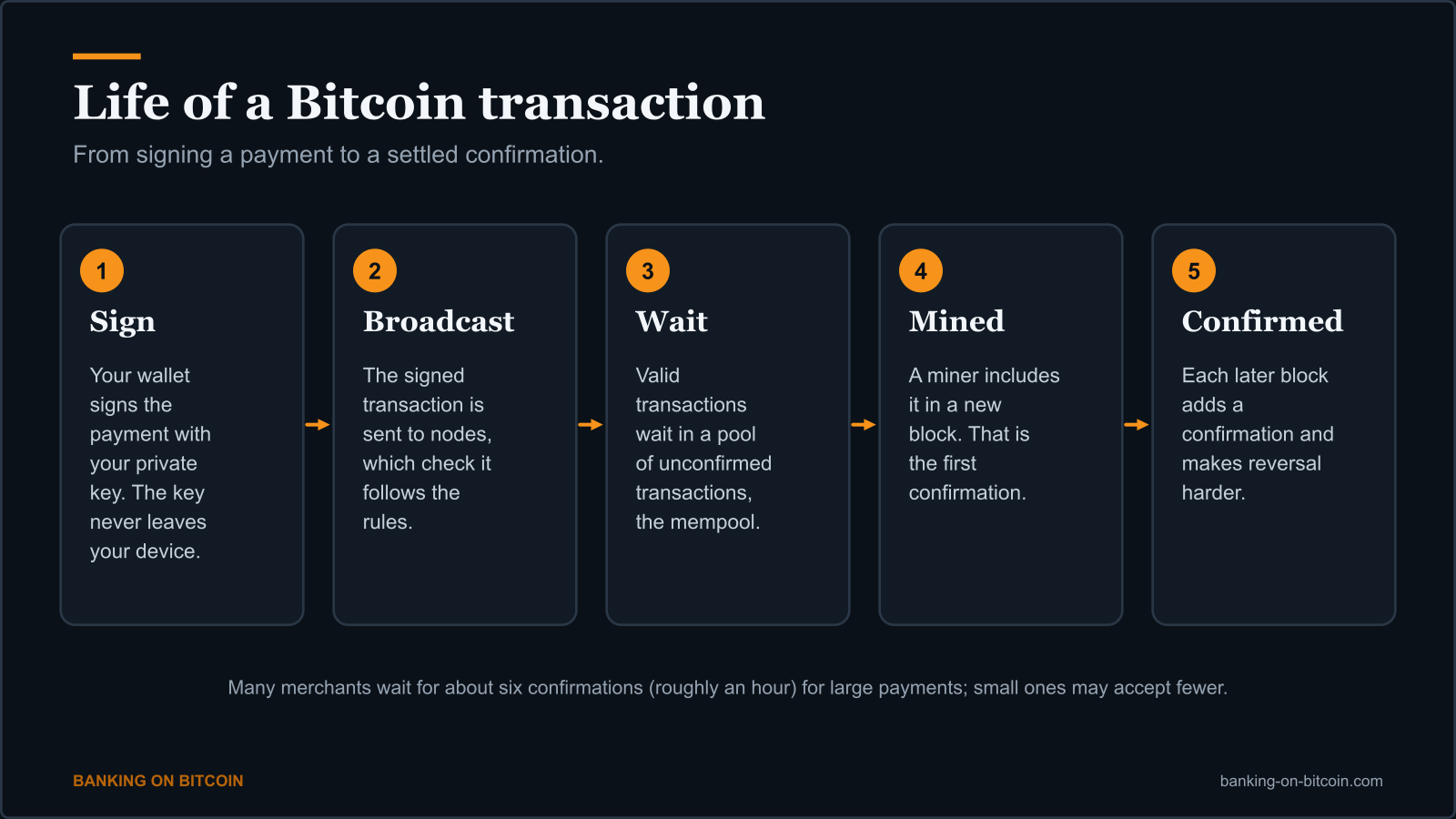
After you broadcast a transaction, nodes check it. Is the signature valid? Do the coins exist and are they unspent? If so, the transaction waits in a pool of pending transactions.
Miners pick transactions from that pool and bundle them into a candidate block. About every 10 minutes on average, one miner succeeds in publishing a valid block, and it gets added to the chain. A transaction inside a block is said to have one confirmation. Each later block adds another.
Many services treat six confirmations, roughly an hour, as very safe for large payments, though the number people wait for varies with the amount and their risk tolerance.
The blockchain
Each block contains a fingerprint, called a hash, of the previous block. A hash is a short string generated from data. Change any part of the data and the fingerprint changes completely.
Because each block includes the previous fingerprint, blocks form a chain. Altering an old transaction would change that block’s fingerprint, breaking every block after it. To make the tampering stick, an attacker would need to redo all the work for that block and everything since, faster than the honest network keeps adding new ones.
Mining and proof of work
Mining is the competition to add the next block. To qualify, a miner must find a number that, when combined with the block’s data, produces a hash below a target. There is no shortcut: the only method is to guess trillions of times. That guessing is called proof of work.
Finding the answer is hard, but checking it is easy. Any node can verify a miner’s work in an instant.
The network adjusts the difficulty of this puzzle every 2,016 blocks, about every two weeks, so that blocks arrive roughly every 10 minutes regardless of how many miners join or leave.
The winning miner collects the block subsidy, newly created bitcoin, plus the transaction fees. The subsidy is cut in half every 210,000 blocks, roughly every four years, and this is what leads to the 21 million cap. The industry side is covered in Inside a Bitcoin Mining Operation.
Nodes: the referees
Miners do not make the rules. Nodes do. A node is a computer running Bitcoin software that stores the ledger and checks every block against the rules. If a miner produced a block that paid itself extra coins, nodes would reject it and the miner would have wasted its money.
Anyone can run a node, and this is what keeps miners honest.
Why the ledger is hard to cheat
Two things work together. Rewriting history requires redoing enormous amounts of proof of work, and the rules are enforced by many independent nodes rather than one authority. A dishonest party would need overwhelming computing power, and even then could not create coins beyond the cap or spend coins they do not control.
That does not make everything risk-free. Software bugs, exchange failures and scams can still cost people their money, and these risks are usually at the edges of the system, not in the ledger itself.
What the ledger reveals
Every transaction is public. Addresses are not names, but they can often be linked to people through exchanges or careless reuse. See Is Bitcoin Private? What Transactions Reveal.
Faster payments on top
Base-layer Bitcoin handles a limited number of transactions per block. A separate layer built on top, called the Lightning Network, aims to make small and fast payments cheaper. It has its own trade-offs, covered in What Is the Lightning Network?.
If you want the big picture before the technical details, start with What Is Bitcoin? or the Start Here path.
Where to go next
- How to Buy and Secure Bitcoin: A Careful Beginner’s Guide: put the knowledge to work safely.
- Inside a Bitcoin Mining Operation: hardware, energy and the halving.
- What Is the Lightning Network?: payments built on Bitcoin.
- The Power of Self-Custody: Owning Your Own Keys: more on keys and recovery phrases.
- What Is a Bitcoin Address?: how addresses receive payments.
- Bitcoin Fees Explained: why transactions pay miners.
- Proof of Work vs Proof of Stake: What’s the Difference?: how networks agree on one history.
- Could Quantum Computers Break Bitcoin? An Honest Explainer: which parts of the design are exposed in theory.
- What Is a Bitcoin Node? What Running One Means: who checks the rules.
- What Is a UTXO? How Bitcoin Tracks Ownership: why there are no account balances.
- What Is a Blockchain? Bitcoin’s Ledger Explained: the data structure behind Bitcoin.
- What Is the Bitcoin Mempool? Why Transactions Wait: why a transaction can be pending.
- Bitcoin Glossary: Key Terms Explained in Plain English: the vocabulary in one place.
- What Is a Bitcoin Block? Size, Time and What’s Inside: the unit of the chain.
- What Is a Bitcoin Transaction ID (TXID)? How to Read One: tracking a payment.
- How Long Does a Bitcoin Transaction Take? Confirmations and Fees Explained: why waits vary.
- What Is Bitcoin Mining? How It Works, Step by Step: the steps from transaction to block, in plain language.