Investing5 min read
Is Bitcoin Regulated in the US? A Plain-English Overview
Bitcoin is legal to own in the US, treated as property for tax, and touched by several agencies. Here is a plain overview of who does what.
By Christopher CannucciariPublished
On this page

Key takeaways
- Owning, buying and selling Bitcoin is legal for individuals in the US. There is no single “Bitcoin law”; several agencies apply existing rules.
- For federal tax purposes, the IRS treats bitcoin as property, not currency. Selling or spending it can create a taxable event.
- The SEC and CFTC have different roles, and the details of who oversees which crypto activity continue to be debated and to change.
- Exchanges that serve US customers generally verify identity and follow anti-money-laundering rules. Rules evolve, so check current guidance and consult a professional for your own situation.
Legal to own, with rules around the edges
If you are wondering whether Bitcoin is legal in the US, the short answer for ordinary individuals is yes. You can buy it, hold it, sell it and, if a merchant accepts it, spend it. Bitcoin is not issued or backed by the government, and it is not legal tender in the way US dollars are, but nothing prevents you from owning it.
What the US has instead of one comprehensive Bitcoin statute is a patchwork. Agencies apply existing laws on taxes, securities, commodities, money transmission and financial crime. Congress and regulators continue to consider new rules, so the exact picture changes over time.
Taxes: bitcoin as property
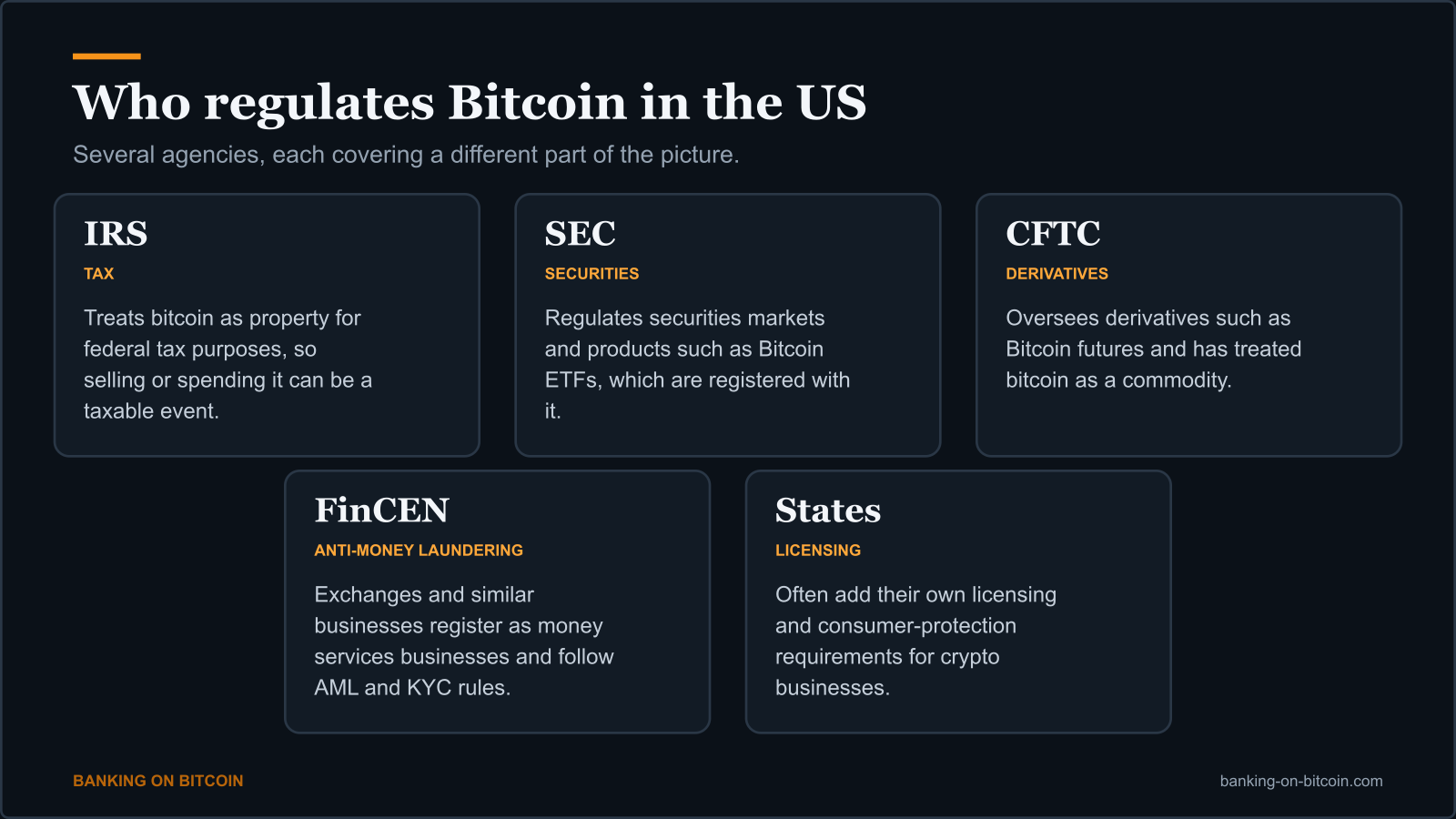
The IRS has said that virtual currency is treated as property for federal tax purposes. In practice, that means general property rules apply. If you sell bitcoin for dollars, trade it for another asset, or use it to pay for goods, that can be a taxable event, and you may have a gain or loss depending on what you originally paid.
Simply buying bitcoin with dollars and holding it is not, by itself, generally a taxable disposal. Records matter: keeping track of when you acquired coins, what you paid and what you did with them makes reporting far easier. Tax forms ask about digital assets, and the reporting requirements have been expanding. The IRS website at https://www.irs.gov/ is the place to check current guidance, and a qualified tax professional can apply it to your circumstances.
The SEC and the CFTC
Two federal agencies come up most often.
The Securities and Exchange Commission (SEC) regulates securities. Whether a particular crypto asset counts as a security has been a contested question for many tokens. Bitcoin, though, has generally been treated differently from most other crypto assets, and US spot Bitcoin ETFs began trading in January 2024 under SEC oversight. Those funds are securities, even though the bitcoin they hold is not. The difference is explained in Bitcoin ETFs: What They Are and What They Mean for Investors. The SEC’s home page is https://www.sec.gov/.
The Commodity Futures Trading Commission (CFTC) regulates derivatives markets, such as futures. It has treated bitcoin as a commodity, and it has authority over bitcoin futures and related derivatives. Its authority over the ordinary buying and selling of the underlying asset has been more limited, which is one reason lawmakers have discussed clarifying roles.
The important takeaway is that the boundaries between agencies are not fully settled, and they can shift through new laws, court decisions and agency actions.
Exchanges, KYC and anti-money-laundering
Most people encounter regulation when they open an account at an exchange. Businesses that exchange or transmit crypto for customers are generally treated as money services businesses at the federal level, and they must register with FinCEN, a bureau of the US Treasury, and follow anti-money-laundering rules. States often add their own licensing requirements as well.
In practice this means you will probably be asked to verify your identity with documents, a process known as know-your-customer, or KYC. The exchange may monitor activity and report certain suspicious transactions. This link between your identity and your withdrawal addresses is a large part of why Bitcoin is pseudonymous rather than anonymous, as described in Is Bitcoin Private?.
Regulation does not protect you from every loss. An exchange can fail or be hacked, and bitcoin held there is not covered by the deposit insurance that applies to bank accounts. Holding your own keys avoids counterparty risk while adding personal responsibility, discussed in The Power of Self-Custody.
Self-custody and rules
Holding bitcoin in your own wallet is legal in the US. The regulatory questions around software wallets and non-custodial services have been an area of active debate, so it is worth keeping an eye on developments if you use them heavily.
States and other countries
State rules differ, and some add licensing regimes for crypto businesses. Outside the US the situation varies widely, from friendly to restrictive. This article covers the US only. If you live elsewhere or move, check local rules.
Staying current
Crypto regulation is one of the faster-changing areas of finance. Use this overview as orientation and confirm details with the primary sources: the IRS for tax guidance, the SEC and CFTC for their statements, and your state’s financial regulator. If you hold meaningful amounts or run a business that touches crypto, a qualified tax adviser or attorney can give guidance tailored to you.
New to the topic? The Start Here path walks through the fundamentals in order.
Where to go next
- Bitcoin ETFs: What They Are and What They Mean for Investors for how regulated funds hold bitcoin.
- Is Bitcoin Private? for how KYC links identity to on-chain activity.
- How to Buy and Secure Bitcoin for a careful walkthrough of buying through a regulated exchange.
- Can You Buy Bitcoin in an IRA? for how retirement accounts fit in.
- How Is Bitcoin Taxed in the US? A General Guide: taxable events, cost basis and records.
- Bitcoin ATMs: How They Work, What They Cost and the Scams to Avoid: identity rules and kiosks.
- Is Bitcoin Mining Legal? What the Rules Cover: the rules for individuals and businesses.
- The US Strategic Bitcoin Reserve: What the Order Says and What It Doesn’t: what the March 2025 executive order says about forfeited coins, selling and buying.