Technology9 min read
Inside a Bitcoin Mining Operation
What Bitcoin miners actually do, how proof of work and ASICs function, why mining uses so much energy, and how halvings change the economics.
By Christopher CannucciariPublished
On this page
Key takeaways
- Miners collect pending transactions into blocks and compete to add the next block to the chain. The winner earns newly issued bitcoin plus the transaction fees in that block.
- The competition is proof of work: machines guess numbers at enormous speed until one produces a result that meets a difficulty target. The work is costly to do and easy for everyone else to verify.
- Specialized chips called ASICs dominate mining. Profit depends on hardware efficiency, electricity cost and the price of bitcoin, and margins can be thin.
- Difficulty adjusts automatically so blocks arrive about every ten minutes, regardless of how many machines join. The block reward halves every 210,000 blocks, roughly every four years.
- Energy use is the central criticism. Supporters and critics disagree about whether it is a fair price for the security it buys.
What miners do
Bitcoin has no central operator to decide which transactions are valid or in what order they happened. Miners solve that problem. They gather unconfirmed transactions, check that each one follows the rules, and bundle them into a candidate block. Then they try to earn the right to publish that block.
The prize is the block reward. It has two parts: the subsidy, which is newly issued bitcoin, and the fees users attached to the transactions in the block. This is the only way new bitcoin enters circulation. If you want the overview of how blocks, transactions and keys fit together first, How Does Bitcoin Work? is the place to start.
Miners do not have the power to create coins outside the schedule or to spend other people’s coins. Every node on the network checks each block against the rules, and a block that breaks them is rejected no matter how much work went into it.
Proof of work in plain terms
To publish a block, a miner must find a number, called a nonce, that when combined with the block’s contents and run through a hash function produces an output below a target value. A hash function turns any input into a fixed-length string that looks random, and Bitcoin uses SHA-256 for this. There is no known shortcut. The only way to find a valid result is to try nonces until one works, like rolling dice until you get an unusually low total.
Because each attempt is unpredictable, finding a valid block is a matter of probability. A miner with more computing power makes more attempts per second, so it wins proportionally more often. But no miner is guaranteed to win, and even a small miner has some chance in any given round.
Then comes the important asymmetry. Finding a valid answer takes enormous effort, but checking it takes one hash calculation. Anyone can confirm in an instant that the work was done. That makes the block’s cost real and its validity obvious, and it is what the network relies on to agree on one history without trusting anyone.
Proof of work also gives the chain its resistance to rewriting. To change an old transaction, an attacker would have to redo the work for that block and all the blocks after it, faster than the honest network keeps adding new ones. The more blocks that pile on top of a transaction, the more costly that becomes.
Difficulty and the ten-minute rhythm
The network aims for one block roughly every ten minutes. It maintains this target with the difficulty adjustment. Every 2,016 blocks, which is about two weeks at the intended pace, the protocol compares how long those blocks actually took and changes the difficulty. If miners added machines and blocks came faster than ten minutes, difficulty rises. If machines left and blocks slowed, it falls.
This is why the number of machines does not change the issuance schedule. More competition makes each attempt harder to win, not the coins more plentiful. It is also why a sudden drop in mining, for example after a country bans it, causes a temporary slowdown and then a correction. Something like this happened in 2021, when China cracked down on mining and many operators relocated, after which the network recovered.
From laptops to ASICs
In the early years, people mined with ordinary computer processors. Over time the competition pushed miners to graphics cards, then to programmable chips, and then to ASICs, which are application-specific integrated circuits built to do one thing, compute SHA-256 hashes, as efficiently as possible. A general-purpose computer cannot compete with them at that task.
An ASIC miner is a box with chips, a power supply and fans, drawing electricity continuously and producing heat. Newer generations are more efficient, meaning more hashes for each unit of energy, so older machines gradually become unprofitable. Miners therefore live on an upgrade treadmill, and their business resembles heavy industry more than software. Hardware manufacturing is concentrated in a small number of companies, which critics point to as a centralization concern.
Inside a facility
A large mining site is mostly a power and cooling problem. Machines sit in racks in warehouse-style buildings, or in containers, connected to a large electricity supply. Most of the electricity consumed leaves as heat, so operators use fans, evaporative cooling or immersion cooling, in which machines are submerged in a non-conductive fluid.
Operators care about a few numbers: the price they pay per unit of electricity, the efficiency of their machines, how reliably the machines stay online, and the cost of capital. Electricity is usually the largest ongoing cost, so miners seek out cheap power. Sites tend to appear near hydroelectric dams, wind and solar projects with excess generation, and regions with low industrial power prices.
Very few miners work alone. Because the chance of winning a block is small for any one machine, most join mining pools. The pool combines the work of many participants and splits the reward in proportion to their contribution, so a small miner receives a steady trickle of income instead of a rare large payout. The tradeoff is that pools concentrate some decision-making power, though individual miners can generally switch pools if they disagree with one.
Some mining companies are publicly traded, which means their business results, debts and hardware purchases are disclosed in regulatory filings. Others are private operations or individuals with a few machines at home.
The economics and the halving
A miner’s profit is the value of the rewards earned minus electricity, hardware costs, facility costs and financing. Because bitcoin’s price fluctuates and difficulty keeps adjusting, this can swing quickly. When prices fall or difficulty rises, the least efficient miners can run at a loss and switch off. Mining companies have gone bankrupt in downturns.
The subsidy is programmed to halve every 210,000 blocks, which works out to about every four years. It started at 50 bitcoin per block in 2009 and has been cut in half repeatedly, most recently in April 2024, when it fell to 3.125. This process continues until the subsidy reaches zero, around the year 2140, and total supply approaches 21 million. See Why Does Bitcoin Have Value? for how this scarcity fits into the case for Bitcoin.
After each halving, miners’ revenue in bitcoin terms drops in half overnight. Whether they stay profitable depends on whether the price or fees rise, or whether they become more efficient. Some miners exit after halvings, and efficient ones tend to stay.
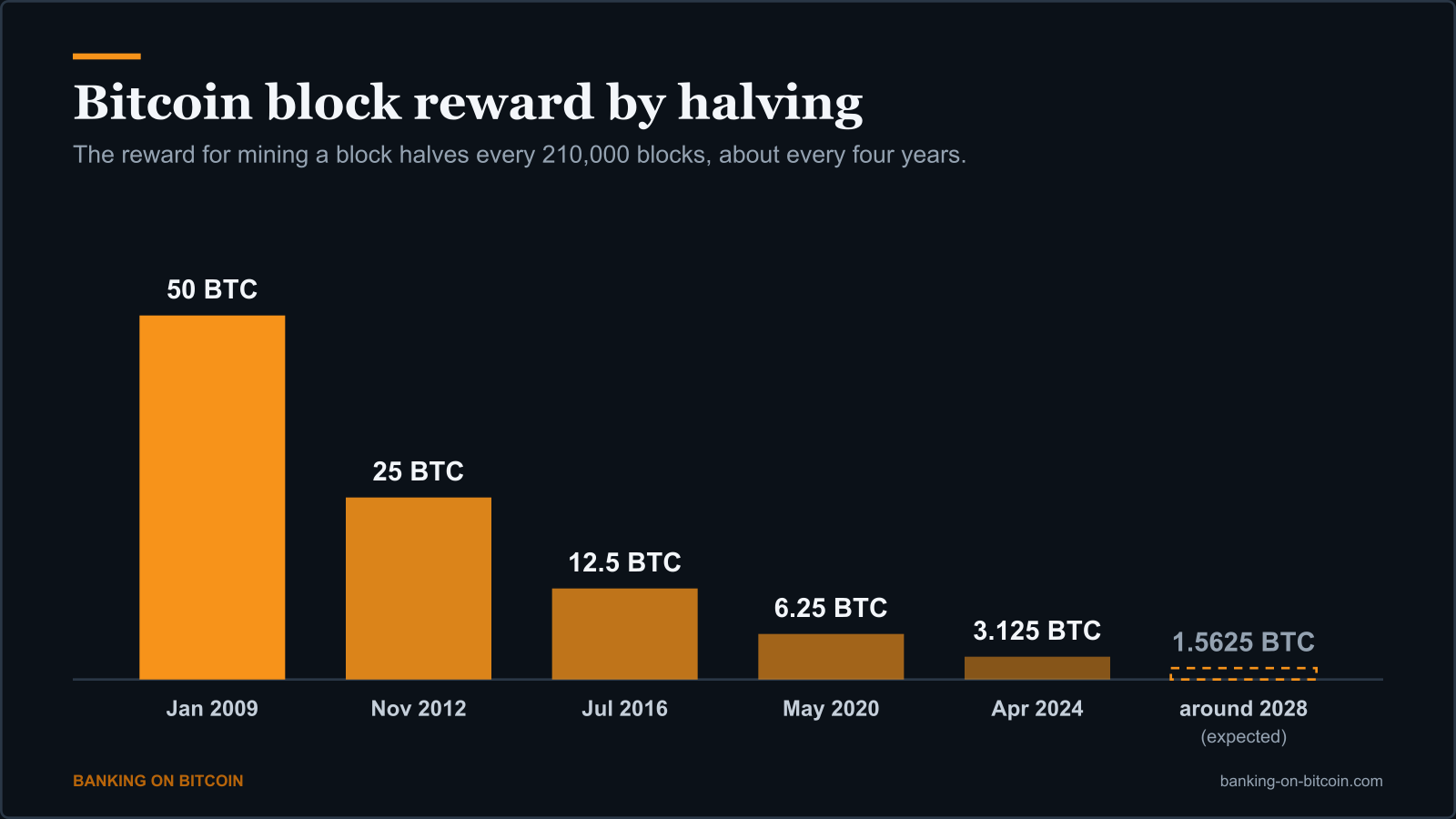
| Period | Reward per block |
|---|---|
| Jan 2009 to Nov 2012 | 50 BTC |
| Nov 2012 to Jul 2016 | 25 BTC |
| Jul 2016 to May 2020 | 12.5 BTC |
| May 2020 to Apr 2024 | 6.25 BTC |
| Apr 2024 to about 2028 | 3.125 BTC |
The energy debate
Proof of work is deliberately expensive. Its security comes from the fact that attacking it would require spending real resources, and those resources are largely electricity. So Bitcoin mining uses a large amount of power, which is not a side effect but a core property of the design.
Critics raise several points. The consumption is substantial, and where power comes from fossil fuels it adds emissions. Mining can raise local electricity prices, and noise from facilities has generated complaints from nearby residents. They also argue that the same security might be achievable with less energy, pointing to other systems that use different consensus methods.
Defenders respond that miners chase the cheapest power and so favor sources that are otherwise stranded or underused. Some operations use natural gas that would otherwise be burned off at oil wells, and some in Texas act as flexible loads that can shut down quickly when the grid is strained, which grid operators can use. They also argue that Bitcoin’s security is worth what it costs, comparing it to the resources consumed by the traditional financial system.
Neither side’s headline claims are settled. The share of mining powered by renewable energy is estimated differently by different researchers, and the estimates change over time, so treat any single figure with caution and check the source and date. What is clear is that the tradeoff is central to any honest assessment of Bitcoin, and that it is a values question as well as an engineering one.
Open questions
Two questions shape the future of mining.
The first is security funding. As the subsidy shrinks, fees must eventually provide more of the miners’ income, or the cost of attacking the network could decline. Whether fee revenue will be enough is unknown, and it is one of the strongest long-term critiques of the design. It will not be tested fully for decades.
The second is centralization. Mining involves scale advantages: cheap power, bulk hardware and access to capital. Pools and equipment makers are concentrated in a few hands, and regulators in some countries can pressure large operators. Because ordinary users can still verify the rules with their own nodes, the miners do not control the rules, but their concentration remains a topic of ongoing debate.
To place mining within the bigger picture of the economy, see Bitcoin’s Role in a Changing Global Economy. If you are new to the subject, Start Here offers an ordered learning path. Mining as a business carries substantial financial risk, and anyone considering it should consult a qualified professional first.
Where to go next
- How Does Bitcoin Work?: blocks, transactions and keys in the broader system.
- The History of Bitcoin: from the first block in January 2009 to today.
- Why Does Bitcoin Have Value?: how the supply schedule and network effects fit together.
- Bitcoin’s Role in a Changing Global Economy: the wider economic case and its limits.
- Halving and supply explorer: see the block reward and how much bitcoin exists for any year or block height.
- What Is the Bitcoin Halving?: the concept and history of the reward cut.
- Proof of Work vs Proof of Stake: What’s the Difference?: why Bitcoin chose proof of work.
- How Many Bitcoin Are Left to Mine? The 21 Million Cap Explained: what happens as issuance winds down.
- Bitcoin Hash Rate and Mining Difficulty Explained: the numbers that set the pace of mining.
- How Long Does It Take to Mine a Bitcoin?: why solo mining takes so long.
- Bitcoin’s Energy Use: What the Debate Is Really About: the arguments on both sides.
- Is Bitcoin Mining Legal? What the Rules Cover: the rules for individuals and businesses.
- Bitcoin Mining Pools Explained: How Miners Share the Work and the Reward: why most miners join a pool.
- Is Bitcoin Mining Profitable? What Decides the Outcome: the economics of mining.
- How to Mine Bitcoin at Home: What You Need and What to Expect: a realistic view of small setups.