Security9 min read
The Power of Self-Custody: Owning Your Own Keys
What it means to hold your own Bitcoin keys, how hardware wallets, seed phrases and multisig work, and the real risks of doing it yourself.
By Christopher CannucciariPublished
On this page

Key takeaways
- Bitcoin is controlled by private keys. Whoever holds the keys controls the coins, whether that is you or a company holding them for you.
- Self-custody removes the risk of an exchange failing or freezing your account, but it replaces that with a new set of risks: loss, theft, mistakes and death without a plan.
- A hardware wallet keeps keys on a dedicated device, and a seed phrase is the backup that can restore them. Protecting that phrase is the main job.
- Multisig spreads control across several keys so no single mistake is fatal, at the cost of extra complexity.
- Custody is not all or nothing. Many careful people hold a small amount for convenience on an exchange and the rest themselves, and the right split is personal.
What “holding” Bitcoin actually means
Bitcoin does not live in a wallet the way cash lives in a physical one. The coins are entries on a shared public ledger, and what you hold is the ability to authorize moving them. That ability is a private key, a very large secret number that produces digital signatures. Whoever can produce the signature can spend the coins, and the network cannot tell whether that person is the rightful owner or a thief.
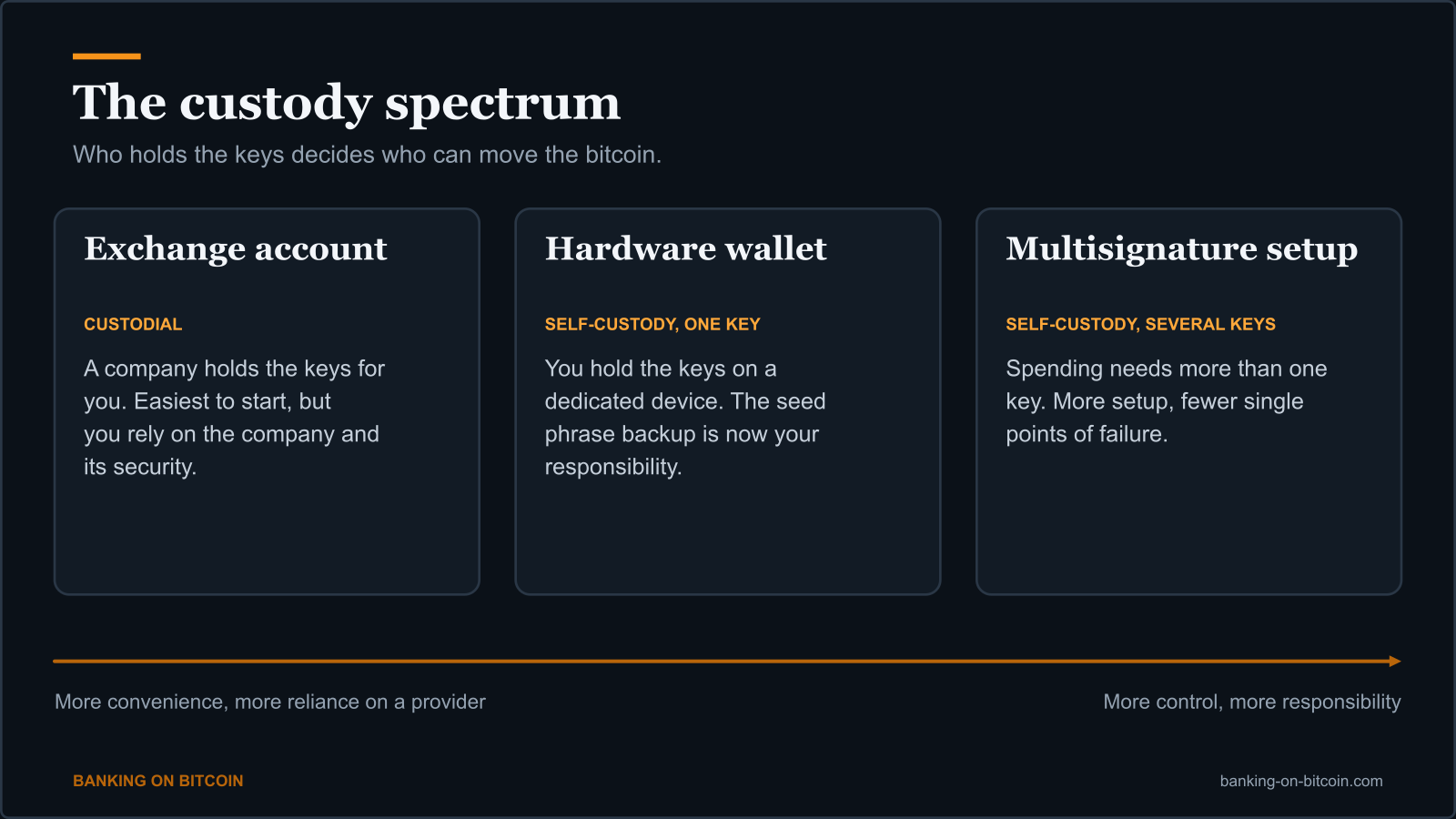
The phrase “not your keys, not your coins” comes from this fact. When you buy Bitcoin on an exchange, the exchange usually keeps the keys and records a balance in your name in its own database. You hold a claim on the exchange, not the coins directly. That claim is only as good as the exchange’s honesty, solvency and security. Several large exchanges have failed or frozen withdrawals over the years, and customers have lost money as a result. If you want the background on how keys and transactions fit together, How Does Bitcoin Work? walks through it.
Self-custody means you keep the keys yourself. No company can freeze, lend out or lose your coins because they never had them. That is the entire appeal, and the entire responsibility.
The trade you are making
It is worth being blunt about the trade. With an exchange or another custodian, if you forget your password you can usually recover the account. There is customer support, an identity check and a reset process. With self-custody, there is nobody to call. If the keys are gone, the coins are gone for good. There is no chargeback and no recovery service that can restore access to keys nobody has.
This risk is not theoretical. Some coins have been lost permanently when people misplaced hard drives, forgot passwords or died without leaving instructions. Others have been stolen by people who tricked owners into typing their seed phrase into a fake website or app. Self-custody trades company risk for personal risk, and for many people that is a worse trade unless they are willing to take the process seriously.
A middle path exists. Some people leave a small spending amount on an exchange and hold the bulk themselves. Others use a regulated custodian and accept counterparty risk in exchange for professional handling. Neither is wrong, but each has its own failure modes, and the choice depends on how much you hold and how confident you are with the process. How to Buy and Secure Bitcoin covers the exchange side and the first steps of this decision.
Wallets: software, hardware and what they really do
A wallet is software or a device that manages keys and builds transactions. There are two broad types.
A software wallet, sometimes called a hot wallet, runs on a phone or computer connected to the internet. It is convenient, but if the device is infected with malware, the keys can be exposed. It suits small amounts you expect to spend.
A hardware wallet is a small dedicated device that stores keys and signs transactions internally, so the keys never reach your computer. When you send Bitcoin, you connect the device, check the transaction details on its own screen and approve it there. Even if your computer is compromised, an attacker generally cannot spend the coins without the physical device and its approval. Hardware wallets are widely regarded as a sound choice for larger holdings, but they are not magic. You should buy them directly from the maker, since tampered devices resold by third parties are a known scam, and you should verify a transaction on the device screen, not just on the computer.
Seed phrases: the backup that is also the risk
When you set up most wallets, you are shown a seed phrase, typically 12 or 24 ordinary words. This phrase can regenerate all the keys in the wallet. It is your backup if the device is lost, broken or stolen. It is also a complete copy of your money: anyone who sees the phrase can take everything without the device.
That dual nature shapes good practice:
- Write the phrase on paper, or stamp it on metal if you worry about fire and water, and store it somewhere secure.
- Never photograph it, type it into a cloud note, email it or store it in a password manager connected to the internet.
- No legitimate wallet maker, support agent or exchange will ever ask you for your seed phrase. Anyone who does is attempting theft.
- Test your backup before relying on it. With a small amount, you can restore the wallet from the phrase on a second device to confirm the words are recorded correctly.
Some wallets support an optional passphrase, sometimes called a 25th word, which adds a further layer. It increases protection but also creates one more thing to forget. If you lose the passphrase, the phrase alone cannot recover the funds.
Multisig: removing the single point of failure
With a standard wallet, one key controls everything. If it is lost or stolen, that is the end. Multisignature, or multisig, wallets require several keys to approve a transaction. A common setup is two of three: three keys exist, held on separate devices and in separate locations, and any two together can spend.
This is meaningfully safer. Losing one key does not lose the funds, and a thief who steals one key cannot spend. It can also allow a family member or a trusted service to hold one key without being able to move the coins alone.
The cost is complexity. Multisig needs more devices, more backups and a record of the wallet’s configuration, and mistakes in setup can lock funds. It also demands more care when you use it. It tends to make sense for larger holdings and for people willing to learn it properly, and it is overkill for a small balance.
Inheritance: the part people skip
If you are the only person who can access your Bitcoin and something happens to you, your family may not be able to recover it. Unlike a bank account, there is no probate process that can force a company to hand over funds, because no company holds them.
Good planning is unglamorous. Family members need to know that the Bitcoin exists and where the instructions are, without the instructions themselves sitting in plain view. Some people leave written instructions with a lawyer, use a multisig arrangement where an executor or trusted person holds one key, or explain the recovery process to a person they trust. The details depend on your family and jurisdiction, and estate rules differ from state to state, so an estate attorney familiar with digital assets can help you set this up properly.
Common ways people lose coins
Most losses fall into a few patterns, and they are mostly avoidable.
Phishing is common: fake wallet websites, cloned apps, and messages that impersonate support staff and ask you to “verify” your seed phrase. Address-swapping malware can change a copied receiving address to an attacker’s. Sending funds to a wrong or mistyped address cannot be reversed. Physical loss, fire and flood destroy the only copy of a backup. And a surprisingly common cause is a plain lack of a plan: a phrase written down in a place nobody remembers.
Sensible habits reduce the risk. Send a small test transaction first, double-check addresses on the device screen, keep more than one backup in separate places, and be suspicious of anyone who creates urgency. The people who lose the most are often the ones who move fast.
Is self-custody right for you?
It depends on the amount, your comfort with the process, and your alternatives. For a small amount you are learning with, an exchange account with strong security settings may be a reasonable starting point, provided you understand what it is. For an amount that would hurt to lose, learning to hold your own keys is a skill worth acquiring gradually, starting with a small sum to practice the whole cycle: setting up, backing up, sending, receiving and restoring.
Self-custody also connects to a broader idea. The point of Bitcoin’s design is that you can hold value without asking permission from a bank, a topic explored in Bitcoin and Monetary Freedom. That freedom is real, and so is the responsibility that comes with it. If you are new here, Start Here offers a step-by-step path through the fundamentals before you get to custody decisions.
This article is educational and not a recommendation for any product or person’s circumstances. For a large holding or a complicated situation, consider speaking with a qualified professional, such as a financial planner or an estate attorney.
Where to go next
- How to Buy and Secure Bitcoin: a careful beginner’s guide to buying, exchanges and first backups.
- Bitcoin Privacy Explained: what your transactions reveal, and why address habits matter.
- Bitcoin and Monetary Freedom: why holding your own keys matters to the people who value it most.
- Bitcoin ETFs Explained: the alternative for people who prefer not to hold keys at all.
- Bitcoin route finder: answer two questions to see which route fits your comfort with holding keys.
- Bitcoin Wallets Explained: Types and How to Choose One: the wallet types behind the choice.
- What Is a Seed Phrase? How Recovery Words Work: how to store the backup safely.
- Bitcoin Cold Storage Explained: How to Keep Coins Offline: keeping keys away from the internet.
- Bitcoin Multisig Explained: Why Some Wallets Need More Than One Key: removing the single point of failure.
- What Happens to Lost Bitcoin?: why nobody can recover lost keys.
- What Is a Hardware Wallet? How It Works and What to Check: the device behind cold storage.
- Public Key vs Private Key in Bitcoin: What’s the Difference?: how keys and addresses relate.
- How to Store Bitcoin: Exchange, Wallet or Cold Storage?: choosing where to keep it.