Security5 min read
Is Bitcoin Private? What Transactions Reveal
Bitcoin is pseudonymous, not anonymous. Learn what the public ledger reveals, how addresses get linked to people, and practical ways to reduce exposure.
By Christopher CannucciariPublished
On this page
Key takeaways
- Bitcoin is pseudonymous, not anonymous. Transactions are public and tied to addresses, not names, but names can often be connected to addresses.
- The most common link is an exchange account: regulated exchanges collect identity information, and your withdrawals point to addresses you control.
- Reusing addresses and combining coins from different sources makes it easier for outsiders to cluster your activity.
- Good habits reduce exposure, but no approach makes on-chain activity fully private. Privacy is a spectrum, and it is also a legal and personal-safety topic worth thinking through.
Pseudonymous, not anonymous
A common belief is that Bitcoin is anonymous, a currency for people who want to disappear. The reality is closer to the opposite. Every confirmed transaction is recorded on a public ledger that anyone can download and read, as described in How Does Bitcoin Work?.
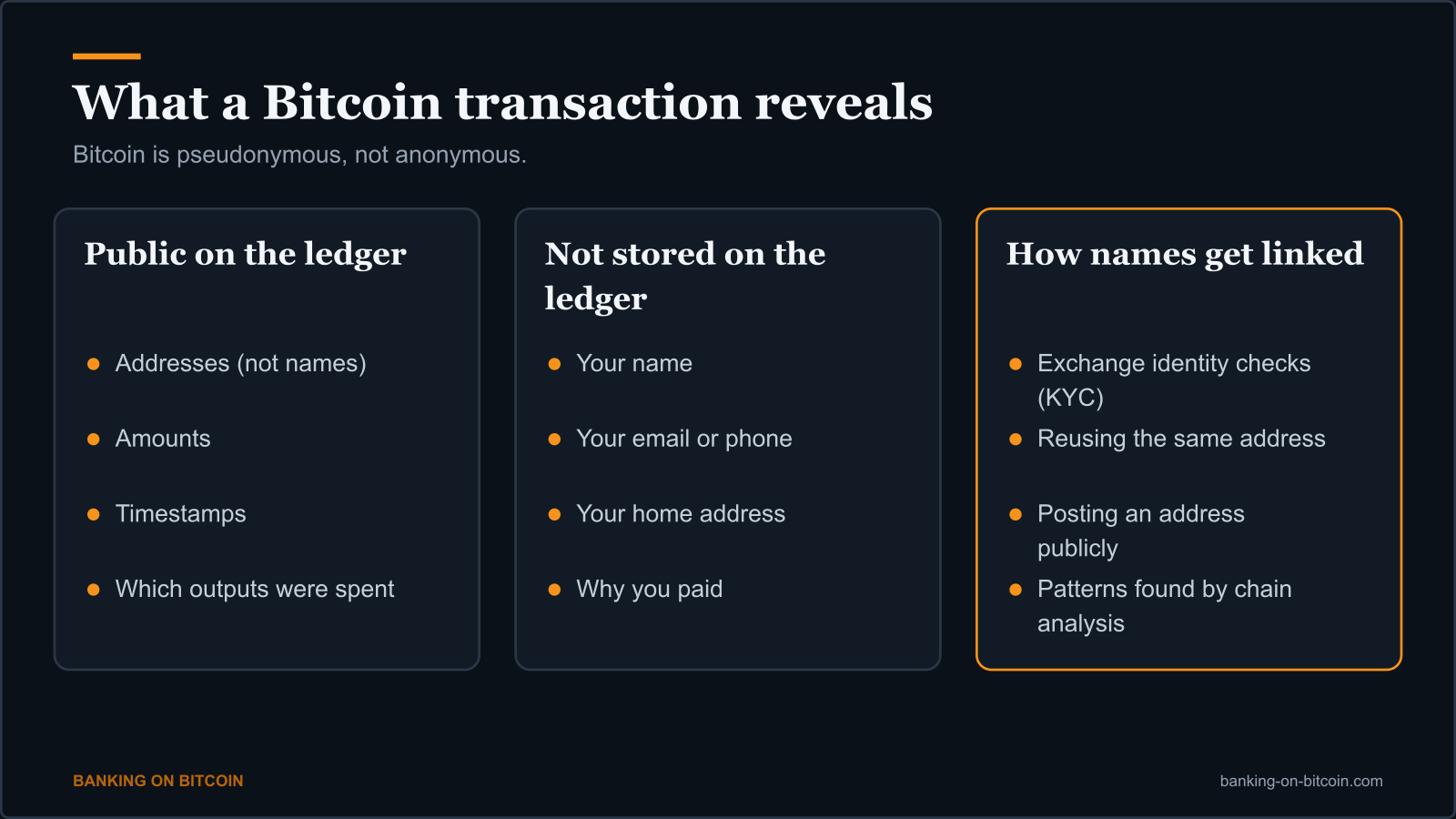
What the ledger shows is addresses, amounts and timing. It does not show names. That is pseudonymity: you act under an identifier, but the identifier’s whole history is visible. If that identifier ever gets tied to you, the full history goes with it.
Compare a bank account. Your bank knows who you are, but strangers cannot see your balance or your spending. On Bitcoin the situation is reversed. Strangers can see the flows, and it may be hard for them to know who is behind them, until a link appears.
How addresses get linked to people
Nobody needs to break Bitcoin’s cryptography to identify users. The links usually come from ordinary places.
Exchanges. Regulated exchanges in the US verify identity as part of know-your-customer rules (more on this in Is Bitcoin Regulated in the US?). If you withdraw to your own wallet, the exchange knows which address received the coins.
Payments and shipping. If you buy something and give a merchant your address, or publish an address to accept donations, that address is tied to you or your business.
Public posts. Addresses shared on social media, forums or websites can be permanently associated with a name.
Address reuse. Using one address again and again lets anyone see your total activity in one place. Wallets normally generate a fresh address for each payment for this reason.
Chain analysis
Specialized firms and researchers use software to study the ledger. They apply heuristics, rules of thumb about how people typically use wallets. One well-known example is the assumption that when several inputs are combined in one transaction, they likely belong to the same person. Another looks at “change” outputs, the leftover amount returned to the sender.
These heuristics are not perfect, and they can be wrong. But combined with exchange records and other outside information, they can build a detailed picture. Law enforcement and compliance teams use this kind of analysis, which is one reason Bitcoin has been used to trace stolen funds and criminal proceeds. For people trying to protect their financial privacy, it means that assuming an address is untraceable is a mistake.
Practical ways people reduce exposure
Nothing here guarantees anonymity, and what is appropriate depends on your situation. These are common general practices.
- Use a fresh address for each receive. Most modern wallets do this automatically. Do not reuse addresses.
- Keep sources separate. Coins from a KYC exchange and coins from other sources, when spent together, reveal that they belong to one person.
- Be careful what you post. Never publish an address that you also use for personal holdings.
- Consider your wallet’s privacy features. Some wallets support coin control, which lets you choose which coins to spend, and other tools designed to reduce linkage. Their quality varies, so research before you rely on them.
- Think about the network layer. Your internet connection can reveal your IP address to nodes you connect to. Some users route traffic through privacy tools for that reason.
- Use Lightning with realistic expectations. Payments over the Lightning Network are not broadcast to the whole world, which helps, but channel opens and closes are on-chain and the trade-offs are covered in What Is the Lightning Network?.
Legal and practical realities
Privacy and legality are different questions. Wanting to keep your finances from being broadcast to strangers is reasonable. It does not change your obligations: US taxpayers must still report as the law requires, and services you use may collect identity information. Certain privacy tools have also drawn regulatory and legal attention in some places, so read up on the rules where you live and seek professional advice if you are unsure.
There is also a personal safety angle. If someone can connect your identity to a large balance, you may become a target for scams or theft. Sharing less about your holdings is sensible regardless of the technology. The wider case for financial privacy, and its trade-offs, is discussed in Bitcoin and Monetary Freedom.
A realistic mindset
Treat Bitcoin like a public bulletin board on which entries are labeled with long codes rather than names. Keep the codes separate from your identity where you can, and assume that any single slip, an exchange withdrawal or a posted address, might connect them.
If you are still learning the basics, the Start Here path covers the fundamentals in order.
Where to go next
- How Does Bitcoin Work? for how the public ledger operates.
- Bitcoin and Monetary Freedom for privacy in the context of financial autonomy.
- Is Bitcoin Regulated in the US? for identity checks, reporting and legal status.
- What Is the Lightning Network? for a payment layer with different privacy properties.
- What Is a Bitcoin Address?: what an address is and why reuse matters.
- What Is a UTXO? How Bitcoin Tracks Ownership: why there are no account balances.
- What Is a Bitcoin Node? What Running One Means: who checks the rules.