Investing7 min read
Can You Buy Bitcoin in an IRA? A Practical Guide
Yes, you can get bitcoin exposure in an IRA, through ETFs or a self-directed account. See how each route works, what to compare, and the risks to weigh.
By Christopher CannucciariPublished
On this page

Key takeaways
- You can get bitcoin exposure inside a retirement account in two main ways: by holding a spot Bitcoin ETF in a regular IRA, or by opening a self-directed IRA whose custodian allows digital assets.
- The account type (traditional or Roth) mostly determines the tax treatment. The asset inside it is a separate decision.
- Fees, custody arrangements and rules vary widely between providers. Compare them yourself; this article does not recommend any.
- Bitcoin is volatile, and retirement money is meant to last. How much, if any, belongs in your plan is a personal question for a qualified professional.
Why people ask this
An individual retirement account, or IRA, is a tax-advantaged account: the tax rules are different from a normal brokerage account. Because bitcoin is taxed as property when held outside such an account (see Is Bitcoin Regulated in the US?), some investors wonder whether holding it inside an IRA changes the tax picture. Others simply want their retirement savings to include bitcoin, alongside stocks and bonds.
The question is reasonable, but the answer comes with more moving parts than a typical purchase. Here is how it works in general terms.
The two main routes
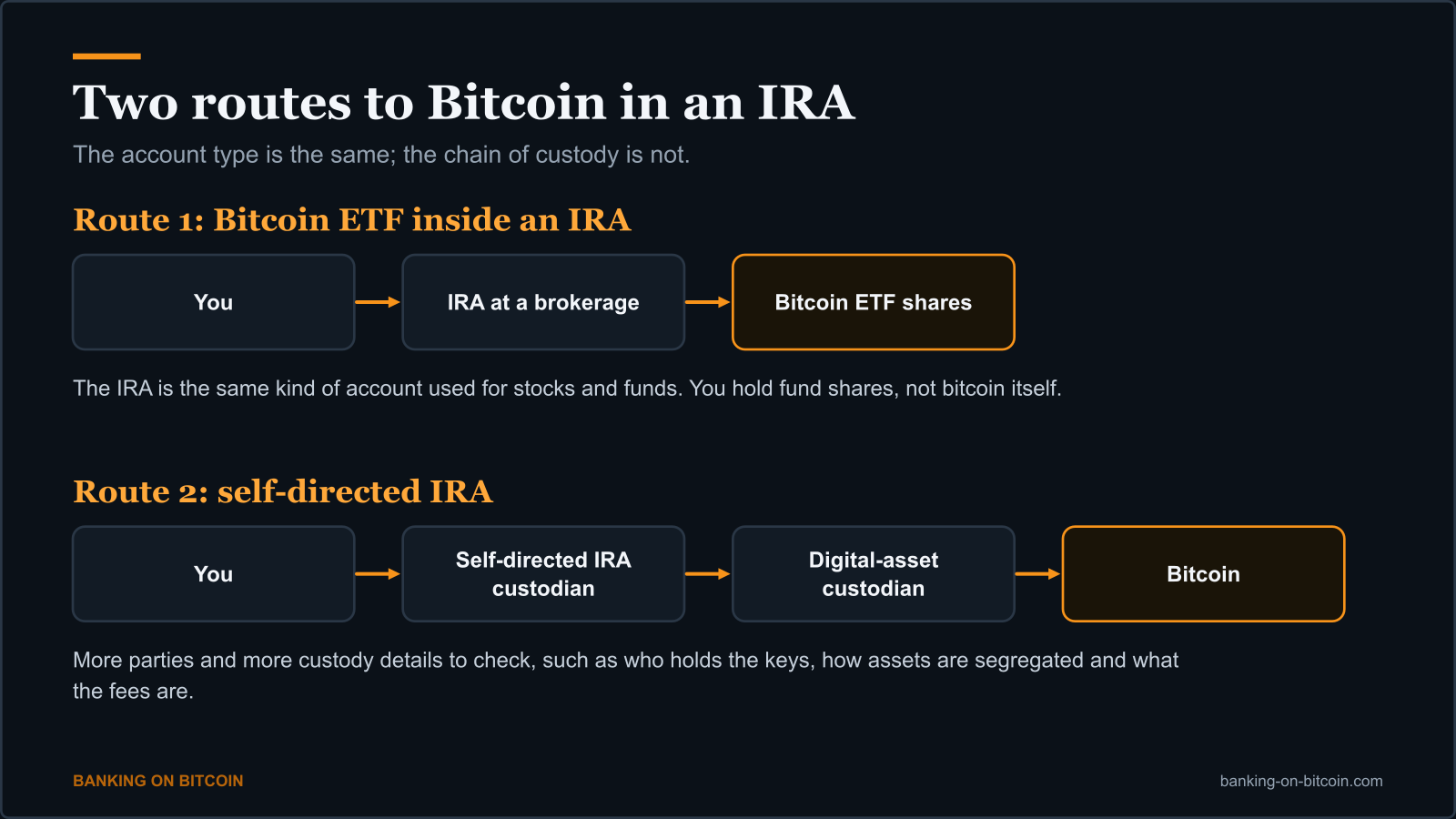
Route 1: A Bitcoin ETF inside a regular IRA
US spot Bitcoin exchange-traded funds began trading in January 2024. An ETF is a fund whose shares trade like a stock, and a spot Bitcoin ETF holds actual bitcoin on behalf of its shareholders. The full mechanics are covered in Bitcoin ETFs: What They Are and What They Mean for Investors.
Because these are securities, they can generally be bought in a traditional or Roth IRA at a brokerage that offers the fund, the same way you would buy any other ETF. There is no special “crypto IRA” needed. You do not manage keys or a wallet, and you can typically buy and sell during market hours through the same account you already use.
The trade-offs are that you own fund shares, not bitcoin itself. You cannot withdraw coins or spend them, and you rely on the fund’s structure, its custodian and its fee. Whether a specific brokerage offers a given fund is something to check with that brokerage.
Route 2: A self-directed IRA
A self-directed IRA is an IRA where the account holder has a wider choice of assets than the usual menu of stocks, bonds and funds. Some custodians that offer self-directed accounts allow digital assets, including actual bitcoin.
The account is held by a custodian, a company that administers the IRA and holds the assets for it. Rules generally require that an IRA be held by an approved custodian, so you cannot hold the account’s coins in your personal wallet. You fund the account, direct it to buy bitcoin through the custodian’s platform or arrangements, and the custodian holds the coins, often through a third-party digital asset custodian.
Compared with the ETF route, this can offer ownership of actual bitcoin inside the account. It can also mean extra setup steps, account or transaction fees, and a narrower set of providers.
What about a Roth IRA?
A Roth IRA is not a different kind of investment. It is a different tax wrapper. Both routes above are generally available in a Roth IRA as well, subject to what the provider allows. The difference is in how the money is taxed, which is covered below.
What about a 401(k)?
A 401(k) is an employer plan, and the employer chooses what it offers. Some plans list a Bitcoin ETF among the options, some have a brokerage window that widens the choices, and many offer neither. If you have a 401(k) and want to know whether bitcoin exposure is available, read your plan documents or ask your plan administrator. Rules for changing employer plans and rolling over old ones are technical, and mistakes can be costly, so ask a professional before moving money.
Choosing a custodian or provider
This site does not rank or recommend providers, and it would be wrong to pick winners in a category where terms change. What you can do is compare the same questions across any providers you consider.
Fees. Ask for a full fee schedule in writing. For an ETF, look at the fund’s expense ratio and your brokerage’s trading costs. For a self-directed IRA, look for account setup fees, annual or asset-based custody fees, transaction fees and any charges for closing or transferring. Some fees are hard to compare at a glance because they are structured differently.
Custody. Where do the coins actually sit? Who is the custodian, and is there a separate digital asset custodian behind it? Are the assets segregated for the account, or pooled? Ask how the provider handles security, audits and insurance, and read what any insurance actually covers, since it is often narrower than people assume.
Regulation and track record. Check whether the company is properly registered or authorized for the services it offers, and how long it has been operating. Search for regulatory actions or customer complaints.
Rules and flexibility. Can you buy and sell whenever you like, or only during set windows? What is the process for moving to another provider? Are there minimums?
Marketing claims. Be skeptical of any promise of returns or urgent pressure to act. Legitimate providers explain risks plainly.
Taxes in general terms
The following is a general orientation only and not tax advice. Tax rules for retirement accounts are detailed and change over time, and the IRS website at https://www.irs.gov/ is the place to confirm the current position.
- Traditional IRA. Depending on your circumstances, contributions may be deductible. Investments generally grow tax-deferred, meaning that buying and selling inside the account is not usually a taxable event in itself. Withdrawals are generally taxed as ordinary income, and there are rules about when you must start taking withdrawals.
- Roth IRA. Contributions are made with after-tax money. Qualified withdrawals are generally tax-free. Eligibility and conditions apply.
- Early withdrawals. Taking money out before the ages set in the rules can trigger taxes and penalties, with some exceptions.
- Contribution limits and eligibility. Annual limits and income-based restrictions exist and are updated periodically. Check current figures with the IRS or your provider.
One important consequence of the tax wrapper: bitcoin you already own personally generally cannot simply be moved into an IRA in kind. Contributions are typically made in cash, and selling coins outside the account first can be a taxable event. Speak to a professional before planning such a move.
Also, many IRA rules restrict “prohibited transactions,” which include things like using IRA assets for personal benefit or dealing with certain related parties. Self-directed accounts, because they have wider options, put more of the compliance responsibility on you.
Risks to weigh
Volatility. Bitcoin can fall sharply, and retirement accounts are meant to fund years you may not be able to work. A loss inside an IRA also cannot be used the way a loss in a taxable account sometimes can, so the tax angle is not a cushion.
Concentration. Putting a large share of retirement savings into any single volatile asset increases the chance that one bad outcome hurts your plans.
Counterparty and custody risk. In a self-directed IRA, you depend on the custodian and its partners. An ETF adds fund and custodian risk. Neither is the same as holding your own keys, which the self-custody guide covers, and an IRA generally does not allow that.
Fees. Ongoing charges compound over decades. A cost that seems small can add up over time.
Complexity and rule changes. Retirement rules, ETF availability and provider terms can change, so read current documents rather than relying on older ones.
A sensible way to approach it
Start by deciding whether you want bitcoin exposure in your retirement plan at all, and how much, before comparing products. If you are still learning what Bitcoin is, the Start Here path and Why Does Bitcoin Have Value? give a grounding. Then compare the ETF and self-directed routes on cost, custody and flexibility, and speak with a fee-only financial planner or tax professional about your own situation, because retirement decisions are personal and the rules change.
Where to go next
- Bitcoin ETFs: What They Are and What They Mean for Investors for how to compare funds by fee, custody and structure.
- Is Bitcoin Regulated in the US? for the tax and regulatory background.
- The Power of Self-Custody for the trade-off between holding coins yourself and using a custodian.
- How to Buy and Secure Bitcoin for buying outside a retirement account.
- Bitcoin route finder to find the route worth reading about first.
- ETF fee-cost calculator to see how a fund’s yearly fee compounds.
- Can You Hold Bitcoin in a 401(k)?: the employer-plan route.
- How Is Bitcoin Taxed in the US? A General Guide: tax concepts in plain terms.
- Is Bitcoin a Good Investment? How to Think About It Without Hype: questions to ask before deciding.
Frequently asked questions
Can you buy bitcoin in an IRA?
Yes, in two main ways. You can hold a spot Bitcoin ETF in a traditional or Roth IRA at a brokerage that offers it, or you can open a self-directed IRA with a custodian that permits digital assets. Availability and terms depend on the provider.
Can you hold bitcoin in a Roth IRA?
Generally yes, through the same two routes. The Roth structure changes how the account is taxed, not what it can hold, but the rules are technical and change, so confirm details with the custodian and a qualified tax professional.
Can you buy bitcoin in a 401(k)?
Only if your employer's plan offers a way to do it, such as a Bitcoin ETF among the investment options or a self-directed brokerage window. Plans are set by the employer, so check your plan documents and ask your plan administrator.
What is the difference between a Bitcoin ETF in an IRA and a self-directed Bitcoin IRA?
With an ETF you own shares of a fund that holds bitcoin, in an ordinary brokerage IRA. With a self-directed IRA, a custodian holds actual bitcoin for the account, often with extra setup steps and fees. The two differ in cost structure, custody and how easily you can trade.
Are the taxes different if bitcoin is in an IRA?
Usually the tax treatment is set by the type of IRA rather than by the asset. In a traditional IRA, growth is generally tax-deferred and withdrawals are generally taxed as ordinary income. In a Roth IRA, qualified withdrawals are generally tax-free. Rules change, so verify with a tax professional.
Related articles