Money & Economics8 min read
Bitcoin Bank Accounts and Savings: What Actually Exists
A clear look at bitcoin bank accounts, savings, lending and mortgages: what they are, where the custody risk sits, and how to move bitcoin to a bank.
By Christopher CannucciariPublished
On this page

Key takeaways
- “Bitcoin bank account” is a loose phrase. It can mean a normal bank account used to buy bitcoin, an exchange account that holds bitcoin for you, or an interest-paying product built on lending your coins.
- Bitcoin is not FDIC-insured. Deposit insurance applies to eligible dollar deposits at insured banks, not to bitcoin or to losses at a crypto company.
- Anything that holds bitcoin for you creates custody and counterparty risk, and interest on bitcoin usually means you are lending it to someone.
- To turn bitcoin into money in a bank account, you usually sell it for dollars on an exchange and withdraw the dollars. Taxes and rules can apply, so check with a qualified professional.
What people usually mean by “bitcoin bank account”
Searches for a bitcoin bank account reflect a real need: people want a familiar, safe-feeling place for their bitcoin, or an easy way to move between bitcoin and dollars. But the term hides a range of very different arrangements. It helps to separate them.
1. A regular bank account that you use for bitcoin. You link an ordinary checking or savings account at a bank to an exchange, buy bitcoin with dollars, and later sell and send the dollars back. The account is a normal bank account, and the bitcoin lives elsewhere.
2. An account at an exchange or app that holds bitcoin for you. Your balance shows in an app, and the company holds the coins. It is convenient, but it is a claim on a company, not a bank deposit.
3. A product that pays interest on bitcoin. A company offers a savings-style rate on coins you deposit. Behind the scenes, the deposited coins are generally lent out or used in other ways.
4. A loan or mortgage secured by bitcoin. You pledge bitcoin as collateral and borrow dollars against it, or a lender takes crypto assets into account when assessing you.
Some traditional banks have also explored offering customers access to bitcoin through partners or funds. Availability changes and differs by institution, so I will not name products here. The point is to work out which of the four types you are looking at.
Custody: who holds the coins
Bitcoin ownership comes down to who controls the private keys. That is explained in How Does Bitcoin Work? and The Power of Self-Custody. When a company holds the keys for you, you are relying on it to be honest, secure and solvent.
This is not a theoretical concern. Crypto firms have failed, and when they did, customers found that their balances were claims against a bankrupt company, not assets set safely aside. Sometimes customers waited years for partial recovery. The lesson is not that every provider is unsafe. It is that a balance shown in an app is only as good as the company behind it, and you should ask where the coins are kept and whether they are segregated from the company’s own money.
The FDIC point
The Federal Deposit Insurance Corporation insures eligible deposits at member banks, up to limits set by law, in the event of a bank failure. Several things follow, and they are often confused.
- It applies to the dollar side. FDIC insurance covers money on deposit at an insured bank, such as the checking or savings account you link to an exchange.
- It does not cover bitcoin. Bitcoin is not a deposit. Its price movements are not insured, and neither are losses when a crypto exchange, wallet provider or lending platform fails.
- Beware of loose wording. Some providers hold customers’ dollar balances at partner banks and mention FDIC insurance. That can offer limited protection for the cash portion under specific conditions, but it is not insurance on bitcoin or against the crypto company failing. Read the fine print and the FDIC’s own explanations at its website.
- Other protections are different. Brokerage accounts may have separate investor protection that covers certain failures at a brokerage, and it also does not cover market losses. Do not assume it applies to a crypto platform.
If a product’s marketing implies that your bitcoin is “insured” or “as safe as a bank,” ask precisely what is covered, by whom, and for what event.
Interest on bitcoin: what is behind it
Bitcoin itself does not pay interest. Any yield has to come from somewhere, and in most cases it comes from the company lending your coins to other borrowers, or using them in trading and other activities. You are effectively making an unsecured loan to that company.
Several well-known platforms that offered such yield failed, and customers suffered losses or long delays. That does not mean the idea is always fraudulent, but it shows the risk: a higher-than-bank rate usually signals that you are taking credit risk. Compare the advertised rate with the questions of who is borrowing, what collateral they post, whether your assets are pledged to others, and what happens in a bankruptcy. Rates and product availability change, and regulators in the US have taken an interest in some of these products, so current rules matter.
Borrowing against bitcoin
Some lenders will lend dollars against bitcoin you pledge as collateral. People do this to avoid selling, since selling can trigger taxes (see below). The catch is that bitcoin’s price can fall quickly. If the value of your collateral drops below a threshold, the lender may demand more collateral or sell it, often at the worst moment. Read the liquidation terms, interest rates and fees closely, and remember that you are also trusting the lender to hold your collateral safely.
A bitcoin mortgage, in the sense of a home loan that recognizes crypto as an asset, is a niche and changing area. Some lenders consider crypto holdings when assessing a borrower, and some arrangements involve pledging crypto. Mainstream mortgage rules are strict, and what is possible varies by lender and over time, so speak to a licensed mortgage professional.
How to move bitcoin to a bank account
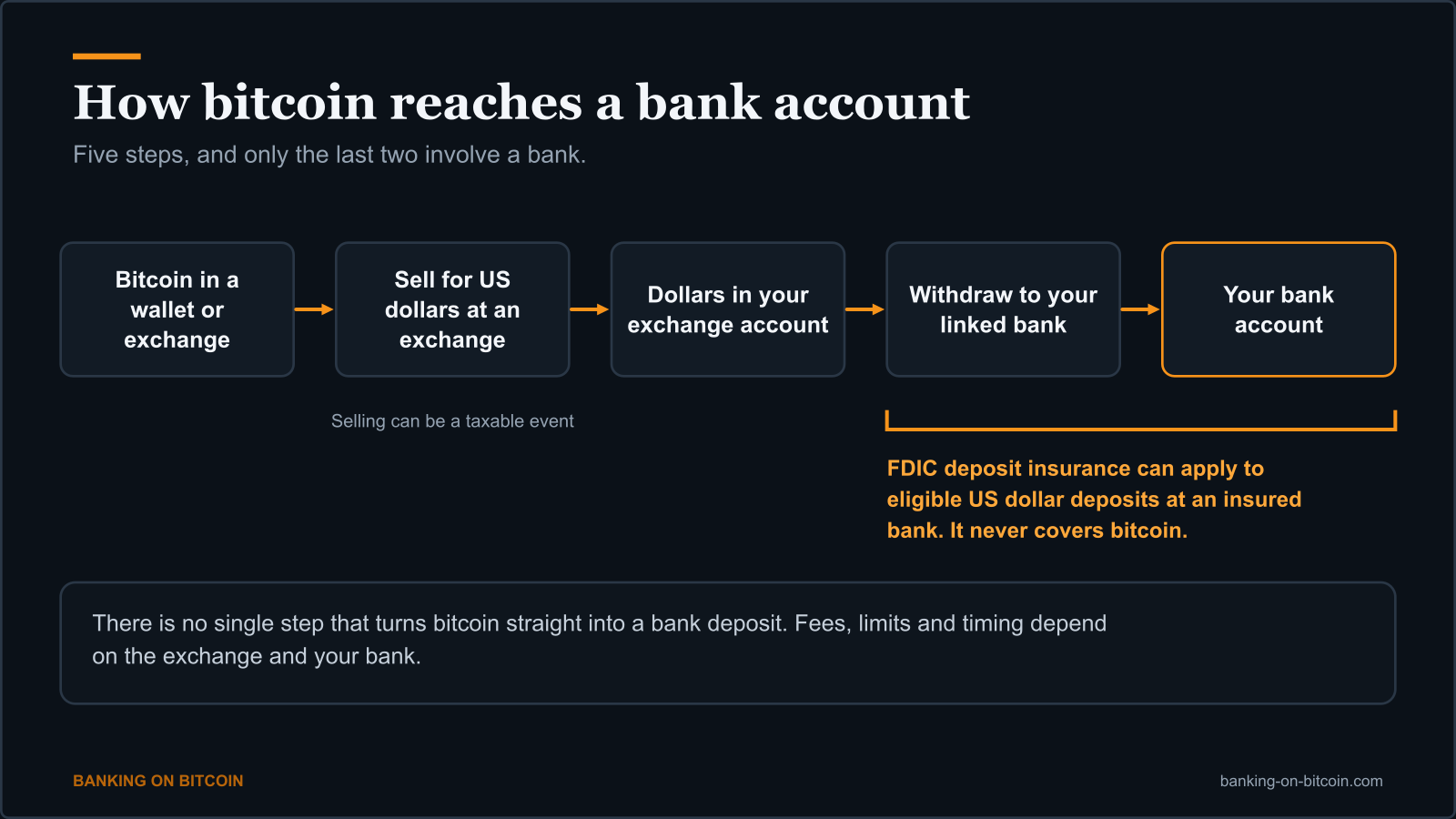
There is no direct route from a bitcoin wallet to a bank account. Banks work in dollars and do not receive bitcoin. The usual path looks like this:
- Choose a regulated exchange or broker that supports selling bitcoin for dollars and withdrawals to a bank. You will normally need to verify your identity, a step explained in Is Bitcoin Regulated in the US?.
- Send the bitcoin to the exchange, if it is not already there. Copy the deposit address carefully, and consider a small test transfer first. Bitcoin transactions cannot be reversed.
- Sell it for US dollars. The exchange will show the price and any fees before you confirm.
- Withdraw the dollars to your linked bank account. Transfer times, limits and fees depend on the method and provider. New accounts may have holds on withdrawals.
For a fuller look at the buying side and safe practices, see How to Buy and Secure Bitcoin.
Be careful with anyone who offers to “convert” bitcoin for you privately, and never send coins to someone who contacted you unprompted. Scams are common in this area.
Taxes: a general note
Selling bitcoin for dollars is generally treated as a sale of property for US federal tax purposes, and it may produce a gain or a loss. Trading bitcoin for goods or another asset can also be taxable. Buying bitcoin with dollars and holding it is generally not a sale. Reporting rules for digital assets have been changing, so keep records of purchase dates, amounts paid and sales. The IRS site at https://www.irs.gov/ has current guidance, and a qualified tax professional can apply it to your circumstances. This is general information, not tax advice.
Saving in bitcoin versus saving in a bank
It helps to be clear about what each provides. A bank savings account offers stable dollar value, insurance up to legal limits on eligible deposits, and interest, but it can lose purchasing power to inflation. Bitcoin offers a fixed supply and the possibility of self-custody, but its dollar price is volatile and there is no insurance against loss of value or lost keys. These are different tools with different risks, and many people who hold bitcoin also keep ordinary savings for emergencies and near-term needs. The reasons people hold bitcoin as a store of value are explored in Bitcoin’s Role in a Changing Global Economy and Why Does Bitcoin Have Value?.
Questions to ask any provider
- Do I hold the keys, or do you?
- Are my coins segregated from your own funds, and can you show how?
- Do you lend or reuse my deposited coins? If so, to whom and under what terms?
- What exactly is insured, by whom, and against what event?
- What happens to my balance if you fail?
- What are all the fees, including for withdrawals?
- Which regulators oversee you, and where are you registered?
Rules and products in this area change, so verify current details directly with providers and regulators, and consider speaking with a qualified financial or tax professional about your own situation. If you are new to all of this, the Start Here learning path is a good place to begin.
Where to go next
- How to Buy and Secure Bitcoin: A Careful Beginner’s Guide for exchanges, wallets and avoiding scams.
- The Power of Self-Custody for holding your own keys.
- Is Bitcoin Regulated in the US? for identity checks and taxes.
- Can You Buy Bitcoin in an IRA? for retirement-account options.
- Bitcoin-Backed Loans and Mortgages: How They Work and What Can Go Wrong: borrowing against bitcoin.
- Bitcoin Fees Explained: the fees behind buying and moving bitcoin.
- How to Spend Bitcoin: Paying With It, Cards and Taxes: using bitcoin for payments.
- What Is a Stablecoin? How It Works and How It Differs From Bitcoin: dollar-linked tokens compared.
Frequently asked questions
Is there such a thing as a bitcoin bank account?
The phrase covers several different things: a bank account you use to buy bitcoin, an exchange or app account that holds bitcoin for you, or a product that pays interest on bitcoin you deposit. They carry very different risks, so it matters which one someone means.
Is bitcoin FDIC-insured?
No. FDIC deposit insurance applies to eligible deposits at insured banks, in US dollars, and does not cover bitcoin's price or losses at a crypto company. A dollar balance held at a partner bank may have pass-through coverage under conditions, so read the provider's disclosures.
How do I withdraw bitcoin to my bank account?
You generally send the bitcoin to an exchange that supports selling, sell it for US dollars, and then withdraw the dollars to your linked bank account. Sending bitcoin is not the same as depositing it at a bank, and the sale may have tax consequences.
Can you earn interest on bitcoin?
Some companies have offered yield on deposited bitcoin, usually by lending it out. That means the company owes you the coins and you take on its credit risk, and several such firms have failed. Rates and availability change, so treat any promised yield with caution.
Can you get a mortgage or loan using bitcoin?
Some lenders offer loans secured by bitcoin as collateral, and a few mortgage arrangements consider crypto holdings. Terms vary, and a sharp price drop can force a lender to sell your collateral, so understand the liquidation rules before borrowing.
Related articles


Money & Economics
Why Does the Bitcoin Price Fall? What Moves It and What Doesn't

Money & Economics
What Is a Stablecoin? How It Works and How It Differs From Bitcoin
Money & Economics