Investing8 min read
How to Report Crypto on Your US Tax Return: Form 8949, Schedule D and Form 1040
How crypto goes on a US federal return for 2025: the Form 1040 digital assets question, Form 8949 boxes, Schedule D totals and crypto income, with an example.
By Christopher CannucciariPublished
On this page

Key takeaways
- The 2025 Form 1040 asks every filer a Yes or No digital assets question on page 1. The IRS says to answer Yes if you received digital assets as payment or a reward, or sold, exchanged or otherwise disposed of any. It says to answer No if you only held them, bought them with dollars or moved them between your own wallets.
- Each sale, trade or spend is a disposal listed on Form 8949 as proceeds minus basis. The totals go to Schedule D and then to line 7a of Form 1040.
- The Form 8949 box you check depends on whether you received a Form 1099-DA and whether it shows basis was reported to the IRS.
- Crypto received as income is reported where that kind of income goes. The IRS names Schedule 1 for mining, staking and forks.
- This covers the 2025 forms, filed in 2026, as of October 2026. It is general information, gives no tax rates and is not tax advice.
Which tax year do these forms cover?
The forms described here are the 2025 versions, used for crypto activity in calendar year 2025 and filed in 2026. The IRS issues new versions every year, so the 2026 forms, filed in 2027, may differ in wording and line numbers.
What does the IRS say about reporting crypto?
The IRS says you may have to report transactions with digital assets such as cryptocurrency on your tax return, and that income from digital assets is taxable. It treats digital assets as property, not currency, which How Is Bitcoin Taxed in the US? explains.
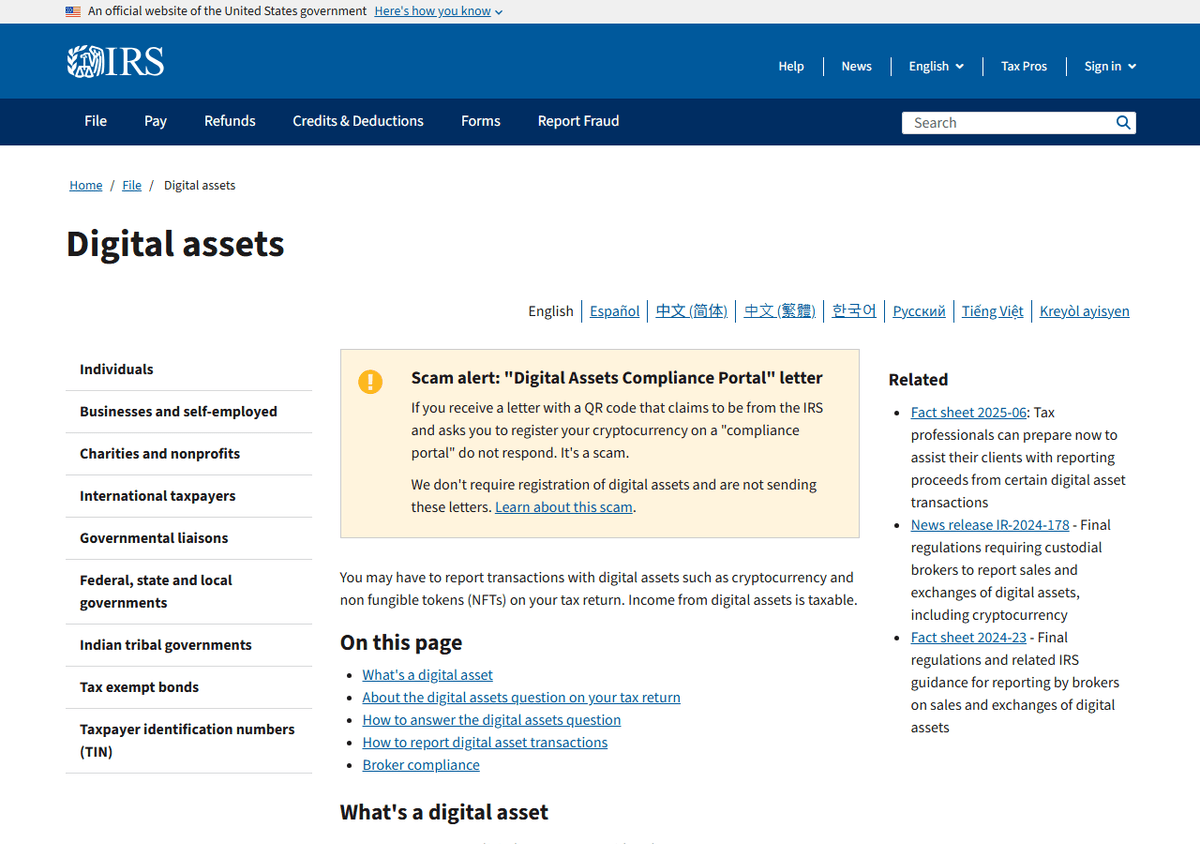
The page also carries a scam alert: the IRS says a letter with a QR code asking you to register your cryptocurrency on a “compliance portal” is a scam, and that it does not require registration of digital assets.
What does the digital assets question on Form 1040 ask?
On the 2025 Form 1040 the question sits on page 1, between the filing status boxes and the dependents block. It asks whether at any time during 2025 you (a) received digital assets as a reward, award or payment for property or services, or (b) sold, exchanged or otherwise disposed of a digital asset or a financial interest in one. The IRS instructions say every filer must answer, whether or not a Form 1099-DA arrived, and must not leave it blank.
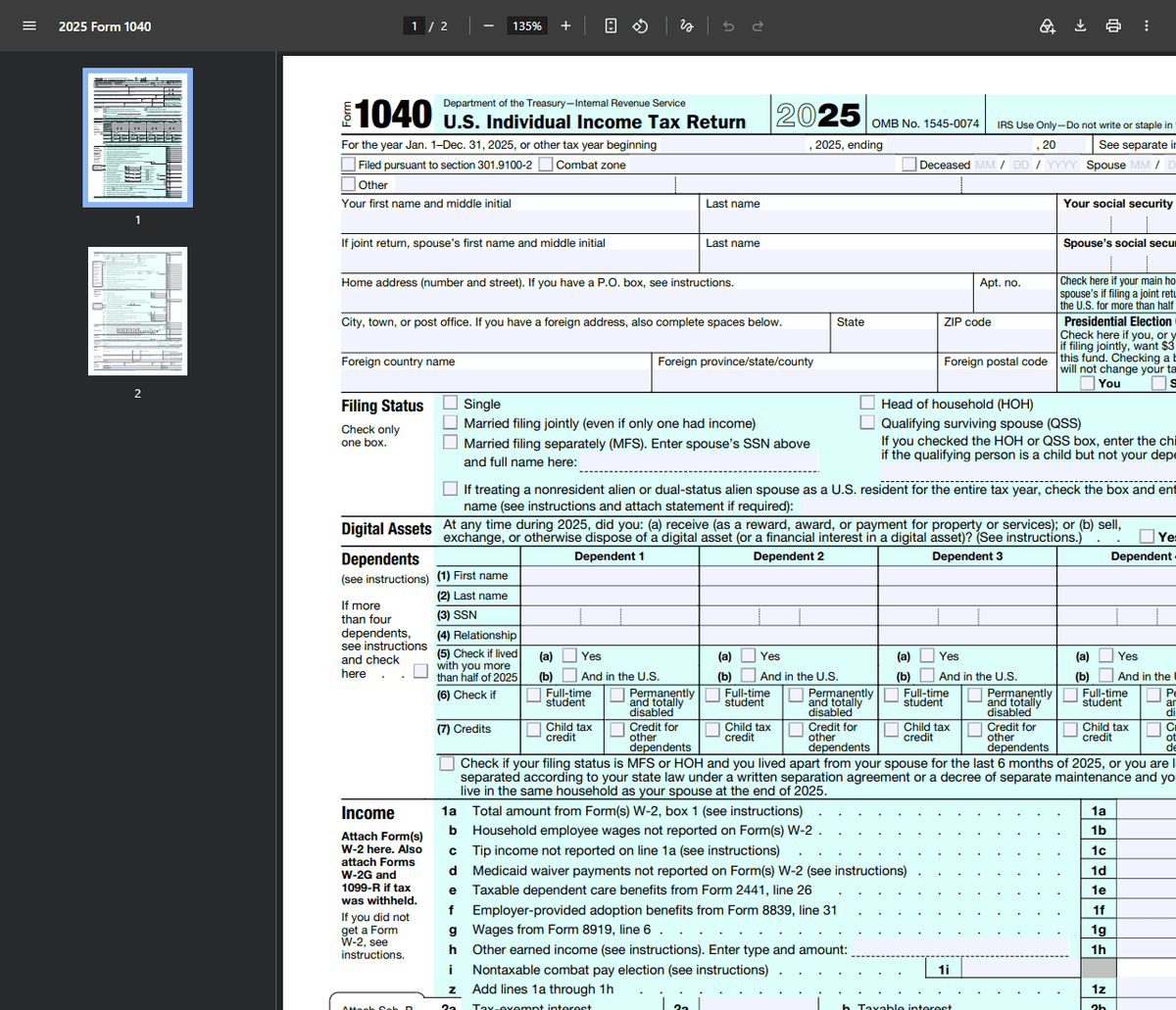
The IRS digital assets page lists what leads to each answer.
| What you did in the year | Answer, as the IRS states it |
|---|---|
| Received digital assets as payment for property or services, or as a reward or award | Yes |
| Received digital assets from mining, staking or similar activities, or an airdrop tied to a hard fork | Yes |
| Sold digital assets, or exchanged them for other digital assets, dollars, goods or services | Yes |
| Paid a transfer fee with digital assets | Yes |
| Only held digital assets in a wallet or account | No |
| Bought digital assets with dollars or other real currency and did not sell | No |
| Moved digital assets between wallets or accounts you own or control | No, unless you paid a transaction fee in digital assets |
How do you work out a gain or loss?
A gain or loss is the amount you received minus your basis, adjusted for fees. The IRS FAQs say transaction costs such as network fees and commissions reduce the amount you received, and that basis is what you paid plus acquisition costs. Selling for dollars, trading one coin for another and spending coins on goods or services are all disposals.
The holding period decides which part of Form 8949 you use. Held one year or less is short-term, and held more than one year is long-term. The count starts the day after you acquired the coin and includes the day you disposed of it.
If you bought at different times, which units count as sold matters. The IRS FAQs let you identify specific units no later than the sale, with adequate records. Otherwise, the earliest acquired are generally treated as sold first within the wallet or account.
What goes on Form 8949?
Form 8949 lists each disposal on its own row, short-term in Part I and long-term in Part II. Each row gives the asset and units, the dates, proceeds, basis, any code and adjustment, and the gain or loss.
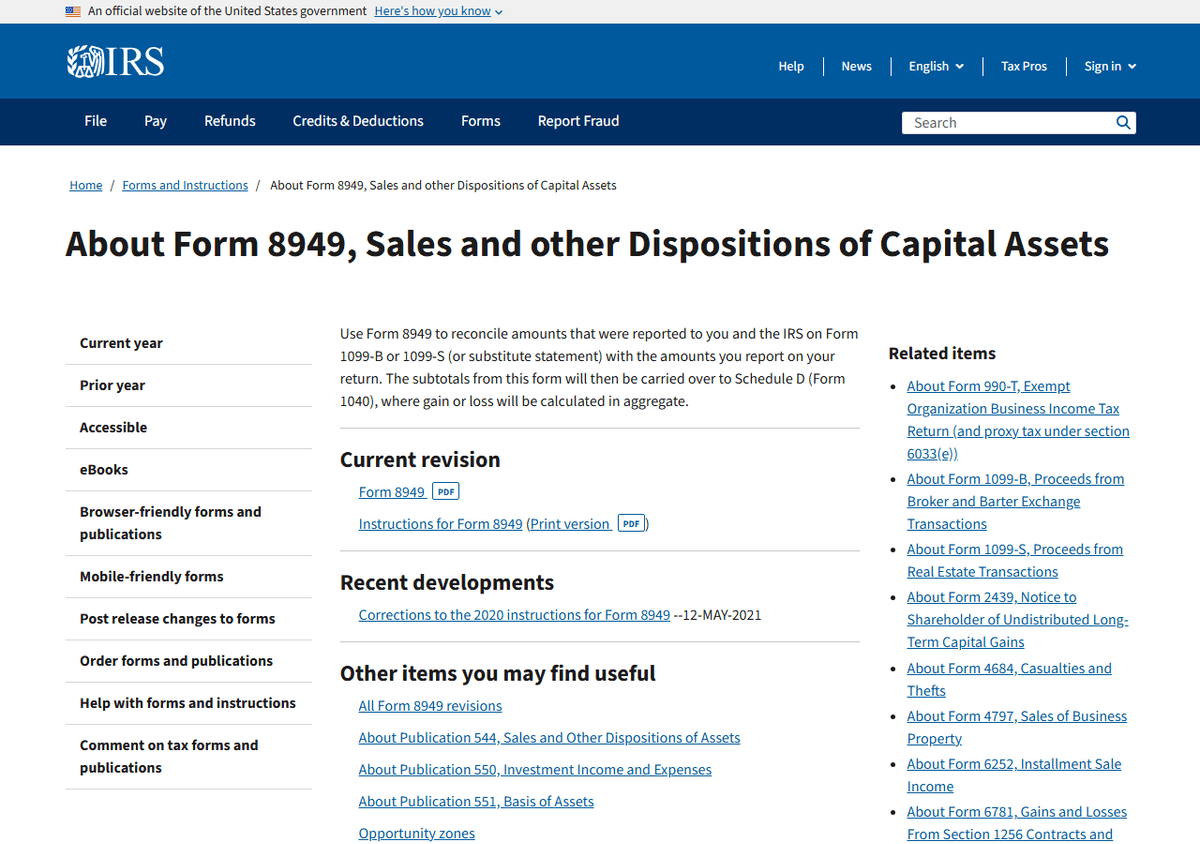
You check one box per page, and for digital assets the choice follows Form 1099-DA, the broker report covered in Form 1099-DA Explained. The IRS says gains must be reported whether or not a form arrived.
| Situation | Short-term | Long-term |
|---|---|---|
| Form 1099-DA shows basis was reported to the IRS | Box G | Box J |
| Form 1099-DA shows basis was not reported to the IRS | Box H | Box K |
| No Form 1099-DA received | Box I | Box L |
Boxes A to F are for other kinds of property, and the instructions say not to use Box C or F for digital assets. If a form shows wrong basis or leaves out your fees, the instructions give codes for column (f), such as B for incorrect basis and E for expenses not reflected, with an adjustment in column (g).
For simple cases you may skip Form 8949. If a Form 1099-DA shows basis was reported to the IRS and nothing needs adjusting, you can enter those totals directly on Schedule D, on line 1a for short-term or 8a for long-term. The instructions add conditions, so read them first.
Where do the totals go on Schedule D?
Schedule D adds up Form 8949 and reports the net result. Short-term totals go on lines 1b, 2 and 3, matching Boxes A or G, B or H, and C or I. Long-term totals go on lines 8b, 9 and 10, matching Boxes D or J, E or K, and F or L. Line 16 combines the two results, and a gain there goes to line 7a of Form 1040. If the result is a loss, the Schedule D instructions explain the annual limit and carryovers. Why some people realize losses on purpose before year-end is covered in crypto tax-loss harvesting.
What does a worked example look like?
These are invented round numbers, not a tax calculation. Maya bought 0.05 bitcoin in March 2024 for $2,000, fees included, and sold it on a custodial platform in May 2025 for $3,500. The platform’s Form 1099-DA shows gross proceeds and no basis, so her basis comes from her own records. In September 2025 she also paid a friend for a used bike with 0.001 bitcoin, worth $120 that day, bought in January 2025 for $90. No broker was involved, so there is no form.
| Transaction | Held | Form 8949 | Proceeds | Basis | Gain |
|---|---|---|---|---|---|
| Sold 0.05 bitcoin on a platform | More than one year | Part II, Box K | $3,500 | $2,000 | $1,500 |
| Spent 0.001 bitcoin on a bike | One year or less | Part I, Box I | $120 | $90 | $30 |
The Box K total goes on Schedule D line 9 and the Box I total on line 3. Line 16 combines them into $1,530, which goes to line 7a of Form 1040. Maya checks Yes on the digital assets question. What she owes depends on her whole return, so rates are outside this article.
What about crypto you received as income?
Crypto received as income is reported where that kind of income goes, not on Form 8949 at first. The IRS says wages paid in digital assets go on Form 1040. Payments to an independent contractor and sales to customers in a business go on Schedule C. Other ordinary income, such as mining, staking or forks, goes on Schedule 1. The 2025 Schedule 1 has a line for digital assets received as ordinary income not reported elsewhere.
The IRS FAQs measure that income at the dollar value when you received the coins, and that value becomes your basis. Selling the coins later is a second event for Form 8949. What Is Bitcoin Mining? explains where mined coins come from.
What is not a disposal, and what records should you keep?
Moving coins between wallets you own is generally not taxable, except for digital assets you use to pay transaction costs, per the IRS FAQs. How to Send and Receive Bitcoin Safely covers transfers.
The IRS says to keep records of every purchase, receipt, sale, exchange and other disposition, plus the dollar value of anything received as income. A transaction ID ties a wallet entry to the blockchain. Selling is covered in How to Sell Bitcoin and spending in How to Spend Bitcoin.
Where do you check for updates?
The facts here come from IRS pages and forms read in October 2026. They include the Digital assets page (last reviewed 2 September 2026), the 2025 Form 1040, Form 8949 and Schedule D with their instructions. They also include the IRS FAQs on digital asset transactions. The IRS home page is https://www.irs.gov/, and searching it for those titles finds the current versions.
The Bitcoin statistics page has a timeline of US reporting milestones, and Is Bitcoin Regulated in the US? gives the wider legal picture. New to Bitcoin? The Start Here path lists the core guides. For your own return, a qualified tax professional such as a CPA or enrolled agent can apply these forms to your facts.
Where to go next
- Form 1099-DA Explained: What Crypto Brokers Report to the IRS and to You: what the broker form shows and what it leaves out.
- How Is Bitcoin Taxed in the US? A General Guide: property treatment, taxable events and cost basis.
- How to Sell Bitcoin: Your Options, the Costs and What to Watch For: the sale that creates a Form 8949 row.
- How to Spend Bitcoin: Paying With It, Cards and Taxes: why spending counts as a disposal.
Frequently asked questions
Do I have to answer the digital assets question on Form 1040?
Yes. The IRS says every filer must check Yes or No, whether or not they received a Form 1099-DA, and must not leave it blank. Answer Yes if you received digital assets as pay or a reward, or sold, exchanged or otherwise disposed of any during the year. Answer No if you only held them, bought them with dollars or moved them between wallets you own.
Which form reports a bitcoin sale?
Sales, trades and other dispositions of digital assets held as capital assets are listed on Form 8949. The totals carry to Schedule D, and the net result goes on Form 1040. In some simple cases, where a broker's Form 1099-DA shows basis and nothing needs adjusting, the instructions let you enter totals directly on Schedule D.
Which box on Form 8949 do I check for crypto?
It depends on the holding period and on Form 1099-DA. For short-term transactions use Box G if the form shows basis was reported to the IRS, Box H if it does not, and Box I if you received no form. For long-term transactions the matching boxes are J, K and L. The instructions say not to use Boxes C or F for digital assets.
Do I report crypto if I only bought and held it?
Buying with dollars and holding is not a disposal, and the IRS says to answer No to the digital assets question if that is all you did. Keep your purchase records anyway, because they establish your basis if you sell later.
Where is crypto income from mining or pay reported?
Not on Form 8949. The IRS says wages paid in digital assets are reported on Form 1040, payments to independent contractors and business sales on Schedule C, and other ordinary income such as mining, staking or forks on Schedule 1. The dollar value when you received it is generally the amount of income.
Related articles