Security8 min read
Fake Crypto Wallets and Websites: How to Tell the Real One
Fake wallets and lookalike sites copy real brands to steal your recovery phrase. See how they work, how to check an app or site and what to do if fooled.
By Christopher CannucciariPublished
On this page

Key takeaways
- A fake wallet or exchange copies a real brand’s name, look and web address so that you type in a recovery phrase or a login. The FBI and the FTC both warn about this.
- No genuine wallet maker or support team asks for your recovery phrase. Ledger and Trezor both say so on their own pages.
- Reach a wallet from the maker’s own address, typed or bookmarked, and not from an ad or a search result. An app-store listing is something to check, not proof.
- Buy hardware wallets new, from the maker or a reseller it lists, and never use one that arrives with words or a PIN already set.
- If you typed your phrase into the wrong place, treat the old wallet as compromised and move what is left to a new one at once.
How do fake crypto wallets and websites work?
A fake copies a real wallet, exchange or support page closely enough that you hand over what the real one would never ask for: your recovery phrase or your login. The FBI’s Internet Crime Complaint Center (IC3) described a common entry point in an alert of 21 December 2022. Criminals buy search ads that use a web address resembling a real company’s, the ad sits at the top of the results, and the page behind it copies the real site. For crypto, the alert says the copies imitate exchange platforms and ask for login details, which lets criminals take the funds.
Apps follow the same pattern. An IC3 alert of October 2022 warns of fake websites and apps that show a crypto investment growing fast. That is the tool at the center of pig butchering scams. A 2023 alert says fraudulent apps may use names, images or descriptions similar to popular ones.
The damage is hard to undo. The FTC’s consumer page on crypto and scams says that if a wallet is stolen or compromised, no one can step in to help you recover the funds, and that crypto payments typically are not reversible. Picture a forged shopfront next to the real branch: the sign looks right, only the address differs, and the cash you hand over is gone.
Which kinds of fake should you expect?
Fakes reach you in six main ways, all after the same thing.
| Kind | How it reaches you | What it wants | Check first |
|---|---|---|---|
| Lookalike website | A search ad, message or social post | Your login or recovery phrase | The address in the browser bar |
| Clone app | An app-store search or a link | Your recovery phrase, often behind a fake error | The publisher and where the link came from |
| Fake browser extension | A search result or a store page | The same phrase or login | The publisher, reached from the maker’s own site |
| Fake support | An unrequested message, text or call | The phrase, a PIN or remote access | Who started the contact |
| Pre-set-up device | A marketplace or third-party seller | You to use a phrase the seller already knows | Whether the device arrives with words or a PIN already set |
| Fake update or “verification” page | An email or pop-up | The phrase, to “verify” or “sync” the wallet | Whether the maker ever sends such requests |
What do the wallet makers say about this?
Wallet makers say on their own pages that they will never ask for your recovery phrase. Ledger’s home page carries a banner about it.

Ledger’s page on phishing campaigns goes further. It says there is never a good reason to type the phrase into a computer. It also says the only place to download the official Ledger Wallet app (formerly Ledger Live) is Ledger’s own website. Ledger, it adds, will never contact customers by text message or phone call.
Trezor’s security page says any request for your wallet backup, PIN, passwords or codes is a scam, and that a caller claiming to be from Trezor should be hung up on. Its example of a lookalike address is “trezorr.io” in place of “trezor.io”. In October 2026, for example, hardware wallet maker Keystone warned after a breach of its customer data that scammers may pose as the company by phone, text, email or mail.
These are two vendors’ statements about their own products, so read your own maker’s page. The shared rule is what matters: a recovery phrase goes only into the hardware device, or into a wallet you installed yourself to restore your own coins. What Is a Seed Phrase? explains why.
How do you check an app before you install it?
Start at the maker’s website and follow its link to the store, then compare what the listing shows with what the maker says. The figure shows a store listing with the app name, developer name, category, rating count and promotional screens.
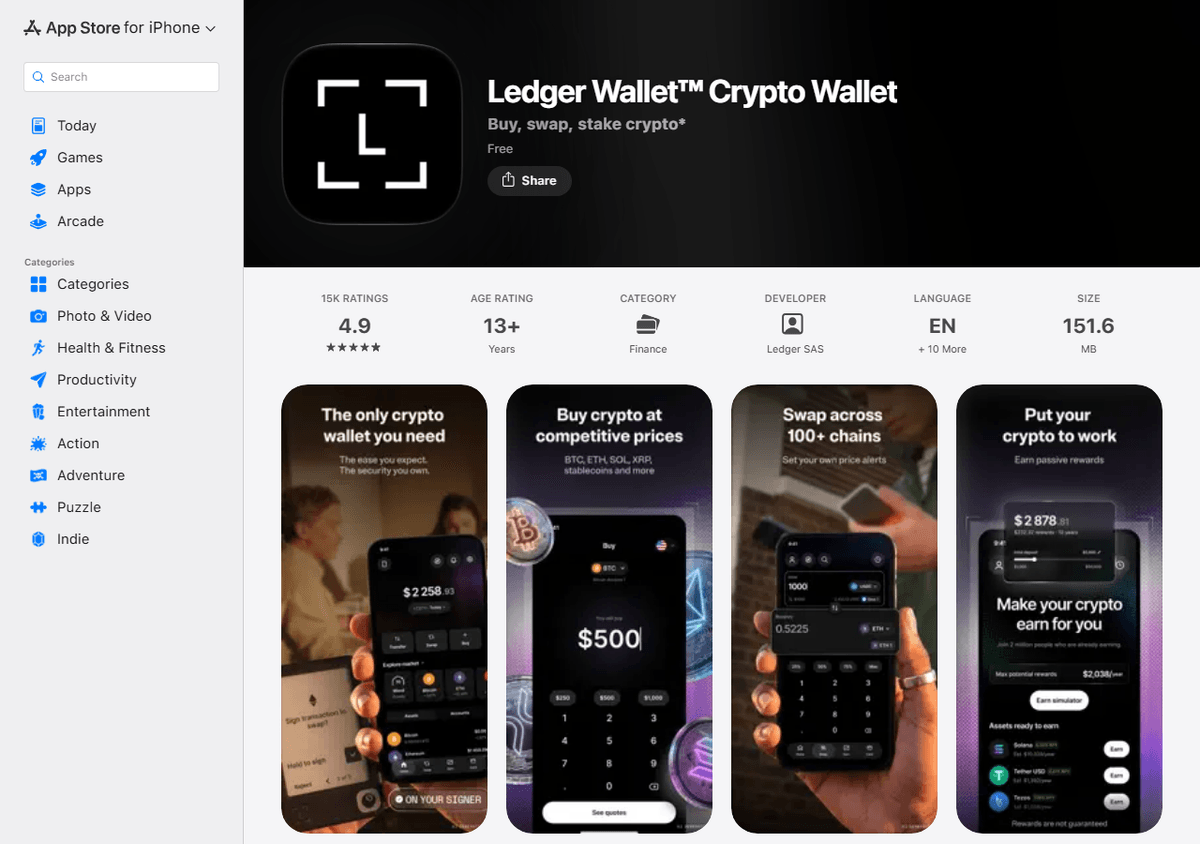
Three checks help. The developer name should match the company on the maker’s own site, and here the listing names Ledger SAS. The FBI’s 2023 alert advises checking developers and customer reviews, and flags many downloads with few or no reviews as a red flag. And a listing you reached from the maker’s site is stronger evidence than one a search or a message put in front of you. Even so, the FBI alerts above treat fake apps as a known route for fraud, so a polished listing proves nothing alone.
How do you check a website?
Type the address yourself, or use a bookmark made from the official site, and do not reach wallet or exchange sites through ads. IC3’s advice to individuals in the December 2022 alert is to check the address for typos or a swapped letter, type the company’s address instead of searching, and consider an ad blocker. Compare the browser bar with the maker’s address character by character, since a one-letter difference is the whole trick.
If you have not picked a wallet yet, a neutral directory is a safer start than a search ad. Bitcoin.org’s “Choose your Bitcoin wallet” page asks a few questions and builds a list of wallets that fit.
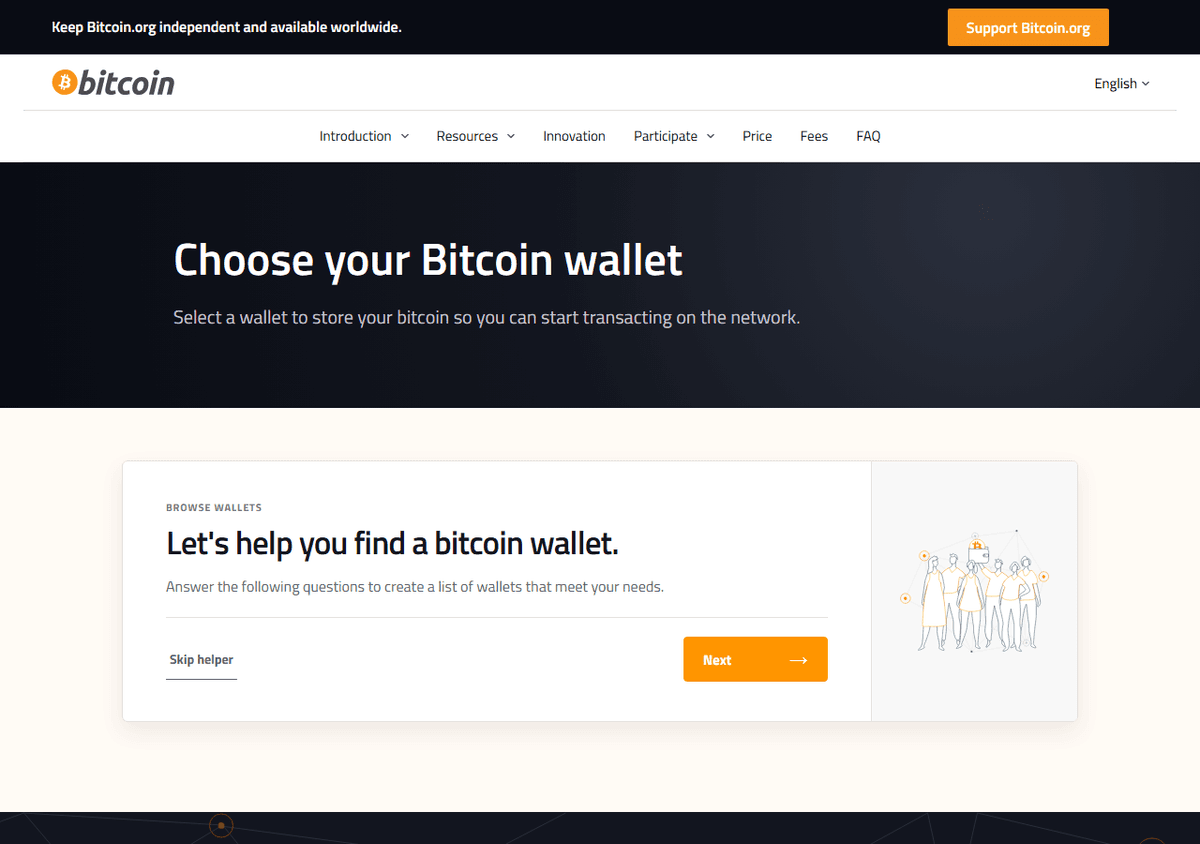
The page asks about your operating system and experience, then filters by criteria and features, and reminds you that you remain responsible for securing and backing up your wallet. It does not explain how wallets are listed or rated, so use it to narrow the choice, then verify the wallet on its maker’s own site. Bitcoin Wallets Explained compares the types.
How do you buy a hardware wallet without getting a fake?
Buy it new, from the maker or a seller it names. Ledger’s buying guide says to buy through its website or an authorized reseller, warns that unlisted sellers add security risks, and says a genuine Ledger device never arrives with a recovery phrase or PIN already configured. If one does, the guide says not to use it. Ledger also says its authenticity check cannot detect unauthorized physical changes to the hardware. What Is a Hardware Wallet? has the full buying checklist, and Ledger Wallet (Ledger Live) and Trezor Suite covers the companion apps.
What is a checklist you can run before you trust a wallet?
Stop at the first step that fails.
- Reach the maker’s site by typing its address or from an old bookmark, and compare the address character by character.
- Get the app through the maker’s own link to the store and check the publisher name.
- Buy hardware new, from the maker or a listed reseller, and create the wallet yourself.
- Type the recovery phrase only into the device or the wallet you are restoring, never into a website, chat or form.
- Treat unrequested contact that claims to be support as fake.
- Send a small test amount first, as How to Set Up a Bitcoin Wallet describes.
What should you do if you already typed your phrase?
Assume that anyone who saw the phrase can move your coins, and move them first. Whoever holds the phrase holds the wallet, and no one can step in to recover funds, so speed is your main protection.
- Set up a new wallet with a new recovery phrase on a device you trust. If you suspect your computer, use another.
- Send everything from the old wallet to an address in the new one. A scammer may already be emptying the old wallet, so do this before anything else.
- Never use the old phrase again, even if the old wallet looks empty.
- Change the password of any account whose login you entered and switch on two-factor authentication. If you paid by card or bank, call the issuer.
- Keep records: the fake address, screenshots, wallet addresses and transaction details. Report the scam to the FTC at reportfraud.ftc.gov and to the FBI’s IC3. How to Report a Crypto Scam in the US explains who takes what.
Ignore anyone who offers to recover the money for a fee, as Common Bitcoin Scams and How to Spot Them explains. Is Bitcoin Safe? covers the wider risks, and The Power of Self-Custody covers holding your own keys. New here? Try the Start Here path. If the loss is large, a qualified professional or your state’s consumer-protection office can advise you.
Where to go next
- Ledger Wallet (Ledger Live) and Trezor Suite: What the Companion Apps Do: what the real apps do.
- What Is a Seed Phrase? How Recovery Words Work: why the words stay private.
- Common Bitcoin Scams and How to Spot Them: other scams that start with a stranger.
Frequently asked questions
How can I tell if a crypto wallet app is fake?
Start from the wallet maker's own website, typed by you or from an old bookmark, and follow its link to the store. Check that the publisher name matches the company, look at the reviews and treat an app found through an ad, a search or a message as suspect. No store listing proves an app is genuine on its own.
Will a real wallet company ever ask for my recovery phrase?
No. Wallet makers such as Ledger and Trezor say on their own pages that they never ask for it. The phrase belongs only on your hardware device or in the wallet you installed yourself to restore your own coins. A site, app, chat or caller asking for it is trying to take your bitcoin.
Is it safe to buy a hardware wallet from a marketplace?
It carries extra risk. Buy new, directly from the maker or from a reseller the maker lists, because a device from an unlisted seller may be tampered with or set up with a phrase the seller knows. Never use a device that arrives with a recovery phrase or PIN already written down or set.
What should I do if I typed my recovery phrase into a fake site?
Assume anyone who saw it can move your coins. Create a new wallet with a new phrase on a device you trust and move your coins there at once, then stop using the old phrase. Keep records of the site, addresses and transactions, and report it to the FTC and the FBI's Internet Crime Complaint Center.
Can stolen crypto be recovered after a fake wallet scam?
Often not. Crypto payments are generally irreversible, and the FTC says that if a wallet is compromised, no one can step in to recover the funds. Anyone who offers to get the coins back for an upfront fee is probably running a second scam.
Related articles