Security8 min read
Datavault AI Says It Cannot Withdraw Its Bitcoin and Will Restate Its Results
Datavault AI told the SEC it could not complete a bitcoin withdrawal from Biconomy and that four sets of its financial statements can no longer be relied on. Its third-quarter report is now late.
By Christopher CannucciariPublished Updated
On this page

Key takeaways
- Datavault AI, a Nasdaq-listed company, said in a Form 8-K filed with the SEC on 26 October 2026 that it asked in June 2026 to withdraw bitcoin from its wallet at Biconomy Pte. Ltd. and had not been able to complete the withdrawal. The filing gives no reason.
- The company’s audit committee concluded on 20 October 2026 that four sets of financial statements, from the third quarter of 2025 through the second quarter of 2026, should no longer be relied upon.
- The bitcoin came from Scilex Holding as payment for Datavault shares. Datavault now says it should not have been recorded as the company’s own asset, and will instead be treated as an amount owed by Scilex.
- Update, 18 November 2026: Datavault told the SEC on 17 November that its third-quarter 10-Q will be late. No restated statements are on file, and no filing says the withdrawal has gone through.
- Since the filing, the board removed chief executive Nathaniel Bradley and named Brett Moyer in his place. Nasdaq suspended trading in the shares from 17 November 2026, according to the company.
- The wider lesson is about custody: a balance held at an exchange or custodian is a claim on that company, and businesses that hold bitcoin as a treasury asset face the same risk as individuals.
What did Datavault AI disclose?
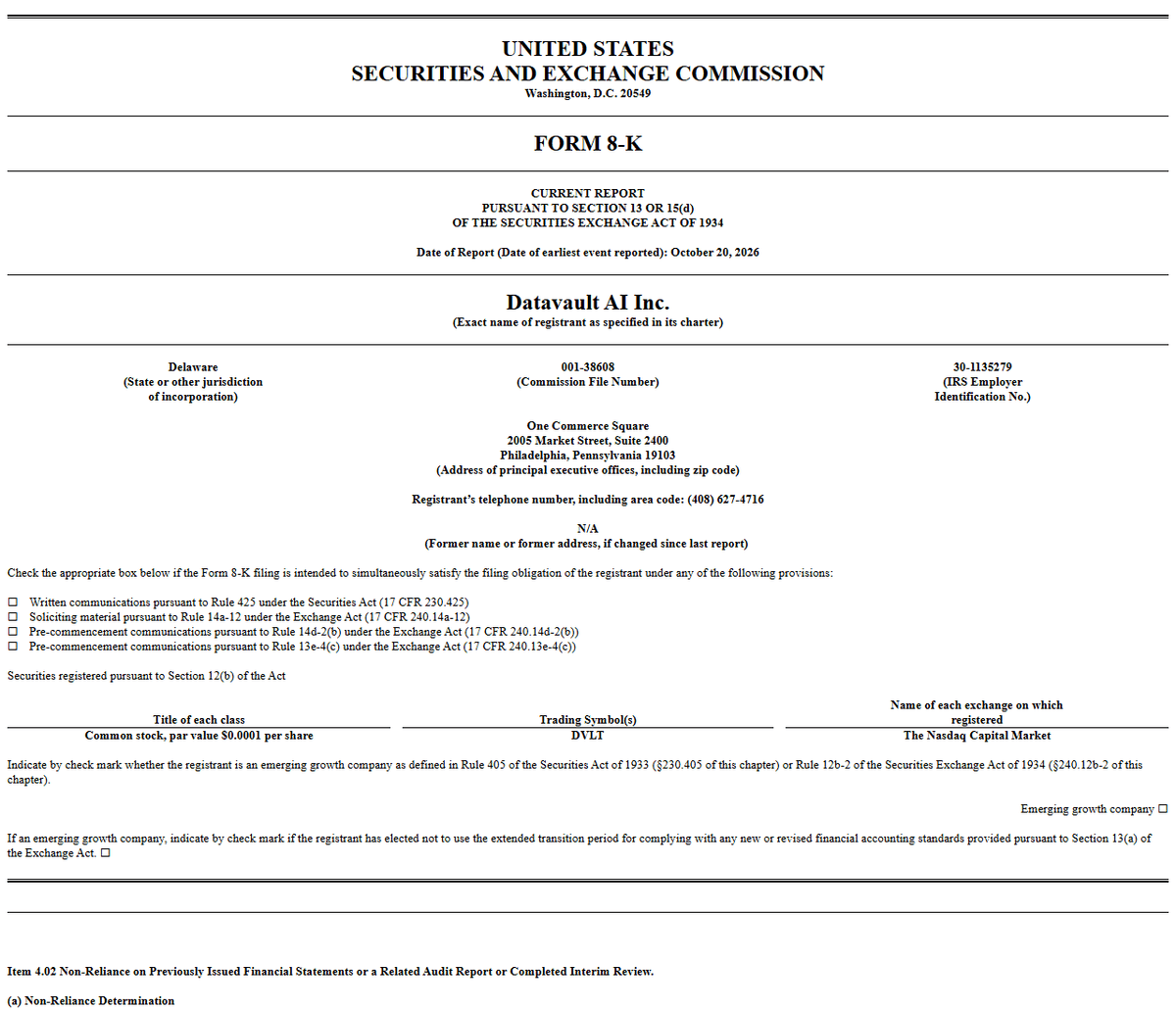
Datavault AI, formerly known as WiSA Technologies, filed a Form 8-K with the US Securities and Exchange Commission on 26 October 2026. It filed under Item 4.02, the section used for “non-reliance on previously issued financial statements.” The filing is signed by Brett Moyer, then its chief financial officer, and gives 20 October 2026 as the date of the earliest event reported.
The filing describes a deal from September 2025. On 25 September 2025, Datavault agreed to sell Scilex Holding 15 million shares of common stock and a pre-funded warrant for about 263.9 million more shares, for $150 million payable in bitcoin. At the rate in the agreement, that came to about 1,328.43 BTC. This is the figure behind headlines about “1,328 bitcoin,” but it is the agreed price, not the amount that sat in the account.
According to the filing, Scilex credited 1,309.04 BTC to Datavault’s wallet at Biconomy on 26 September and 25 November 2025, net of a deduction for cash advances Scilex had made to the company. The credits were made “through an off-chain transfer,” meaning balances changed inside Biconomy’s books rather than coins moving on the Bitcoin blockchain. Between 26 September 2025 and 30 January 2026, Datavault sold 491.431 BTC back to Scilex for about $40.5 million in cash, also off-chain.
Then comes the problem. In June 2026, the company says, it asked to withdraw bitcoin from the Biconomy wallet to an external account. It “has, as of the date of this Current Report on Form 8-K, been unable to complete the withdrawal.” The filing does not say how much bitcoin it asked to move or how much remains in the wallet. Nor does it say why the withdrawal has not gone through.
What the restatement is about
The audit committee and management concluded that the bitcoin tied to the Scilex purchase never qualified to be recognized as Datavault’s own digital asset. Instead, the company says, the purchase price should be recorded as a subscription receivable, an amount still owed for newly issued shares, shown as a reduction of stockholders’ equity. Cash from the sales back to Scilex reduces that receivable, and the company expects to reverse crypto gains and losses it had reported.
The four periods affected are the quarter ended 30 September 2025, the full year 2025 (in the annual report filed 18 March 2026), and the quarters ended 31 March and 30 June 2026. The filing estimates that total assets will fall by $8.1 million, $92.2 million, $57.1 million and $49.0 million at those four dates, and stresses that these figures are not final.
Two more points in the filing matter. Management is reassessing whether the company can continue as a going concern, because its earlier analysis counted the bitcoin balances as a source of cash and collection from Scilex is uncertain. And the company has not set a date for the restated statements. It says it discussed the matter with its current auditor, CBIZ CPAs, and its former auditor, BPM.
The Block and Decrypt reported the filing on 27 October 2026, and both said the filing gives no cause for the failed withdrawal. Neither published a response from Biconomy.
What has happened since the filing?
Datavault has not filed its restated statements or its third-quarter report, as of 18 November 2026. On 17 November it filed a Form 12b-25 notice of late filing for the 10-Q covering the quarter ended 30 September 2026. The notice cites the demands of the restatement and a “recent transition in its financial leadership.” The company says it does not expect to file within the five-day extension the rule allows, and will file “as soon as practicable.”
The leadership change came first. According to an 8-K filed on 5 November, the board removed Nathaniel Bradley as chief executive and president on 1 November 2026, and Bradley voted against it. He remains a director. A second 8-K, filed on 9 November, says the board named Brett Moyer chief executive on 6 November. Stanley Mbugua, the chief accounting officer, became chief financial officer.
Bradley is contesting the board. In an amended Schedule 13D filed on 17 November, he said he had delivered a written consent to start a stockholder vote. It seeks to remove eight directors and elect his own slate, and he said he would then seek reinstatement as chief executive.
The listing has changed too. In an 8-K filed on 13 November, Datavault said Nasdaq had told it on 10 November that its shares were subject to delisting under Nasdaq’s minimum bid price rule. Nasdaq suspended trading from 17 November, and the company said the shares should be eligible to trade on the OTC Markets. Datavault said it would ask a Nasdaq hearings panel to keep its listing.
None of these later filings mentions Biconomy, the withdrawal or Scilex. As of 18 November 2026, we found no public explanation from Biconomy and no statement that the withdrawal has been completed.
Why a balance at an exchange is a claim, not coins
The Datavault case shows the core custody point in a corporate setting. When bitcoin sits in an account at an exchange or custodian, the holder does not control the coins on the blockchain. It holds a promise from that company to deliver them on request. If the company does not process a withdrawal, the holder has a contract and a dispute, not bitcoin.
Off-chain credits make this sharper. A transfer recorded only in an exchange’s internal ledger leaves no public trace on the Bitcoin blockchain that an outsider can check. The only proof of the balance is the exchange’s own record. What Happens to Your Crypto if an Exchange Goes Bankrupt? explains how that claim is treated when a platform fails, and why proof of reserves only goes so far.
Holding the keys yourself removes that dependency and brings its own risks, such as losing them. The Power of Self-Custody: Owning Your Own Keys covers both sides, and How to Choose a Crypto Exchange: A Safety Checklist lists the questions to ask any platform before leaving money there.
Treasury companies face the same custody risk
Datavault is one of many listed companies that have added bitcoin to their balance sheets. Bitcoin Treasury Companies: What They Are and How They Work explains the model. A company’s bitcoin is only as accessible as the arrangement that holds it, and shareholders usually cannot see that arrangement directly. They depend on what the company discloses.
This case also shows a second risk that has nothing to do with Bitcoin’s technology: accounting. Here the question went beyond whether the coins could be moved. It was whether the company ever owned them in the accounting sense. For anyone looking at shares in such companies, Bitcoin Stocks Explained: Miners, Treasury Companies and Exchanges describes how they differ from owning bitcoin directly.
How SEC filings disclose problems like this
US public companies must file a Form 8-K within four business days of certain events. Item 4.02 is used when a company, its board or its auditor concludes that past financial statements contain an error serious enough that investors should stop relying on them. The restated numbers usually follow later in amended quarterly or annual reports.
Anyone can read these filings for free on the SEC’s EDGAR system, reachable from sec.gov, by searching a company’s name and filtering for 8-K filings. The filing itself is the primary source. News articles, social posts and newsletter summaries can get details wrong, as the “1,328 bitcoin” shorthand shows. If you are new to Bitcoin, the Start Here learning path explains the basics behind all of this.
This article is general information, not investment advice. For decisions about your own money, speak to a qualified professional.
Where to go next
- Bitcoin Treasury Companies: What They Are and How They Work: why companies hold bitcoin and what can go wrong.
- The Power of Self-Custody: Owning Your Own Keys: what changes when you hold the keys yourself.
- Bitcoin Stocks Explained: how company shares differ from owning bitcoin.
Frequently asked questions
What did Datavault AI disclose?
In a Form 8-K filed with the SEC on 26 October 2026, Datavault AI said it asked in June 2026 to withdraw bitcoin from a wallet at Biconomy to an external account and had not been able to complete the withdrawal. It also said four sets of financial statements, from the third quarter of 2025 to the second quarter of 2026, should no longer be relied upon.
Why is Datavault AI restating its financial statements?
The company concluded that the bitcoin it received from Scilex as payment for new shares did not qualify to be recorded as its own digital asset. It plans to record the amount as a subscription receivable, which reduces stockholders' equity, and to reverse related crypto gains and losses.
Why can't Datavault AI withdraw its bitcoin?
The filing does not give a reason. It says only that the company requested the withdrawal in June 2026 and, as of the date of the filing, had been unable to complete it. As of 18 November 2026, none of Datavault's later SEC filings says the withdrawal has been completed, and we found no public explanation from Biconomy.
Has Datavault AI filed its restated results?
No. As of 18 November 2026, no restated statements are on file. On 17 November 2026 the company filed a Form 12b-25 notice saying its third-quarter 10-Q would be late because of the restatement work and a change in its finance leadership.
What is an Item 4.02 filing?
Item 4.02 of Form 8-K is the section a US public company uses to tell investors that previously issued financial statements should no longer be relied upon because of an error. It usually comes before restated statements, which are filed later.
Does this mean bitcoin itself failed?
No. The disclosure concerns an account at a company and how a share sale was accounted for, not the Bitcoin network. It is a custody and counterparty problem: a balance held at a third party depends on that third party letting you move it.
Related articles